A standard cholesterol panel checks your LDL, HDL, and triglycerides. But the latest 2026 guidelines from the American Heart Association and American College of Cardiology actually recommend testing more. We’ve helped thousands of patients get advanced cardiac blood tests, and in this article, we’ll share what we’ve learned.
The best blood tests for heart health are ApoB, Lp(a), hs-CRP, HbA1c, eGFR. In addition, everyone should blood pressure.
Let’s dive into how these tests work together, and then each one.
The 6 heart health tests that matter most
Cardiovascular disease isn’t caused by a single number. As Dr Wessler of Heartbeat Health put it, heart disease happens when “circulating fats in the blood (e.g. ApoB & Lp(a)) are pushed by a driving force (i.e. blood pressure) into a vessel wall that is vulnerable (inflammation).” To understand your heart heatlh, you need to understand each independent risk factor:
| Test | What the test measures | Risk threshold |
|---|---|---|
| ApoB | Number of atherogenic particles in your blood (a better cholesterol) | ≥ 100 mg/dL |
| Lp(a) | Genetically-determined lipoprotein that accelerates plaque | ≥ 50 mg/dL |
| hs-CRP | Systemic inflammation, an independent driver of heart disease | ≥ 2.0 mg/L |
| HbA1c | Average blood sugar over 3 months (diabetes marker) | ≥ 5.7% |
| Blood pressure | Force on arterial walls | ≥ 130/80 mmHg |
| eGFR | Kidney function (reduced function = higher CV risk) | < 60 mL/min |
While some of these tests have funny names, they aren’t obscure research markers. The 2026 AHA/ACC guidelines significantly strengthened recommendations for all of these. Lp(a) testing is now a Class 1 (strongest) recommendation for all adults, ApoB is recommended (COR 2a) to guide treatment, and the PREVENT-ASCVD equations (which incorporate eGFR and metabolic markers) formally replace the older Pooled Cohort Equations. The American College of Cardiology’s 2025 statement separately recommends universal hs-CRP screening. Most annual physicals only check a few of these (A1c, blood pressure, and sometimes eGFR).
87% of people have at least one abnormal cardiac blood test
Among Empirical Health members with all six heart health biomarkers tested, 87% found at least one abnormal result. 52% had two or more abnormal biomarkers. Only 17% had a clean bill of health across all six heart health markers.
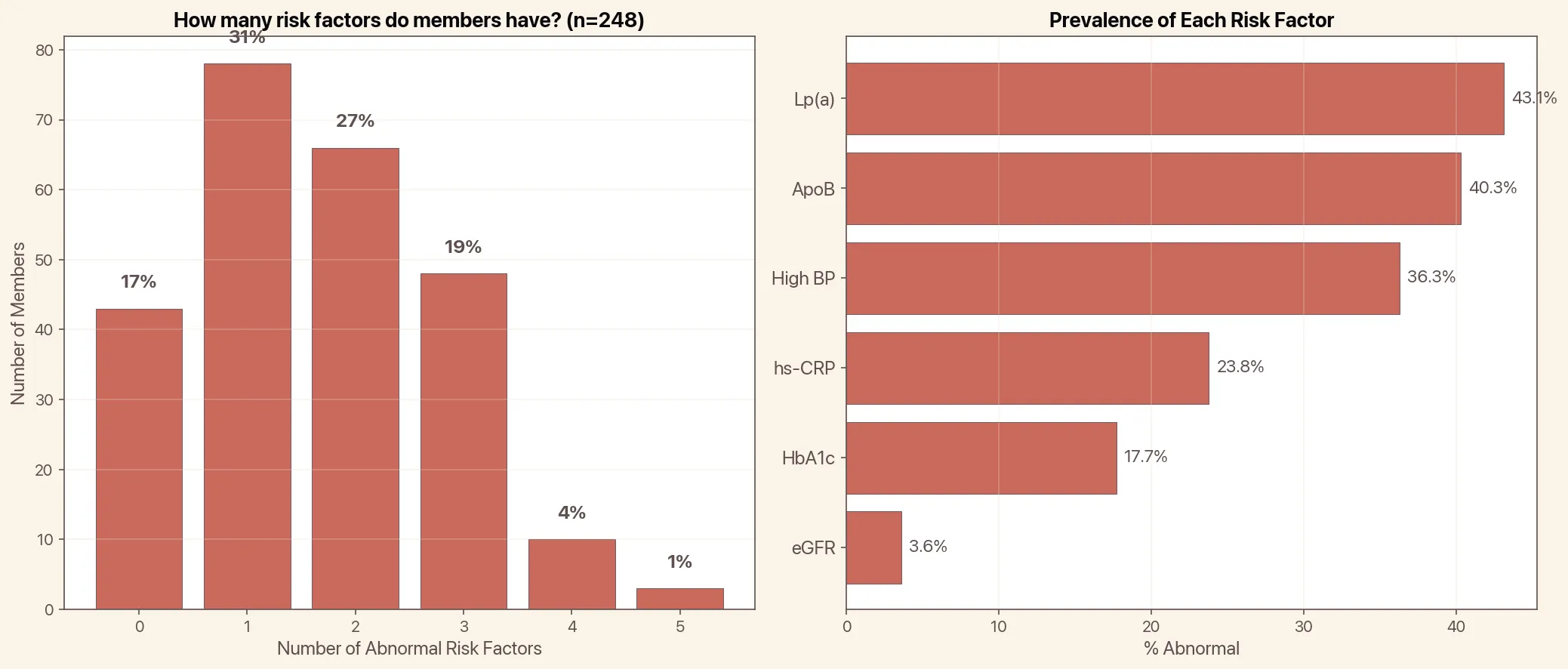 Left: 83% of people had at least one abnormal blood test results. Right: breakdown for each heart health test of what percentage of patients received an abnormal result. Source: Empirical Health.
Among Empirical members, Lp(a) is the heart health blood test that was most commonly abnormal, with 43% of people getting an elevated result. About 40% of people had an elevated ApoB. eGFR, which measures kidney function, was the biomarker that was normal for the greatest number of people.
Heart health blood tests
Let’s go through each heart health blood test that we recommend one-by-one, to understand exactly what they measure and why they’re important screenings.
ApoB: a more accurate blood test than cholesterol
A standard lipid panel measures LDL cholesterol, which is the amount of cholesterol carried by atherogenic particles. But it doesn’t measure the number of particles themselves. This distinction matters since ApoB is more accurate than LDL cholesterol. The two disagree more than people realize:
ApoB is the accurate sum of all the atherogenic particles, and that’s the most important measure you can make. When your LDL or non-HDL cholesterol are measured, you may not have an accurate idea of the risk posed to you.
— Allan Sniderman, MD, Edwards Professor of Cardiology, McGill University (CAP TODAY)
The 2024 National Lipid Association consensus statement puts it plainly:
“ApoB has been shown to be superior to LDL-C in risk assessment both before and during treatment with lipid-lowering therapy. LDL-C may be an inadequate measure when discordant from apoB levels.”
— National Lipid Association Expert Panel, Journal of Clinical Lipidology, 2024 (PMC)
Inflammation: an emerging heart health biomarker
Inflammation is an independent driver of cardiovascular events. The latest evidence shows that inflammation may be a stronger biomarker of heart disease than even LDL cholesterol:
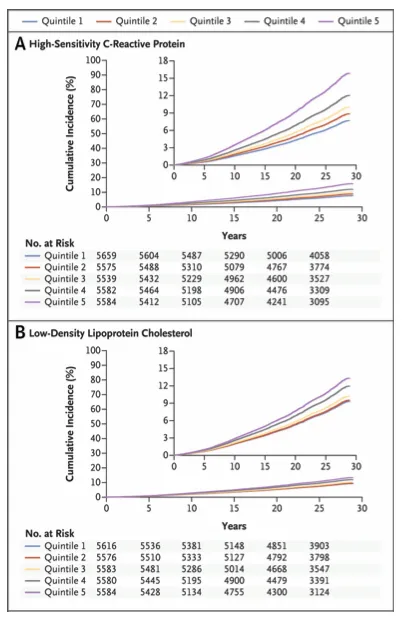 Inflammation is now a stronger predictor of heart health than even LDL cholesterol. Source: Journal of the American College of Cardiology
The American College of Cardiology now recommends that people test their inflammation for heart health. The specific inflammation blood test they recommend is hsCRP (high sensitivity c-reactive protein). The ACC says:
Universal screening of hsCRP in both primary and secondary prevention patients, in combination with cholesterol, represents a major clinical opportunity and is therefore recommended.
- American College of Cardiology scientific statement
If you’re not measuring CRP, you have no idea that your patient even has this problem.
— Paul M. Ridker, MD, Director, Center for Cardiovascular Disease Prevention, Brigham and Women’s Hospital (TCTMD)
We can’t treat what we don’t look for, and that’s why we as cardiologists and our primary care colleagues need to be more attuned to the role of inflammation in cardiovascular risk.
— Jared A. Spitz, MD, Inova Health System (ACC.org, 2025)
Lp(a): hereditary risk of heart disease
Lipoprotein(a), or Lp(a), is a type of cholesterol particle that is almost entirely determined by your genes. Each Lp(a) particle is 6.6x more likely to cause hart disease than a “standard” cholesterol particle. A recent study shows that only 0.2% of people get their Lp(a) tested, but the American College of Cardiology recommends an Lp(a) test at least once in your lifetime.
Blood pressure: not a blood test, but measurable at-home
Your doctor almost certainly has measured your blood pressure in the office. Modern medical guidelines recommend measuring your blood pressure at home, taking the average of many measurements. Our data indicates blood pressure varies day-to-day by up to 20 mmgHg.
eGFR and HbA1c: the effect of kidneys and liver on heart heatlh
eGFR (estimated Glomerular Filtration Rate) is a blood test that measures how well your kidneys are filtering waste from your blood. Declining kidney function is an important risk factor for heart disease. People with reduced eGFR face significantly higher cardiovascular risk, even if their cholesterol is normal.
HbA1c (Hemoglobin A1c) is a marker that reflects your average blood sugar levels over the past 2-3 months. Elevated HbA1c means you have prediabetes or diabetes, both of which greatly increase the risk of heart attack and stroke. Even mildly elevated HbA1c can quietly increase cardiovascular risk, making it important to check regularly. Most doctors check HbA1c.
Heart health biomarkers sometimes cluster
Cardiovascular risk factors don’t occur independently. In our data, heart health blood tests are highly linked:
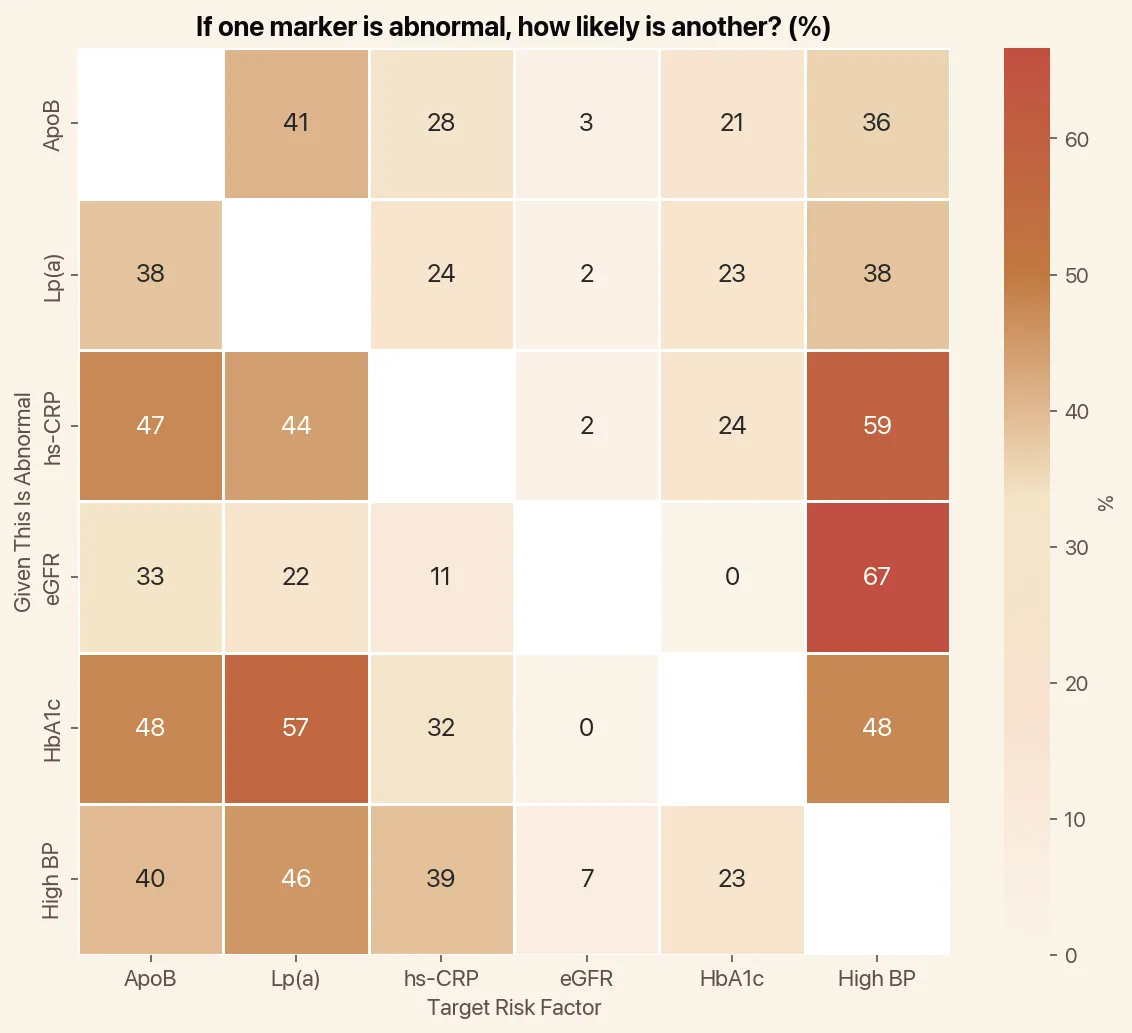 How heart health blood test results are linked. This chart shows the percentge of people with an abnormal result for the test listed in each column, given that they had an abnormal result for the test listed in the row.
For example, if you have elevated hs-CRP, you have a 47% chance of also having elevated ApoB. Among those with elevated HbA1c (insulin resistance), 57% had high Lp(a).
This clustering effect is well-documented in the medical literature. It’s why the AHA’s new PREVENT risk calculator incorporates kidney function (eGFR) and metabolic markers alongside traditional lipid levels. These systems are interconnected.
A new cardiovascular disease risk calculator was needed, particularly one that includes measures of CKM syndrome, which is highly prevalent in the U.S. The new PREVENT risk calculator enables clinicians to quantify this risk and may help people receive preventive care or treatment earlier to reduce CVD risk.
— Sadiya S. Khan, MD, Associate Professor of Cardiology, Northwestern University; Chair of the AHA PREVENT equations committee (AHA Newsroom, 2023)
How to get the best heart health blood tests
A comprehensive cardiovascular screening should include six key tests: ApoB, Lp(a), hs-CRP, HbA1c, blood pressure, and eGFR. The good news is that these tests are are widely available, relatively inexpensive, and can be ordered through your doctor or through services like Empirical Health’s advanced heart health test for under $200.
Get your free 30-day heart health guide
Evidence-based steps to optimize your heart health.