Heart rate variability (HRV) is a very powerful metric of your nervous system. Most wearables measure HRV, including Apple Watch, Whoop, Galaxy Watch, Fitbit, Oura, and Google Pixel Watch.
But the way they measure HRV varies. Apple Watch’s original HRV metric uses SDNN, whereas most other wearables use RMSSD. Apple has now added Recovery HRV, which uses RMSSD, alongside SDNN. Recovery HRV is available only on Apple Watch Series 12 and Ultra 4. An SDNN reading of 35 ms and an RMSSD reading of 35 ms are not interchangeable; even devices using the same formula can differ in sampling and averaging.
Updated September 15, 2026, to include Apple’s Recovery HRV.
I helped run one of the first studies to detect major illnesses using heart rate data from consumer wearables, in collaboration with UC San Francisco’s cardiology department. I’ve been working with HRV-based analysis in some form for 12 years now. I’ll first describe SDNN vs RMSSD, then show how each major wearable measures HRV. For those interested in more, we also have guides to 33 distinct formulas used to calculate HRV from the medical literature.
Main HRV formulas: SDNN vs RMSSD
Both SDNN and RMSSD start from the same raw data: the time intervals between consecutive heartbeats. These are called R-R or N-N intervals, where “N” means normal, non-ectopic beats.
SDNN (Standard Deviation of N-N intervals) is the standard deviation of all the beat-to-beat intervals in a given time window. SDNN captures both short-term and long-term variability. These represent a mix of both the sympathetic and parasympathetic branches of your nervous system, plus slower regulatory cycles. SDNN is sensitive to recording length: a 24-hour SDNN will be much higher than a 5-minute SDNN.
RMSSD (Root Mean Square of Successive Differences) looks at the difference between each consecutive pair of intervals. Then it squares those differences, averages them, and takes the square root. Because it focuses on beat-to-beat changes, RMSSD is dominated by fast parasympathetic nervous system activity. It’s less affected by recording length, which makes it more stable for short overnight windows.
How major wearables measure HRV
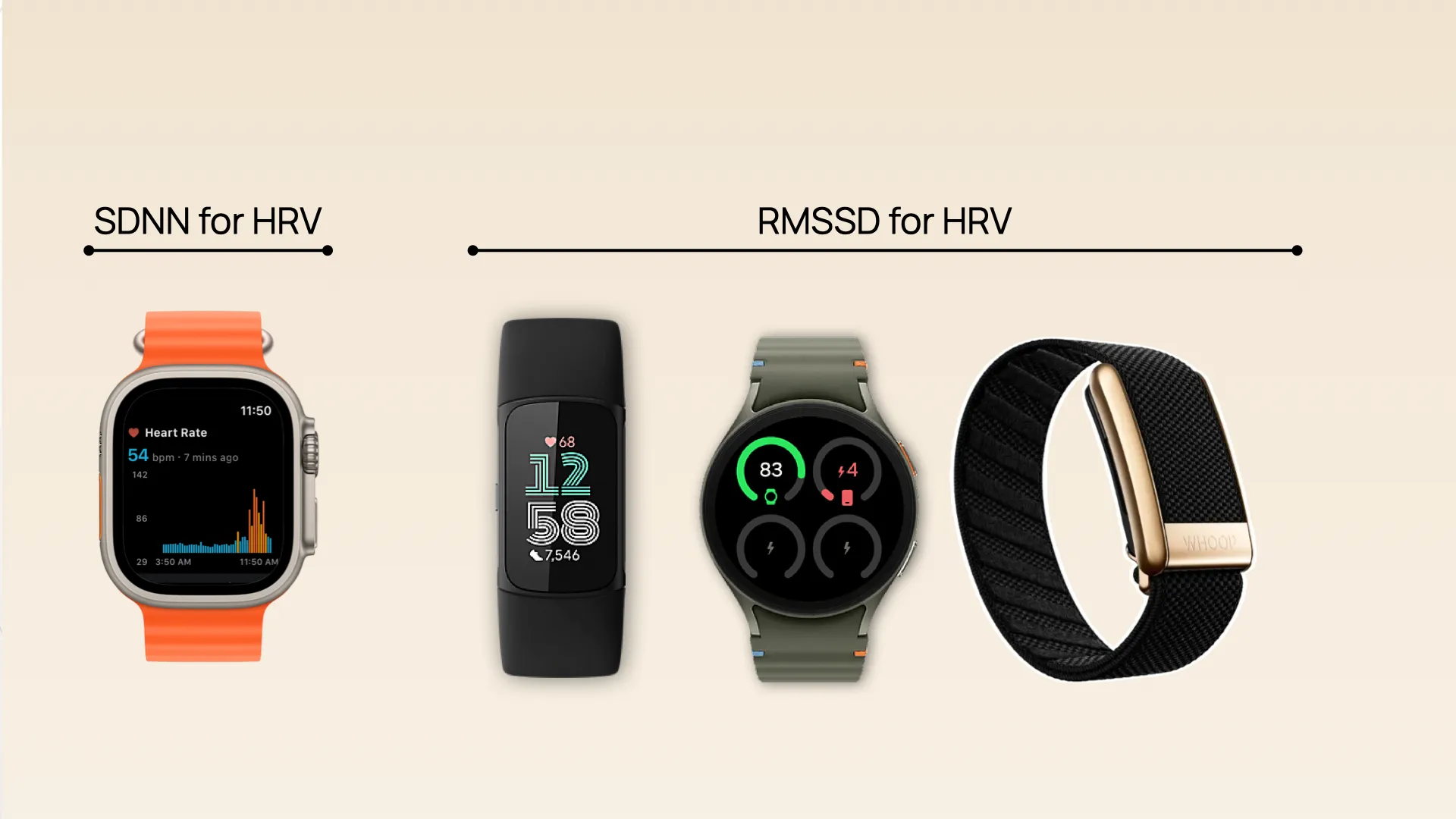 This illustration shows Apple’s original SDNN metric. Series 12 and Ultra 4 now also support RMSSD through Recovery HRV, as detailed below.
| Wearable | Formula | When it measures | What’s reported |
|---|---|---|---|
| Apple Watch Series 12 / Ultra 4 | SDNN + RMSSD | HRV as often as every 5 minutes while still | Original SDNN HRV + Recovery HRV (RMSSD); Recovery HRV also appears in Vitals |
| Older Apple Watch models | SDNN | Opportunistic + Breathe sessions | Original SDNN HRV; no native Recovery HRV |
| WHOOP | RMSSD | During deepest sleep | Nightly RMSSD, plus HRV-CV |
| Oura | RMSSD | Throughout sleep (5-min samples) | Average and max of all samples |
| Fitbit | RMSSD | Longest sleep period (>3h) | Nightly RMSSD |
| Pixel Watch | RMSSD | Longest sleep period (>3h) | Nightly RMSSD |
Apple Watch
Apple now provides two HRV measures. The original metric uses SDNN. Recovery HRV in the Health app uses RMSSD, which HealthKit now supports through heartRateVariabilityRMSSD. It supplements the existing SDNN metric.
Recovery HRV is available only on Apple Watch Series 12 and Ultra 4. Older models continue to record SDNN opportunistically and via the Mindfulness/Breathe workflow. Apple describes Recovery HRV as a way to track daily stress and recovery, and includes it in overnight Vitals alongside the new Readiness score.
Series 12 and Ultra 4 also support HRV recording as often as every 5 minutes. Readings are taken while you’re still, so their number varies with activity. That frequency does not establish a five-minute recording window. Keep a separate baseline for each HRV metric: a difference between your old SDNN readings and new Recovery HRV readings does not by itself mean your health or recovery changed.
Fitbit
Fitbit says it uses RMSSD and that the displayed HRV comes from the longest sleep period in the past 24 hours, considering only sleep periods longer than 3 hours.
WHOOP
WHOOP says it uses RMSSD and calculates HRV during deepest sleep each night, explicitly avoiding continuous daytime HRV because of noise and instability. WHOOP then folds HRV into its Recovery scoring.
Oura
Oura says it calculates nighttime HRV from repeated 5-minute samples throughout sleep and reports the average of all 5-minute samples across the night; it also shows max HRV. Oura measures HRV only during sleep for its main readiness interpretation.
Pixel Watch
Pixel Watch inherits Fitbit’s exact approach. Pixel Watch’s HRV is calculated from the longest sleep period in the last 24h.
HRV-CV: WHOOP’s newer metric
In late 2025 and early 2026, WHOOP hlaunched HRV-CV, HRV coefficient of variation. HRV-CV is a new “stability” layer on top of daily HRV. HRV-CV is calculated as your HRV’s standard deviation divided by its mean over a rolling window. The idea is that it’s not just your HRV level that matters, but how consistent it is. A stable, high HRV suggests robust autonomic regulation, while a highly variable HRV (even if the average is decent) may signal that your nervous system is struggling to maintain homeostasis.
Medical guidelines for HRV
The American College of Cardiology says that interpreting HRV trends can be valuable, but discourages using absolute values:
Heart rate variability (HRV), while shown to have prognostic value among cardiovascular disease populations, is challenging to collect and interpret in clinical practice. CWDs use a variety of different metrics to calculate HRV (both time and frequency domain metrics), are often sensitive to ectopic beats, and were validated in controlled research settings. Interpretation of HRV using absolute values is discouraged, though trends over time and when integrated with the clinical history may be valuable.
The main takeaway is not to obsess over your absolute HRV number or how it compares to someone else’s. Track your own trend over time. A sustained drop in your personal HRV baseline, especially one lasting more than a few days, may indicate overtraining, illness, poor sleep, or chronic stress.
Get your free 30-day heart health guide
Evidence-based steps to optimize your heart health.