Updated Sep 6, 2026 with new Horizon results.
If you have high Lp(a), what should you do? The answer to that question is about to change. Four new medications that lower Lp(a) by up to 94% are in clinical trials: pelacarsen, olpasiran, lepodisiran, and muvalaplin. The first dedicated cardiovascular outcomes trial has completed follow-up, but results have not yet been announced.
Lp(a) is the strongest genetic risk factor for heart disease. About 20% of people have elevated levels, and current medications (statins, ezetimibe) do not lower it. These four trials will answer the question every cardiologist is asking: does lowering Lp(a) actually prevent heart attacks and strokes?
In this post, we’ll walk through each of the four drugs (pelacarsen, olpasiran, lepodisiran, and muvalaplin), the trial behind each one, its timeline, and what the data shows so far.
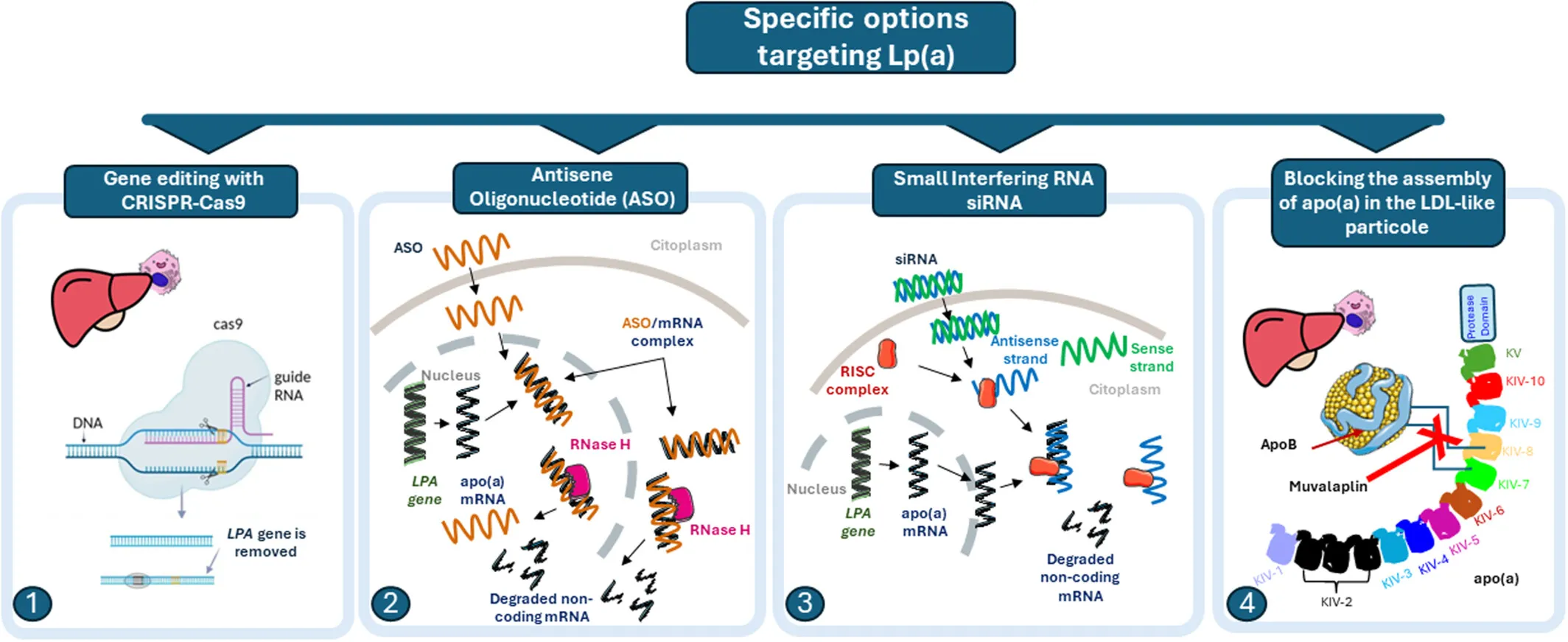 Diagram of various potential approaches to lowering Lp(a).
Pelacarsen (Novartis)
Pelacarsen is an antisense oligonucleotide (ASO) that blocks production of apolipoprotein(a) in the liver. It is given as a monthly subcutaneous injection (80 mg).
The Lp(a) HORIZON trial started in December 2019 and enrolled 8,323 patients with established cardiovascular disease and Lp(a) of at least 70 mg/dL. On September 4, 2026, Novartis announced that the trial did not meet its primary endpoint; more details are expected around the AHA Scientific Sessions in November. Phase 2 trials showed pelacarsen lowered Lp(a) by up to 80%. Lp(a) HORIZON is the first cardiovascular outcomes trial for any dedicated Lp(a)-lowering therapy, so its full results will help define the field.
Olpasiran (Amgen)
Olpasiran is a small interfering RNA (siRNA) therapy that silences the LPA gene in the liver. It is given as an injection every 12 weeks.
The Phase 3 trial started in December 2022 and enrolled roughly 7,000 patients with established ASCVD and Lp(a) of at least 200 nmol/L. Estimated completion is December 2026. In the earlier Phase 2 OCEAN(a)-DOSE trial, olpasiran lowered Lp(a) by more than 95% at the highest dose.
Lepodisiran (Eli Lilly)
Lepodisiran is an siRNA therapy targeting apolipoprotein(a). Phase 2 data suggests dosing may be as infrequent as every 6 months.
The ACCLAIM-Lp(a) trial started in 2024 and is still enrolling. It plans to randomize 16,700 patients, making it the largest of the four trials. It enrolls both secondary prevention (established ASCVD) and primary prevention (high-risk first-event) patients. Estimated completion is 2029. Lepodisiran lowered Lp(a) by 93.9% in the Phase 2 ALPACA trial
Muvalaplin (Eli Lilly)
Muvalaplin is the only oral drug in the group. It is a small molecule that blocks the assembly of the Lp(a) particle by disrupting the bond between apolipoprotein(a) and apolipoprotein B. Muvalaplin lowered Lp(a) by 47-86%, depending on the dose, in KRAKEN (Phase 2 trial). Lilly’s Phase 3 cardiovascular outcomes trial is now enrolling, with results expected later this decade.
Lp(a) lowering drugs compared
| Drug | Sponsor | Modality | Dosing | Outcomes trial | Started | Expected results |
|---|---|---|---|---|---|---|
| Pelacarsen | Novartis / Ionis | Antisense oligonucleotide | Monthly injection | Lp(a) HORIZON (n=8,323) | Dec 2019 | Follow-up complete; results awaited |
| Olpasiran | Amgen | siRNA | Injection every 12 weeks | OCEAN(a)-Outcomes (n=~7,000) | Dec 2022 | Dec 2026 |
| Lepodisiran | Eli Lilly | siRNA | Injection every 6 months | ACCLAIM-Lp(a) (n=16,700) | 2024 | 2029 |
| Muvalaplin | Eli Lilly | Oral small molecule | Daily pill | Phase 3 (enrolling) | 2025 | Late decade |
When will Lp(a) drugs be available?
The Lp(a) HORIZON readout will be the first time we know whether lowering Lp(a) translates into fewer heart attacks and strokes. Follow-up is complete, but no result has been announced, and pelacarsen remains investigational. If the trial succeeds, it will validate the treatment strategy and could accelerate regulatory review and development of the other drugs in the class.
In the meantime, the 2026 AHA/ACC guidelines recommend that every adult test their Lp(a) at least once. Our Lipoprotein(a) page covers the normal ranges and how to test. Knowing your Lp(a) now means you will be ready to act the moment these therapies reach the market.
Get your free 30-day heart health guide
Evidence-based steps to optimize your heart health.