Most people on a statin were never told why their doctor picked that statin over another. The differences are real. A high dose of rosuvastatin lowers LDL almost twice as much as the same dose of pravastatin. Some statins cross the blood-brain barrier and others do not. Some have many drug interactions and others have almost none.
This post compares the seven statins available in the US on the dimensions that actually matter when choosing one: LDL and ApoB reduction by dose, side-effect profile, blood-brain barrier permeability and cognitive effects, drug interactions, and cost.
Which statin lowers LDL the most?
Direct head-to-head data, most notably the STELLAR trial, let us rank statins on a single scale. Within a given drug, doubling the dose adds roughly six percentage points of LDL reduction. Across drugs, potency per milligram varies substantially.
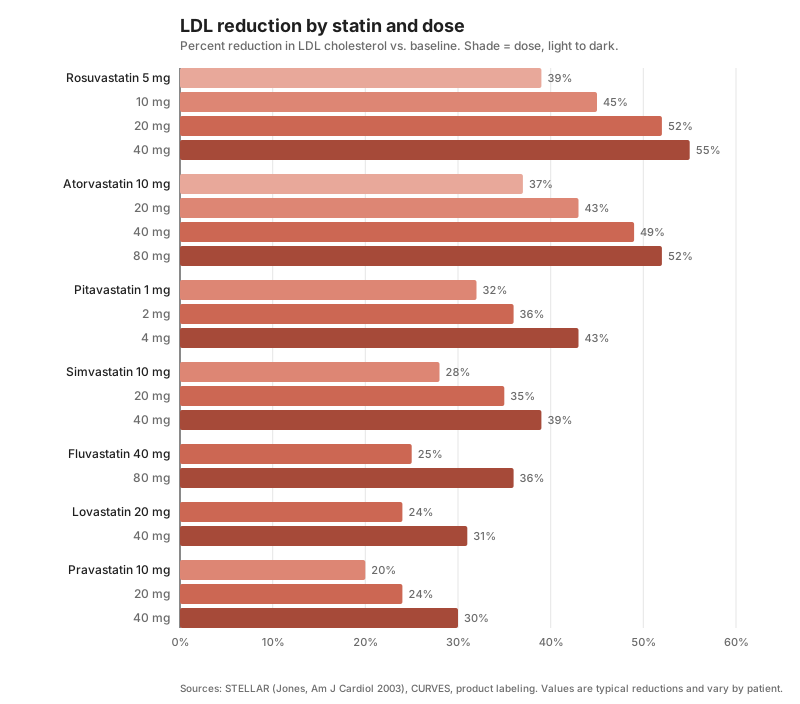 LDL reduction (%) by statin and dose. Within each statin, shade goes light (low dose) to dark (high dose). Sources: STELLAR, CURVES, product labeling.
| Intensity tier | Drug and dose | LDL reduction | ApoB reduction |
|---|---|---|---|
| High | Rosuvastatin 20-40 mg | 52-55% | ~37-45% |
| High | Atorvastatin 40-80 mg | 49-52% | ~37-45% |
| Moderate | Rosuvastatin 5-10 mg | 39-45% | ~30-35% |
| Moderate | Atorvastatin 10-20 mg | 37-43% | ~25-35% |
| Moderate | Simvastatin 20-40 mg | 35-39% | ~24-32% |
| Moderate | Pitavastatin 2-4 mg | 36-45% | ~28-38% |
| Low | Pravastatin 20-40 mg | 24-30% | ~19-22% |
| Low | Lovastatin 20-40 mg | 24-31% | ~19-22% |
| Low | Fluvastatin 40-80 mg | 25-36% | ~22-28% |
Rosuvastatin is the most potent statin on a per-milligram basis. At 40 mg rosuvastatin reduces LDL by about 55%, slightly above atorvastatin 80 mg at around 52%. Pravastatin 40 mg sits at the other end at about 30%. ApoB reductions track LDL but tend to be a few points smaller, because statins also clear non-LDL atherogenic particles.
For most patients, the practical question is simply whether they need a high-intensity statin (rosuvastatin 20-40 mg or atorvastatin 40-80 mg) or a moderate-intensity statin. The March 2026 ACC/AHA dyslipidemia guidelines bring back explicit LDL-C targets, a notable shift from the risk-category framing of 2018. The new targets are under 100 mg/dL for borderline or intermediate 10-year risk (now scored using the PREVENT-ASCVD equations), under 70 mg/dL for high risk, and under 55 mg/dL for very high-risk patients with established cardiovascular disease. Reaching the lower targets typically requires a high-intensity statin, often combined with ezetimibe or a PCSK9 inhibitor.
Statins and the blood-brain barrier
Statins divide into two chemical groups based on how they cross cell membranes. Lipophilic statins (atorvastatin, simvastatin, lovastatin, fluvastatin, and pitavastatin) dissolve in fats and pass through membranes by passive diffusion. Hydrophilic statins (rosuvastatin and pravastatin) are water-soluble and rely on transporter proteins to enter cells.
The practical consequence is tissue distribution. Lipophilic statins reach more tissues, including the brain, since they cross the blood-brain barrier. Hydrophilic statins concentrate more selectively in the liver, which is where the drug actually needs to work to reduce cholesterol synthesis.
This chemistry is the basis of most statin-and-cognition theories: if a drug enters the brain, it could plausibly affect cognition. The next section is about whether that translates into a real population-level signal.
Do statins cause brain fog?
The FDA added a warning about memory loss to all statin labels in 2012, based on case reports rather than trial data. Several large analyses since have looked for a cognitive effect, and most have not found one.
The cognitive substudies of the PROSPER trial (5,800 elderly patients on pravastatin) and the HOPE-3 trial (12,700 patients on rosuvastatin) found no significant cognitive decline versus placebo. Multiple meta-analyses since have concluded the same, and some observational data even suggest a modestly lower incidence of dementia in long-term statin users. Individual case reports of reversible cognitive complaints are real, and lipophilic statins do show a slightly higher rate of CNS-related adverse events in some pharmacovigilance databases. If a patient experiences cognitive symptoms on atorvastatin or simvastatin, switching to rosuvastatin or pravastatin is a reasonable empirical trial. But population-level data does not support the idea that statins as a class cause meaningful cognitive impairment.
What are the side effects of statins?
Three statin side effects matter clinically: muscle pain, liver enzyme elevation, and new-onset diabetes.
Muscle complaints are the most common reason patients stop a statin. In observational studies, 5-10% of users report myalgia. In blinded RCTs, the rate is closer to 1-2% above placebo, suggesting most muscle complaints are not actually caused by the drug. The SAMSON trial tested this directly with an n-of-1 crossover design and found that 90% of self-reported statin muscle pain occurred just as much on placebo as on atorvastatin. True statin-induced myopathy and rhabdomyolysis are rare. Risk is highest with simvastatin 80 mg, which is no longer recommended.
Liver enzyme elevations occur in about 1% of users and are usually mild and transient. Routine ALT monitoring is no longer recommended unless symptoms develop.
New-onset diabetes is a class effect, with about a 9-13% relative increase in incidence. Absolute risk is small and concentrated in people who already have prediabetes. High-intensity rosuvastatin and atorvastatin show slightly higher diabetes risk than moderate-intensity statins. For most patients the cardiovascular benefit outweighs this risk by a wide margin.
Statin drug interactions
Drug interactions vary substantially by metabolism. Simvastatin and lovastatin are heavily metabolized by CYP3A4, the same enzyme that processes grapefruit juice, macrolide antibiotics (clarithromycin, erythromycin), azole antifungals, and certain calcium channel blockers (diltiazem, verapamil). Combining these with simvastatin or lovastatin can multiply blood levels several-fold and increase the risk of myopathy.
Atorvastatin is also CYP3A4-metabolized but less sensitive to interactions because of higher first-pass extraction. Rosuvastatin and pravastatin are minimally metabolized by CYP enzymes and have the fewest drug interactions, which makes them attractive for patients on many medications.
Are all statins generic now?
All seven statins available in the US are now generic. At a typical pharmacy, generic statins cost $4-15 per month, and discount programs bring the price below $5. Branded versions (Crestor, Lipitor, Zocor, Pravachol, Mevacor, Lescol, Livalo) are still marketed but rarely offer any clinical advantage at this point.
How to choose a statin
Most patients who need a high-intensity statin will do well on rosuvastatin or atorvastatin. Most patients who need a moderate-intensity statin will do well on any of the others. Choice within each tier comes down to drug interactions, individual tolerance, and whether you have prediabetes.
If you have cognitive complaints on a lipophilic statin, switching to a hydrophilic one is a reasonable trial. If you have muscle symptoms, the SAMSON evidence is worth knowing about before stopping the drug, since most reported muscle pain on a statin is not actually from the statin. The 2026 ACC/AHA dyslipidemia guidelines and your physician are the right place to land on a specific choice.
The goal is to match statin intensity to your level of cardiovascular risk. With every statin now generic, cost is rarely the reason to pick one over another.
Get your free 30-day heart health guide
Evidence-based steps to optimize your heart health.