Saturated fat and fiber are the two nutrition numbers that move LDL cholesterol the most. Cut saturated fat and add soluble fiber, and LDL typically drops within a few weeks. The catch is that almost no one knows their daily totals for either, and the average American eats only about 16 grams of fiber, well under half the recommended intake.
This post covers how to track both with a single nutrition app, what daily targets to aim for, and how to read the weekly trend charts that actually predict where your next lipid panel will land.
Why track saturated fat and fiber together?
These two nutrients act in opposite directions on the same biomarker. Saturated fat raises LDL cholesterol. Soluble fiber lowers it, by binding bile acids in the gut and forcing the liver to pull more cholesterol out of circulation to make new bile.
Tracking only one tells half the story. A day with low saturated fat but no fiber is not as good for your LDL as a day with the same saturated fat plus 35 grams of fiber. Tracking both together gives you a complete picture of your LDL trajectory from food.
How to track saturated fat with a nutrition app
Most nutrition apps will surface saturated fat on the standard nutrition label after you log a meal. The hard part is logging consistently. AI-powered nutrition apps like Empirical Health reduce the friction by letting you snap a photo, type a description (“turkey sandwich on rye with avocado”), or scan a packaged food label.
What to look for in an app:
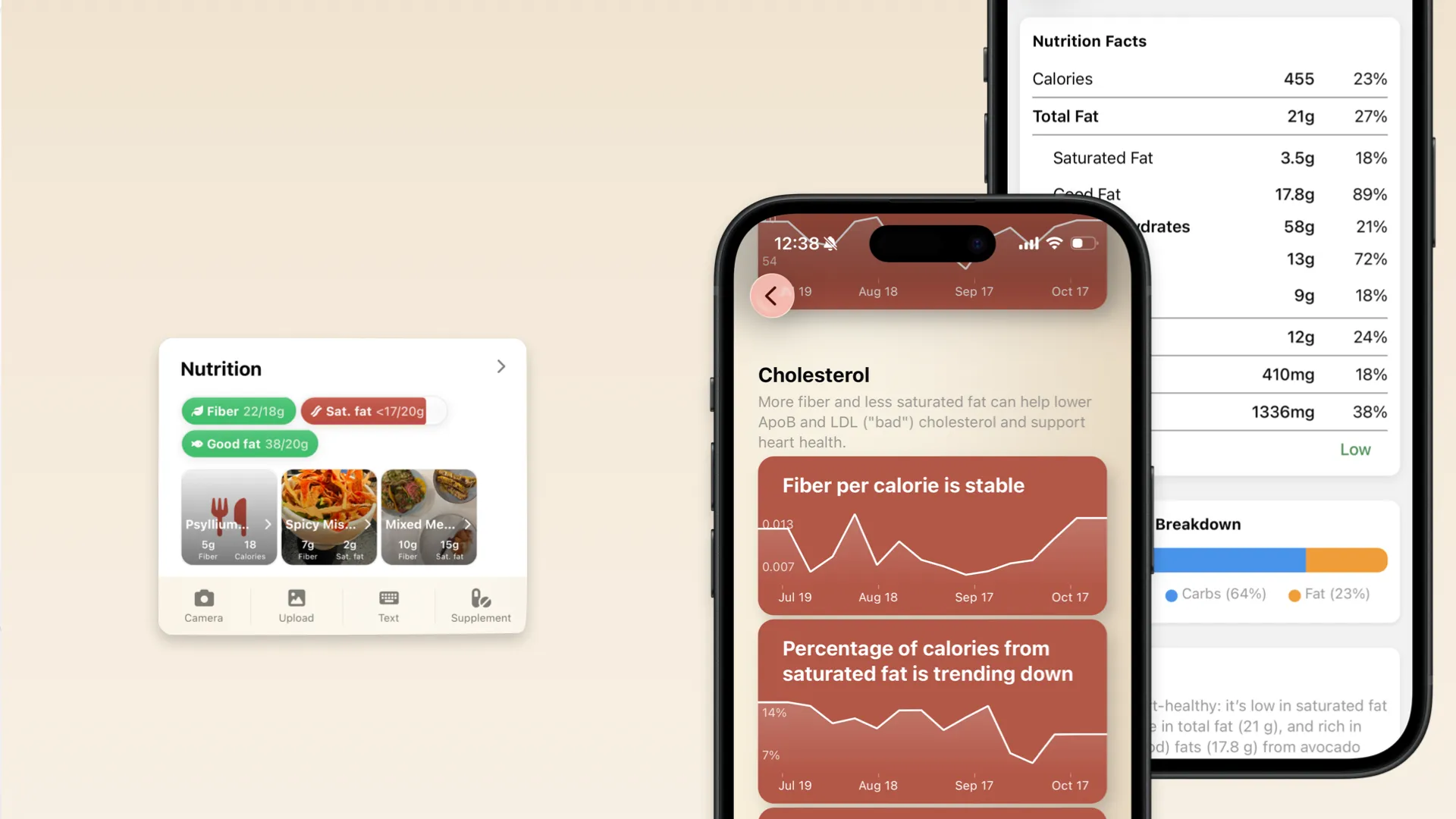
- A daily saturated fat total against a cap (the app shown above uses a 15 g cap).
- A per-meal breakdown so you can see which dishes drove the day’s total.
- A weekly or monthly trend chart, not just today’s number.
A single high-saturated-fat day matters very little. The trend over four to twelve weeks matters a lot.
How to track fiber with an app
Fiber tracking works the same way, but the targets and patterns are different. You’re trying to exceed a number, not stay under one.
In practice, hitting 35 to 40 grams of fiber a day is hard from food alone. The easiest way to close the gap is to log supplements like psyllium husk, oat bran, or fiber gummies in the same app. Empirical Health has a dedicated supplement input alongside meals so the totals match what you actually consumed.
Soluble fiber (oats, beans, psyllium, apples, citrus) is the LDL-lowering kind. Insoluble fiber (wheat bran, leafy vegetables) is great for digestion but does less for cholesterol. Most apps don’t break out soluble vs insoluble, so the practical rule is to track total fiber and lean toward soluble sources when you can.
Daily targets for saturated fat and fiber
Reasonable starting points if you’re trying to lower LDL:
| Nutrient | Target |
|---|---|
| Saturated fat | Under ~13 g/day (6% of calories on a 2,000-cal diet, per AHA) |
| Fiber | 25 g/day (women), 38 g/day (men), per Institute of Medicine |
If your LDL is already high, your doctor may recommend a tighter saturated fat target. These numbers are the population baseline.
Reading the saturated fat and fiber trend over weeks
A single day’s nutrition tells you very little. What matters is whether your typical week sits inside the targets.
The Empirical Health app shown above includes trend charts for “percentage of calories from saturated fat” and “fiber per calorie.” Both are normalized by total calories, which makes them more comparable across high-eating and low-eating days. A four-week trend that points down on saturated fat and up on fiber is the pattern you want before your next lipid panel.
Free apps for tracking saturated fat and fiber
You can track both for free using Empirical Health on iPhone or Android.
Get your free 30-day heart health guide
Evidence-based steps to optimize your heart health.