Vitamin D is a steroid hormone with a misleading name.
First, let me quickly define terms:
- Vitamins, by definition, are compounds your body cannot make on its own (which is why you have to eat them). But your skin synthesizes vitamin D whenever UVB sunlight hits it.
- Hormones are your body’s chemical messengers.
- Steroid hormones in particular are hormones derived from cholesterol.
When researchers worked out Vitamin D’s full pathway in the 1970s, they found it binds a nuclear receptor that regulates roughly 1,000 to 2,000 genes (about 5 to 10% of the human genome). That receptor is in the same family as the receptors for estrogen, testosterone, cortisol, and thyroid hormone.
This explains why a “vitamin” has implications for immunity, blood pressure, glucose control, and (as the TARGET-D trial suggested) heart attack risk. In the rest of this post, we’ll trace how vitamin D is a hormone in everything but name, what the vitamin D receptor actually does, and what this means for testing and supplementation.
Why vitamin D was originally misclassified as a vitamin
Vitamin D got its name in 1922. Elmer McCollum had spent the previous decade naming fat-soluble compounds in cod liver oil by letter (vitamin A, then B, then C), and the factor that cured rickets in rats became the fourth letter. The “vitamin D” name stuck before anyone understood the full implications of what it does. (Elmer McCollum became known as “Dr Vitamin” and famously said, “Eat what you want after you have eaten what you should.”)
How vitamin D becomes an active hormone
The vitamin D that your skin produces (or what arrives in food) is not the active form. Vitamin D₃ is a precursor that’s activated in two steps:
- The liver adds a hydroxyl group, producing 25-hydroxyvitamin D (25(OH)D, calcidiol). This is the form measured by a standard vitamin D blood test. Vitamin D 25(OH)D it has a half-life of weeks and reflects overall stores.
- The kidney adds a second hydroxyl, producing 1,25-dihydroxyvitamin D (calcitriol). Calcitriol is the biologically active hormone, but its half-life is hours and blood levels are tightly regulated.
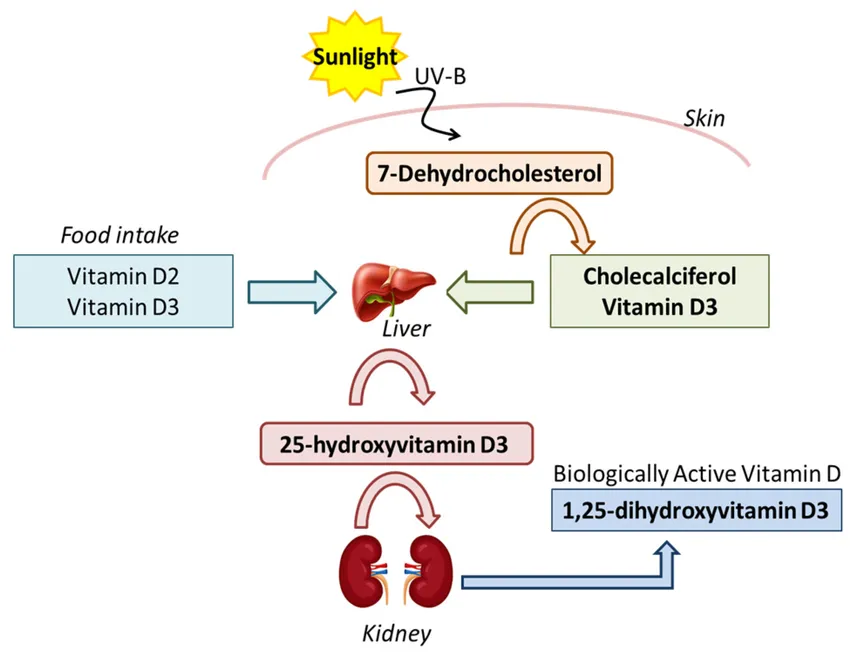 Vitamin D₃ from skin or diet is activated through the liver and kidney before binding to the vitamin D receptor.
A two-step activation in distant organs is characteristic of a hormone.
The Vitamin D receptor (VDR)
Once activated, calcitriol travels through the blood and binds to the vitamin D receptor (VDR). VDR lives in the nucleus of nearly every cell type studied: intestine, kidney, bone, parathyroid, pancreatic beta cells, T and B lymphocytes, vascular smooth muscle, endothelium, heart muscle, and many neurons.
The VDR belongs to the nuclear receptor superfamily, the same family that contains the receptors for:
- Estrogen
- Testosterone
- Cortisol
- Thyroid hormone
- Retinoic acid (the active form of vitamin A)
Each of these receptors works the same way. A hormone binds, the receptor changes shape, pairs up with a partner protein, slides into DNA at specific response elements, and turns genes on or off. VDR ultimately regulates transcription 1,000 to 2,000 genes.
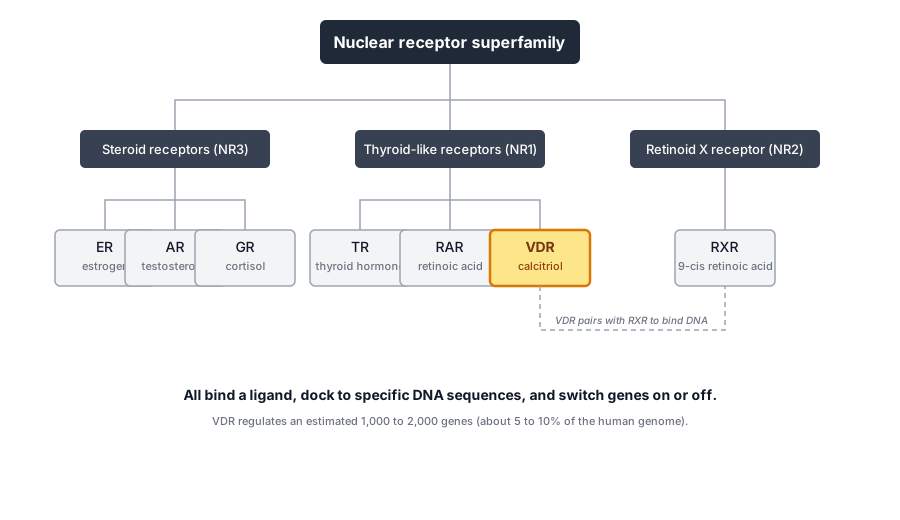 The vitamin D receptor (VDR) sits in the same superfamily as the receptors for estrogen, testosterone, cortisol, thyroid hormone, and retinoic acid. All bind a ligand, dock to specific DNA sequences, and switch genes on or off.
This is why vitamin D effects span so many systems. Vitamin D is a transcription factor running in parallel across most tissues at once.
How vitamin D drives different organ systems
If vitamin D is truly a hormone, its effects should reach beyond bone. They do. Vitamin D drives outcomes across cardiovascular, autoimmune, respiratory, cancer, falls (obviously has some relation to bone health), and diabetes:
| Body system | Effect | Study |
|---|---|---|
| Cardiovascular | 52% lower risk of repeat heart attack | TARGET-D, post-MI patients held at 40 to 80 ng/mL |
| Autoimmune | 22% lower rate of new autoimmune disease (RA, psoriasis, autoimmune thyroid, and others) | VITAL, 25,871 adults, 2,000 IU/day, 5 years |
| Respiratory infections | 12% fewer acute respiratory infections overall; 70% fewer in people starting below 10 ng/mL | IPD meta-analysis of 25 RCTs, 10,933 participants |
| Cancer mortality | 25% lower cancer mortality after excluding the first 2 years; 17% across the full window | VITAL |
| Falls | 22% fewer falls in adults who started deficient | Pooled meta-analysis |
| Type 2 diabetes | 12% lower progression to T2D (non-significant); larger in those who reached optimal blood levels | D2d, 2,423 adults with prediabetes, 4,000 IU/day |
Why viewing Vitamin D as a hormone matters for testing and supplementation
The hormone vs vitamin framing has two practical consequences for testing and supplementation:
Optimal blood levels are not the same as minimum levels. The original “vitamin” framing produced an recommended daily allowance (600 to 800 IU per day) tuned to prevent rickets, which is a most severe deficiency disease. The hormone framing asks a different question: at what 25(OH)D level does the receptor have enough substrate to function in all the tissues that express it? The Endocrine Society suggests 30 to 50 ng/mL. The TARGET-D heart trial used 40 to 80 ng/mL. Both are well above the deficiency threshold of 20 ng/mL.
Overdose risk is real, because it is a steroid hormone. Water-soluble vitamins like vitamin C get flushed in urine. Steroid hormones do not. Sustained intake above ~10,000 IU per day can drive calcium absorption past what bone and the kidney can handle, leading to hypercalcemia. This is rare in practice, but it is a reminder that the “more is better” rule of thumb for B vitamins does not apply here.
How can you measure Vitamin D?
If you want to know where you stand, the 25-hydroxyvitamin D blood test is the standard measurement, and it is included in the comprehensive panel of an Empirical Health membership.
Get your free 30-day heart health guide
Evidence-based steps to optimize your heart health.