If your doctor handed you a prescription for “vitamin D,” do you know if it’s ergocalciferol (vitamin D2) or cholecalciferol (vitamin D3)? The two share a name and a category, but not a pharmacology. D3 binds the vitamin D binding protein more tightly, lasts longer in circulation, and (in most studies) raises 25-hydroxyvitamin D levels more per equivalent dose.
The mismatch matters because prescription D2 is still the default treatment for diagnosed deficiency in the US, and patients reasonably assume the prescription form is the strongest option. The research suggests otherwise. In the rest of this post, we’ll cover how D2 and D3 differ chemically, what the bioavailability data shows, and why the prescription system still defaults to the weaker form.
How vitamin D2 and D3 differ chemically
Both D2 and D3 are sterols built from cholesterol-family precursors. Structurally, D2 has an extra methyl group at carbon 24 and an extra double bond between carbons 22 and 23. But the sources are different. Vitamin D2 (ergocalciferol) is made by exposing ergosterol in yeast, mushrooms, or fungi to UVB light. It is the cheap commercial source and shows up in fortified plant milks, mushroom-based supplements, and most prescription tablets. Vitamin D3 (cholecalciferol) is made by exposing 7-dehydrocholesterol in skin (yours) or lanolin (sheep wool oil) to UVB light. It is the form your body makes naturally, and the dominant form in fatty fish and egg yolks.
The small structural difference makes a surprisingly large impact in your body.
Does D3 raise vitamin D levels more than D2?
Yes, D3 usually raises vitamin D levels more than D2.
A 2012 meta-analysis pooled randomized trials directly comparing D2 and D3, and found that in Bolus dosing (single large doses): D3 raised 25(OH)D significantly more than D2. In daily low-doses, there was no statistically significant difference, but the point estimate still favored D3. A more recent 2023 meta-analysis updated the picture with newer trials. D3 outperformed D2 even with daily dosing, by about 13% in total 25(OH)D rise across studies, with a larger gap in adults with higher BMI.
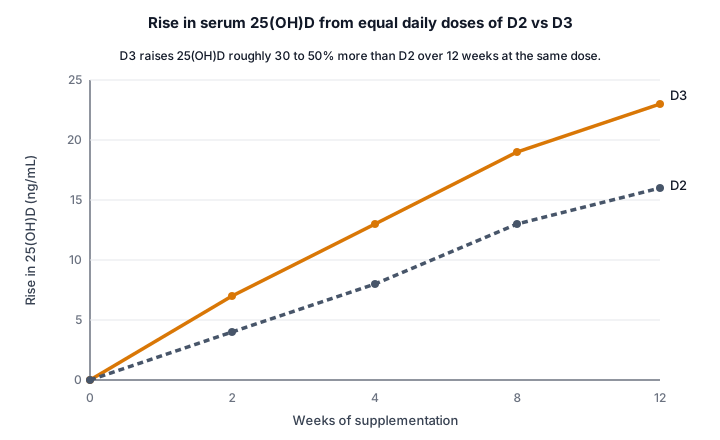 Across pooled trials, the same daily dose of D3 raises 25(OH)D roughly 30 to 50% more than D2 over 12 weeks, with the gap widening over time.
A few mechanisms explain the gap:
- DBP affinity. D3 and its metabolites bind the vitamin D binding protein more tightly than D2’s metabolites do. That extends the circulating half-life.
- Clearance. 25(OH)D2 is cleared from blood faster than 25(OH)D3. After a bolus, the D2 peak fades sooner.
- Assay sensitivity. Some commercial 25(OH)D assays detect D3-derived metabolites better than D2-derived ones. Part of the measured gap may be assay bias rather than biology, though it does not flip the conclusion.
When D3 is recommended over D2
For most healthy adults, D3 is the better default than D2. It’s more effective per dose, cheaper, and closer to what your body makes from sunlight.
A few cases keep D2 in the conversation:
- Strict vegan supplementation. D3 is usually made from lanolin (sheep wool), which some vegans avoid. Lichen-derived D3 is now widely available and solves this.
- Cost or access constraints that make prescription D2 the only available option.
- Specific medical regimens prescribed by an endocrinologist or nephrologist, where the prescriber may have particular reasons.
Standard maintenance doses for adults range from 1,000 to 4,000 IU/day of D3, but the right number depends on your starting 25(OH)D level, body weight, and sun exposure. The 25-hydroxyvitamin D blood test is the only honest way to know whether your current regimen is working.
Vitamin D2 vs D2: summary
Vitamin D2 and D3 share a name but not a pharmacology. D3 binds the carrier protein tighter, lasts longer in blood, and raises 25(OH)D more per dose, especially at higher or less-frequent dosing. The prescription system in the US defaults to D2 for historical reasons that no longer match the evidence. Ask your doctor about D3, and confirm it is working with a blood test.
Get your free 30-day heart health guide
Evidence-based steps to optimize your heart health.