Updated 7/23 based on the FDA vote
BPC-157 has more than 50 million tagged video views on YouTube and TikTok, over 100,000 members in peptide subreddits, and Google search volume that hit an all-time high in 2024. It’s sold as the “wolverine compound” for repairing tendons, ligaments, and joints. Pages announcing that BPC-157 is legal again are easy to find.
The FDA published a 68-page review of BPC-157, and they found one clinical trial across the whole orthopedic literature: 17 patients, who received BPC-157 mixed with a second peptide. On July 23, the agency’s advisory committee voted 8-6 to add BPC-157 to the 503A bulk list, a first step toward making compounded BPC-157 legal.
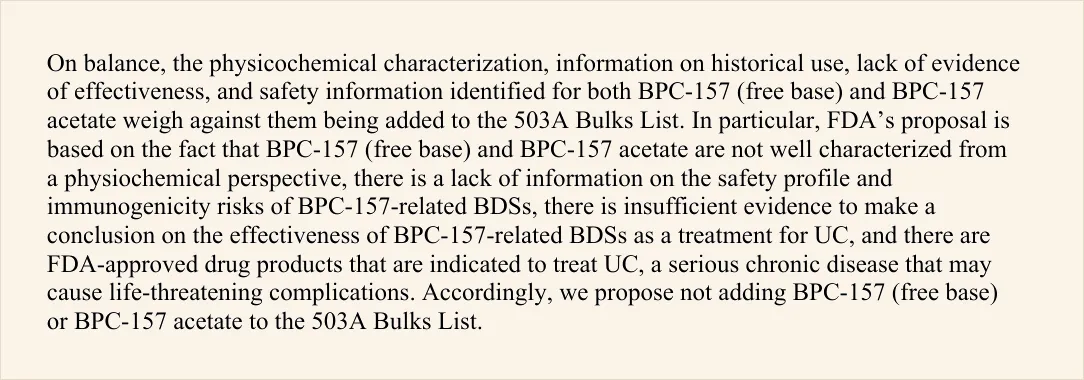 The closing paragraph of the FDA’s evaluation of BPC-157. Source: FDA briefing document, Pharmacy Compounding Advisory Committee, July 2026.
In this article, we’ll review what the FDA found and the evidence base for BPC-157.
Does BPC-157 work for tendon and joint repair?
Unfortunately, there’s no reliable clinical evidence that BPC-157 repairs tendons, ligaments, or joints in people. A 2025 systematic review in HSS Journal identified 36 studies of BPC-157 in orthopedic sports medicine. Thirty-five were preclinical (i.e., in rodents or cell culture). The only human study enrolled 17 patients with knee pain and gave them both BPC-157 and thymosin beta-4, so any effect can’t be attributed to either one.
Tendonitis was one of four conditions formally nominated to the FDA, alongside ulcerative colitis, Crohn’s disease, and celiac disease. The agency declined to evaluate three of them, writing that the nominations “did not include sufficient information” and that it “did not identify clinical studies using BPC-157 in these populations.” The 68-page review is entirely about ulcerative colitis, because that’s the only proposed use with any human trial behind it.
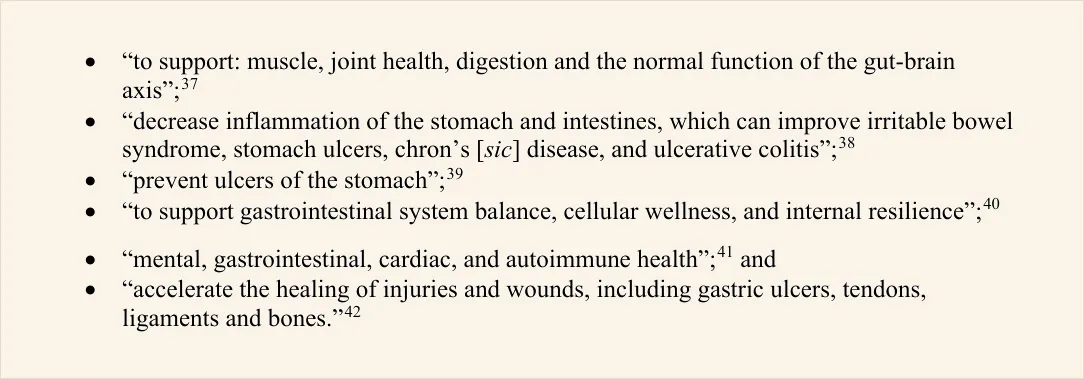 Claims the FDA collected from compounding pharmacy, med spa, and clinic websites. Source: FDA briefing document, July 2026.
Side note: BPC-157 free base and BPC-157 acetate are different active ingredients, and both are sold as “BPC-157.” So some of the claims you see are conflated.
Has BPC-157 been tested in humans?
Roughly 80 people have received BPC-157 across five published studies. The longest anyone was treated in any of them is two weeks.
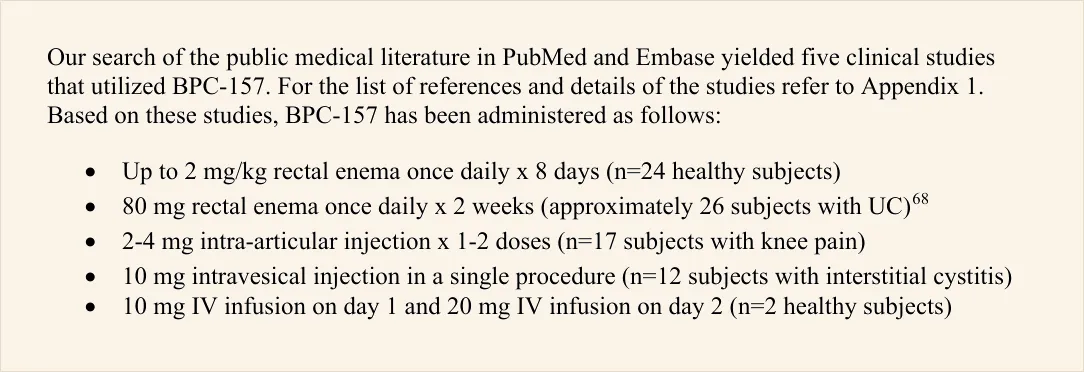 Every published human study of BPC-157. Source: FDA briefing document, July 2026.
The routes those studies used and the routes people are buying don’t overlap much:
| Route | People ever dosed | What was studied | Sold to consumers |
|---|---|---|---|
| Rectal enema | ~50 | Healthy volunteers, ulcerative colitis | No |
| Intra-articular | 17 | Knee pain (with thymosin beta-4) | No |
| Intravesical | 12 | Interstitial cystitis | No |
| Intravenous | 2 | Healthy volunteers | No |
| Subcutaneous injection | 0 | Nothing | Yes |
| Oral capsule | 0 | Nothing | Yes |
| Nasal spray | 0 | Nothing | Yes |
| Transdermal cream | 0 | Nothing | Yes |
The FDA states it plainly: “We found no studies that administered BPC-157 to humans via the proposed oral, SC, nasal, or transdermal ROA.”
Is BPC-157 FDA approved?
BPC-157 isn’t approved as a drug in any country, and isn’t available for compounding. A pharmacy can compound with a bulk substance only if that substance has a USP or NF monograph, is a component of an FDA-approved drug, or appears on the FDA’s 503A bulks list. BPC-157 satisfies none of the three today. The July 23 advisory committee vote is the first step toward changing that. BPC-157 is also prohibited under category S0 of the World Anti-Doping Agency’s list.
What happens after the vote
The 8-6 vote is a nonbinding recommendation. The FDA usually follows its advisory committees, but it isn’t required to. Even if it does move to add BPC-157, doing so requires rulemaking with notices and a comment period. So I wouldn’t expect compounded BPC-157 to be legal in the next few months; actual rulemaking will take time.
IMO, the most informative data will come from clinical trials that are currently in progress. There’s one phase 2 trial of BPC-157 for hamstring strain in Shenzhen Hospital. It measures time to return to unrestricted sport and MRI-assessed injury volume at day 14. Completion is expected in February 2027. I think given the state of evidence, hopefully there will be a lot more clinical trials run.
Get your free 30-day heart health guide
Evidence-based steps to optimize your heart health.