If you drink French press coffee to protect your heart, you may be nudging your LDL cholesterol in the wrong direction. The new 2026 AHA scientific statement on caffeine found no clear relationship between caffeine and blood lipids, but it singled out an exception: unfiltered coffee raises LDL. (The statement was chaired by Greg Marcus, a UCSF cardiologist I worked with a while back on an early study using the Apple Watch to detect atrial fibrillation.)
The cause is your brewing method, not the caffeine or the amount you drink. A compound called cafestol in unfiltered coffee raises your LDL. Paper filters remove almost all cafestol. This article covers which brewing methods raise cholesterol and how big the effect is.
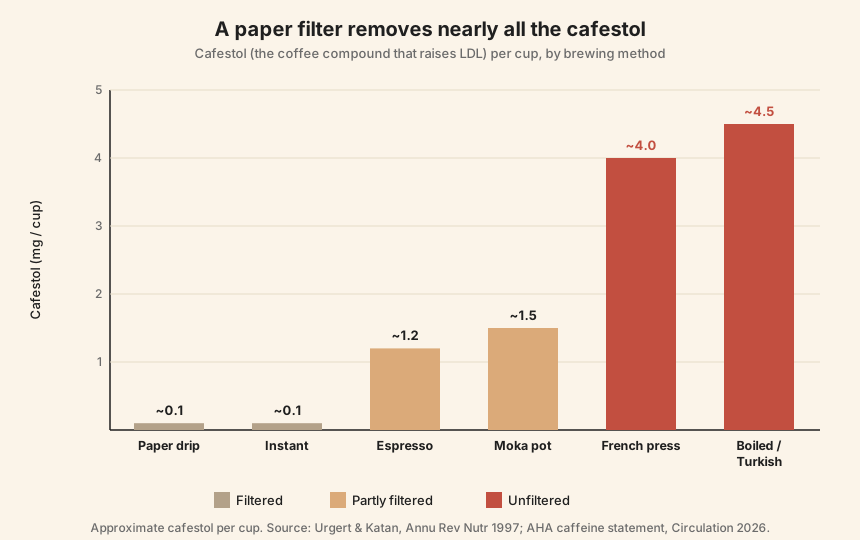 Cafestol is concentrated in unfiltered brews. A paper filter brings it close to zero. Source: Urgert & Katan, Annu Rev Nutr 1997; AHA caffeine statement, Circulation 2026.
Does coffee raise cholesterol?
Filtered coffee doesn’t meaningfully raise cholesterol, but unfiltered coffee does. The difference comes down to a diterpene called cafestol, which is present in the oils of coffee and gets trapped by a paper filter. So drip coffee brewed through a paper filter, and instant coffee, have little effect on your LDL. French press, Turkish, Greek, and Scandinavian boiled coffee raise LDL cholesterol.
This is partly why the evidence on “coffee and cholesterol” can look contradictory. Studies that pool all coffee together blur two very different drinks.
Why unfiltered coffee raises LDL (cafestol and kahweol)
Cafestol is the most potent dietary cholesterol-raising compound known. It (along with a related diterpene, kahweol) reduces the liver’s uptake of LDL from the blood, so LDL levels climb. Coffee beans contain these oils naturally. What varies is whether they end up in your cup.
The cleanest evidence that caffeine isn’t the problem comes from the AHA statement’s account of the randomized trials: cafestol given in capsules raised LDL, but caffeine capsules did not. Decaffeinated French press still raises LDL, because it still contains cafestol. Caffeine and cafestol travel together in coffee, but only one of them touches your cholesterol.
Which coffee raises cholesterol the most?
Cafestol content ranges from near zero in paper-filtered coffee to roughly 4 to 5 mg in boiled and pressed coffee:
| Brewing method | Cafestol per cup | Effect on LDL |
|---|---|---|
| Paper-filtered drip | ~0.1 mg | Negligible |
| Instant | ~0.1 mg | Negligible |
| Espresso | ~1.2 mg | Modest |
| Moka pot | ~1.5 mg | Modest |
| French press | ~4 mg | Meaningful |
| Turkish / Greek | ~4 mg | Meaningful |
| Scandinavian boiled | ~4.5 mg | Largest |
Note that a metal mesh or a cloth lets the oils through; you need a paper filter specifically.
How much does unfiltered coffee raise your LDL?
Heavy unfiltered coffee raises LDL by about 10 to 16 mg/dL compared with filtered coffee. In randomized trials, boiled coffee raised LDL by roughly 0.4 mmol/L (about 16 mg/dL), and Scandinavian boiled coffee raised LDL by at least 10%. A meta-analysis of randomized trials put the average LDL rise across coffee types at about 5.4 mg/dL, with the effect concentrated in the unfiltered studies and growing with the dose.
An LDL change of 10 to 16 mg/dL is nontrivial if you’re already working to lower it. For someone managing cardiovascular risk, it’s in the same range as the effect of some dietary and lifestyle changes people work hard to achieve. Getting there by switching filters is as close to a “free lunch” as you can get in heart health.
Does espresso raise cholesterol?
Espresso has more cafestol than paper-filtered coffee but less than French press, so its effect on cholesterol is smaller. In the Tromsø Study of over 21,000 adults in Norway, drinking 3 to 5 espressos a day was associated with higher total cholesterol. The association was stronger in men than in women. A shot of espresso is small, so the cafestol per serving is lower than a full mug of unfiltered coffee, but several a day add up. Moka pot coffee, brewed the stovetop way, behaves similarly.
How to keep drinking coffee and protect your LDL
Brew through a paper filter. A standard drip machine, a pour-over with a paper cone, or a paper filter dropped into your French press captures nearly all the cafestol. Instant coffee works too. You keep the caffeine, the taste is close, and the cholesterol effect goes away.
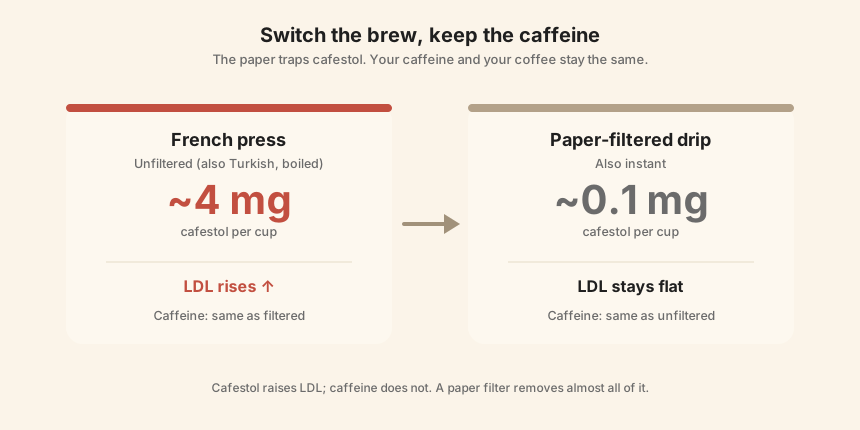 Switching to a filtered brew changes your cafestol intake, not your caffeine. Source: AHA caffeine statement, Circulation 2026.
If you drink unfiltered coffee daily and you’re tracking your lipids, this is worth measuring rather than guessing. Check your ApoB or LDL, switch to a filtered brew, and retest in about six weeks. Or consider one of the many cholesterol-lowering medications. At Empirical, we’ve run more than a million lab tests, and the most reliable way to know whether a habit is moving your numbers is to measure, change one thing, and measure again.
Get your free 30-day heart health guide
Evidence-based steps to optimize your heart health.