For much of the last 60 years, official guidelines recommended against eggs even though the underlying science wasn’t clear-cut. That’s changing, and now the American Heart Association’s 2026 dietary guidelines state that “moderate egg consumption can be included as part of a heart-healthy dietary pattern”. The AHA no longer recommends dietary cholesterol as “a primary target for CVD risk reduction.” (Blood cholesterol is still important, but blood cholesterol is driven primarily by fiber and saturated fat.)
Did the science change? Or just the guidance? This post traces how official guidance went from a strict egg limit to no limit at all, including the moment the guidelines dropped its cap on dietary cholesterol, what other health organizations now say, and what the evidence on eggs actually showed over the last six decades.
A brief history of egg guidance
 How US guidance on dietary cholesterol changed over six decades.
In 1968, the American Heart Association recommended that people eat no more than three whole eggs per week and keep dietary cholesterol under 300 mg per day. The logic was based on three three lines of evidence, each of which proved shakier than it first looked:
- Animal studies. Feeding cholesterol raised plasma cholesterol and drove atherosclerosis. But the studies often used herbivores like rabbits, which are far more sensitive to dietary cholesterol than omnivores like humans, and they relied on pharmacological doses no person would eat.
- Epidemiology. Populations that ate more cholesterol had more cardiovascular disease. But the 1960s and 1970s analyses used simple correlations that could not separate cholesterol from its travel companion, saturated fat, since both show up in the same animal foods. Later multivariate studies found dietary cholesterol was not an independent risk factor.
- Clinical feeding studies. Eating more cholesterol raised serum cholesterol. But the early trials fed extreme amounts (six eggs a day for six weeks) and measured only total cholesterol, not the LDL and HDL fractions that actually matter for risk.
Better methods slowly dismantled each of these. In 2015, after reviewing the accumulated evidence, the advisory committee for the Dietary Guidelines for Americans concluded that “cholesterol is not a nutrient of concern for overconsumption.” At this point, the 300 mg per day cholesteorl limit was dropped from the official guidelines. The reasoning was the one we now take for granted, which the body makes most of its own cholesterol, and dietary cholesterol has a small effect on blood levels for most people.
In 2019, an AHA science advisory reaffirmed that there is no useful numeric limit for dietary cholesterol. It shifted the emphasis to overall eating patterns rather than single nutrients. By 2026, the AHA’s dietary guidance made it explicit that dietary cholesterol in general (and eggs in specific) weren’t an important target.
Ancel Keys was on the side of eggs
If you have heard one name from the diet wars, it is probably Ancel Keys. Keys is the scientist most associated with the idea that saturated fat raises cholesterol and drives heart disease (sometimes cast as the villain in popular books arguing that saturated fat was wrongly demonized!). Most people who recognize his name know him from that controversy.
I was surprised to learn that Keys didn’t think dietary cholesterol mattered much. In fact, he had a famous equation which predicted the change in blood cholesterol from diet:
ΔCholesterol = 1.2 (2ΔSatFat − ΔPolyUnsaturatedFat) + 1.5 Δ√Chol
Here ΔSatFat and ΔΔPolyUnsaturatedFat are the changes in saturated and polyunsaturated fat as a percent of calories, and Chol is dietary cholesterol. Saturated fat counts double (the 2ΔS term), and cholesterol enters only through a square root; so its effect is small to begin with and flattens as intake rises. In a 1991 letter, Keys put it pretty plainly that dietary cholesterol “has a limited effect in humans.”
What the AHA’s 2026 guidance says about cholesterol
The AHA’s 2026 guidance has a bit of nuance:
Dietary cholesterol is no longer a primary target for CVD risk reduction for most people. Nevertheless, heart-healthy dietary patterns are low in foods high in cholesterol such as fatty cuts of meat and foods typically eaten with eggs such as processed meats (sausage or bacon). Moderate egg consumption can be included as part of a heart-healthy dietary pattern.
In other words, eggs are healthy in moderation. However, the foods that often share a plate with eggs (sausage and bacon) are still worth limitin, because of their saturated fat, sodium, and processing.
The 2026 dietary guidelines have no limit on cholesterol.
Dietary Guidelines for Americans: no limit on eggs or cholesterol
The Dietary Guidelines for Americans removed the limit on eggs and cap on dietary cholesterol. For decades they carried the same “less than 300 mg per day” cap the AHA introduced in 1968. Then in 2015 the advisory committee concluded that “cholesterol is not a nutrient of concern for overconsumption,” and the 300 mg cap was dropped. There is now no numeric limit on dietary cholesterol, and no limit on how many eggs you can eat.
Eggs themselves never left the protein group of the USDA’s food guides, from the wartime Basic 7 through the 1992 Food Guide Pyramid to today’s MyPlate.
The one piece of officialdom that has not caught up is the FDA’s Nutrition Facts label. It still lists cholesterol with a Daily Value of less than 300 mg per day.
Does dietary cholesterol literally have no effect on blood cholesterol?
As with many things in nutrition science, there’s some subtlety when you consider secondary effects, variation between people, and the overall uncertainty in evidence base. A meta-regression showed that dietary cholesterol has a slight (but noisy) effect on blood cholesterol. In praticular, it raises LDL modestly and raises HDL alongside it, for a balancing effect:
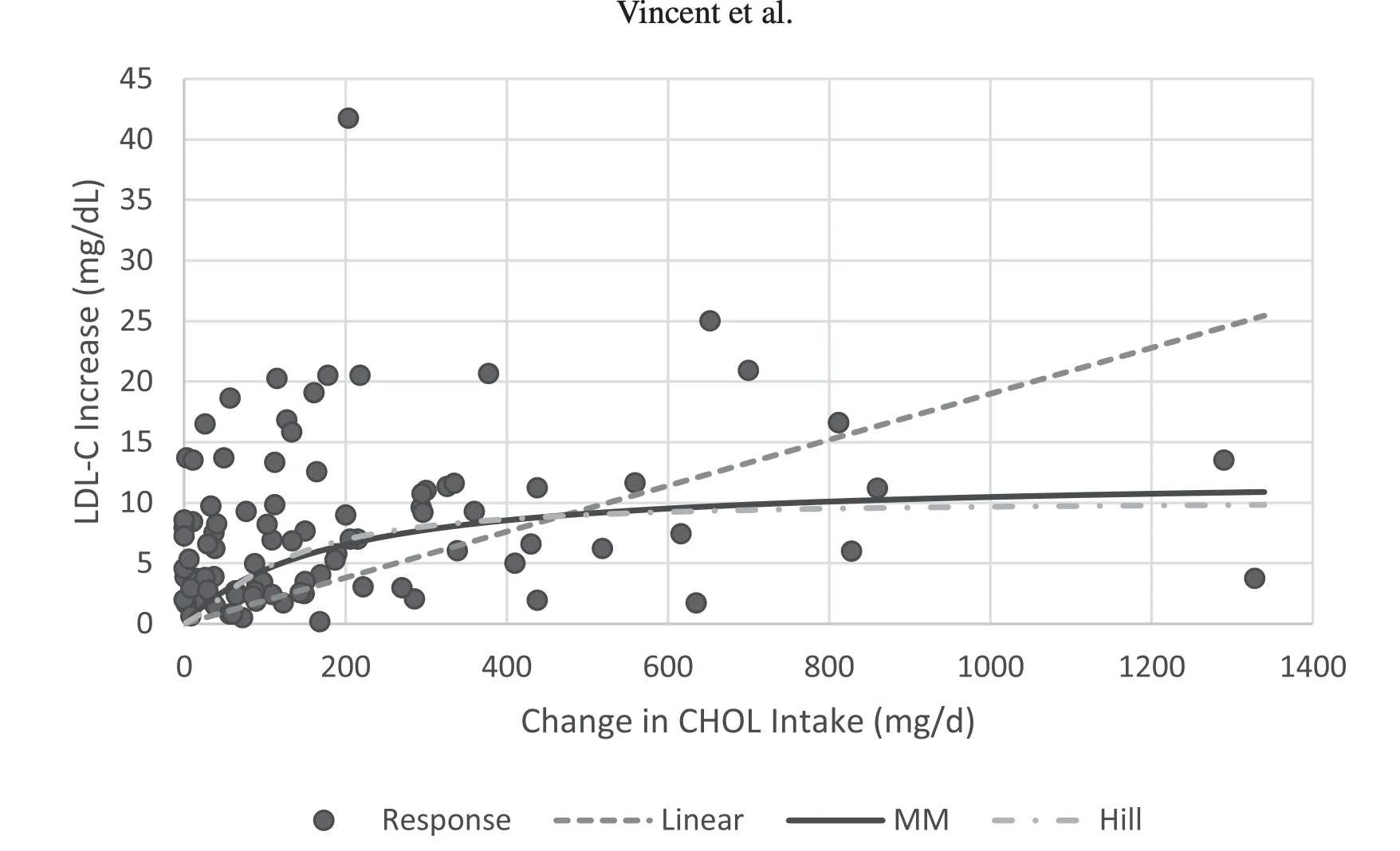 Across controlled feeding studies, more dietary cholesterol nudges LDL up, and HDL up alongside it. The effect is small relative to saturated fat. Source: Am J Clin Nutr 2019.
So when we say that blood cholesterol is primarily synthesized by your liver, and primarily driven by saturated fat and fiber (not dietary cholesterol), it’s true as a first-order approximation. But there are more subtle effects.
So, are eggs officially healthy?
In moderation, yes, eggs are healthy. What matters more for your blood cholesterol is the balance of saturated fat and fiber across your whole diet. The evidence base has been fairly clear for decades, but now in 2026 the official guidelines have caught up to the science.
Get your free 30-day heart health guide
Evidence-based steps to optimize your heart health.