VO2Max (maximum volume of O₂) is one of the strongest predictors of longevity. Every 1 ml/kg/min increase in VO2Max is associated with roughly a 9% reduction in risk of death, and the curve doesn’t seem to plateau even at elite-athlete levels of fitness.
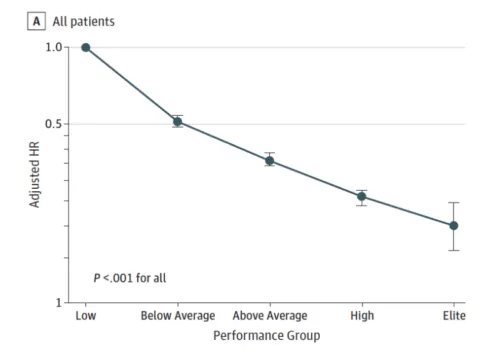 Adjusted hazard ratio of all-cause mortality vs VO2Max performance group, from a JAMA Network Open 2018 study of 122,000 patients at the Cleveland Clinic. Mortality keeps falling all the way to elite fitness, with no upper plateau.
So what is VO2Max actually measuring? Most people assume lungs (VO2Max is a metric of oxygen, after all). But decades of cardiac catheterization studies show that the main thing separating the VO2Max elite endurance athletes from the rest of us isn’t lung capacity. Rather, it’s heart size and how easily that heart fills with blood between beats.
The Fick Equation explains why this is true. This post walks through the Fick equation and the role of all three terms, how lab tests and wearables measure or estimate VO2Max, and how to improve VO2Max.
What is the Fick equation?
The Fick equation says that your maximum oxygen uptake is the product of three terms:
VO2Max = (LV end-diastolic volume − LV end-systolic volume) × heart rate × arteriovenous O2 difference
The first part (the difference in left ventricular volume between the end of filling and the end of contraction) is your stroke volume: how much blood your heart pumps per beat. Multiply by heart rate and you get cardiac output. Multiply that by the arteriovenous (a-v) O2 difference, which is how much oxygen your tissues actually pull out of the blood, and you get VO2.
The equation is a definition, not a model or approximation. Every molecule of oxygen your muscles burn had to be pumped there by your heart, carried in blood, and extracted at the tissue. VO2Max describers the ceiling on that whole pipeline.
Why VO2Max correlates with heart muscle strength
Of the three terms in the Fick equation, two are hard to change. Maximum heart rate barely budges with training; in fact, elite athletes often have slightly lower max heart rates than non-athletes. The A-V O2 difference is also constrained: blood can only carry so much oxygen, and tissues can only extract so much. Estimates put the upper bound around 200 ml/L of blood.
That leaves stroke volume as the modifiable factor.
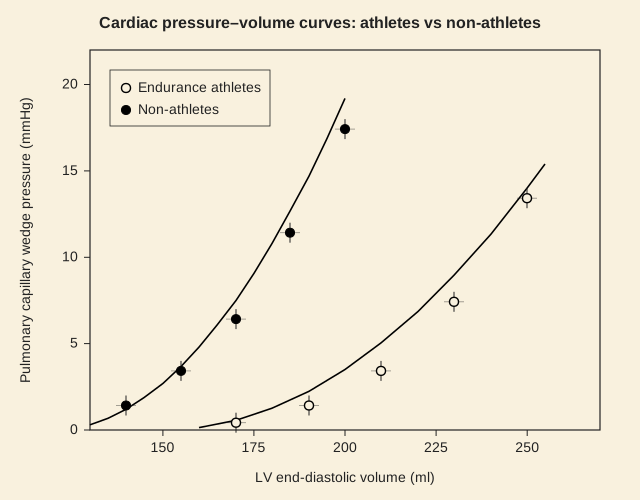 Cardiac pressure-volume curves for athletes vs non-athletes. Athlete hearts fill to much larger volumes at much lower wedge pressures, indicating greater compliance. Redrawn from Levine et al. 1991.
Stroke volume in elite athletes is huge. Levine et al. 1991 used invasive cardiac catheterization to compare endurance athletes against non-athletes. End-systolic volumes were similar between the two groups. The difference was almost entirely in end-diastolic volume (the amount of blood the heart can hold at the end of filling). Male endurance athletes had end-diastolic volumes up to 250 ml. Non-athletes were closer to 150 ml. Why? The athletic heart is more compliant — in other words, it stretches more easily for a given filling pressure. The pericardium (the sac around the heart) also stretches over time with training. A bigger, stretchier ventricle fills with more blood, and pumps more blood per beat.
Athletes also relax faster between beats. At very high heart rates, you only have a fraction of a second to fill the ventricle. Endurance-trained hearts develop “diastolic suction”: the ventricle actively pulls blood in from the atrium. This is why elite athletes can keep increasing stroke volume even at maximal exercise, while untrained hearts hit a wall. So when someone says “high VO2Max means a strong heart,” they’re being imprecise but not wrong. What they mean is: a large, compliant ventricle that fills fast and pumps a lot of blood per beat. That’s describes the quality of your heart muscle.
How to measure VO2Max
There are two ways to get a VO2Max number:
- Cardiopulmonary exercise test (CPET) in a lab. This is the gold standard. You wear a respiratory mask while running on a treadmill or pedaling a cycle ergometer at increasing intensity. The mask measures O2 consumed and CO2 expelled, breath by breath, until oxygen uptake plateaus. The output is a nine-panel plot showing oxygen uptake, CO2 production, heart rate, and breathing rate over time.
- Wearables. Apple Watch, Garmin, Fitbit, Polar, and most modern fitness watches estimate VO2Max from heart rate plus either GPS pace or accelerometer-derived workload. At a given submaximal intensity, a lower heart rate means a higher VO2Max. Apple Watch’s VO2Max algorithm combines a physiological ODE for heart rate dynamics with a deep neural network. Validation data shows it’s accurate to within 1.2 ml/kg/min against true CPET. Wearable VO2Max estimates are best for tracking trends over time, not for absolute precision.
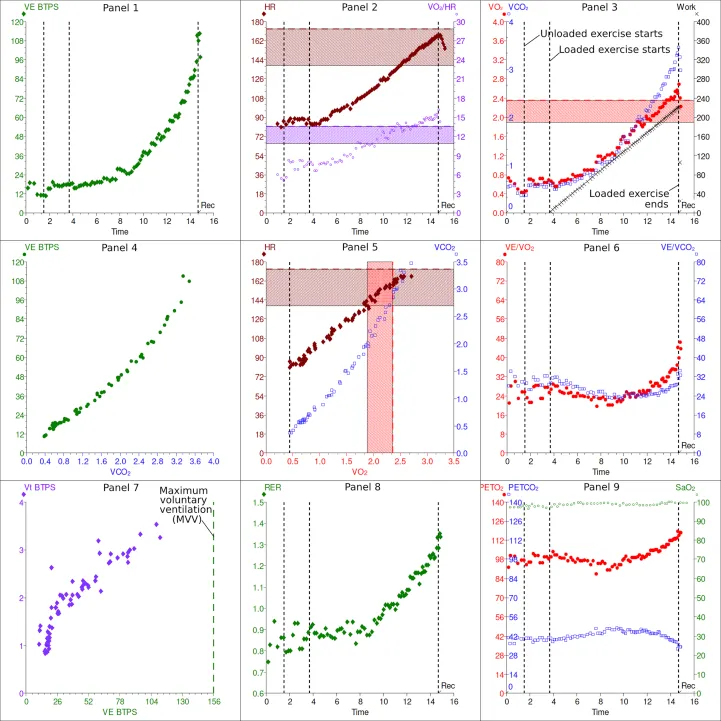 Output of a CPET test: the nine-panel plot. Panel 3 shows O2 (red) and CO2 (blue) diverging at the anaerobic threshold.
How to improve VO2Max
The good news: VO2Max is one of the more trainable systems in the body. Untrained adults typically gain 10 to 15% in 8 to 12 weeks of structured training. In Levine’s 2018 sedentary-aging-reversal trial, 45 to 64 year old sedentary adults gained 18% over two years, and the stiffness of their hearts measurably reversed (the same compliance metric in the chart above). The cardiac remodeling that drives VO2Max isn’t reserved for people who started young.
Intensity matters more than volume. Across Bacon 2013, Milanović 2015, and Weston 2014, high-intensity interval training produces roughly twice the VO2Max gains of moderate continuous training. Most people doing “cardio” sit in a moderate zone that’s too hard to be true zone 2 and too easy to grow VO2Max.
The most-studied protocol is the Norwegian 4x4: four bouts of four minutes at 90 to 95% of max heart rate, separated by three minutes of easy recovery. Helgerud 2007 saw a 13% VO2Max gain in 8 weeks. One 4x4 session per week, layered on a base of easy zone-2 work, is the recipe most-cited in r/peterattia and the longevity community.
Two more levers matter. Volume: studies showing the largest gains use roughly 4 to 6 hours of cardio per week. Recovery: high-intensity sessions need real rest days between them, and chronic sleep deprivation blunts adaptation. Strength training doesn’t directly grow VO2Max, but it preserves the muscle that lets you keep training intensely for years.
If you want to track your VO2Max trend over time, Empirical Health for Apple Watch charts your cardio fitness alongside other heart metrics, and our VO2Max guide walks through how to interpret the numbers.
Get your free 30-day heart health guide
Evidence-based steps to optimize your heart health.