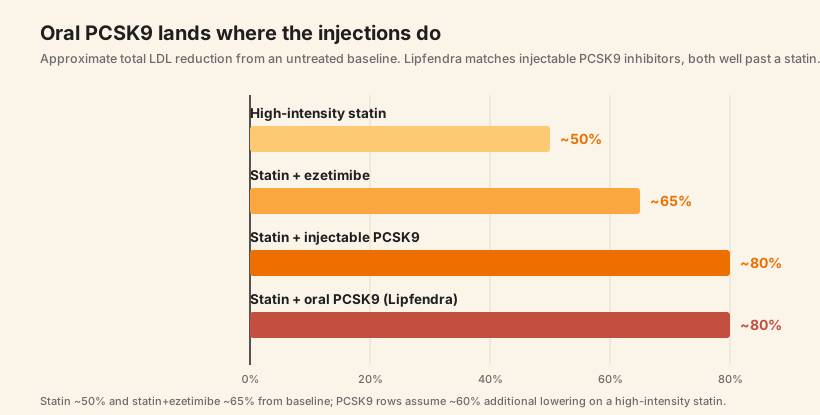
Until July 2026, PCSK9 inhibitors were only injectables like Repatha. The FDA has now approved the first oral PCSK9 inhibitor, Lipfendra (enlicitide). Both Lipfendra and Repatha block the same protein and have similar effects on LDL, ApoB, and Lp(a), but the form factor and price differ.
Lipfendra is a daily tablet and Repatha is a syringe you keep in the fridge. Lipfendra lists for $315 for 30 tablets, or about $3,780 a year, and is now reaching U.S. pharmacies. Repatha has spent a decade proving it prevents heart attacks, while Lipfendra has an outcomes trial that doesn’t complete until 2029.
This article compares Lipfendra and Repatha on LDL reduction, convenience, cost, outcomes evidence, side effects, and insurance coverage.
| Lipfendra (enlicitide) | Repatha (evolocumab) | |
|---|---|---|
| Form | 20 mg tablet, once daily | Injection, every 2 or 4 weeks |
| Storage | Room temperature | Refrigerated |
| LDL reduction | 56-60% | ~60% |
| Lp(a) reduction | 28% | ~27% |
| List price | ~$3,780/yr | ~$6,900/yr |
| Outcomes data | Expected 2029 | FOURIER, published 2017 |
| FDA approved | July 2026 | 2015 |
Which lowers LDL more? Lipfendra or Repatha?
Lipfendra lowered LDL by 56-60%, about the same as Repatha (evolocumab) at 60%. Both Lipfendra and Repatha also lower Lp(a) by 27-28%. So the outcomes are essentially identical.
Lipfendra is a pill, Repatha is a shot
Repatha is an autoinjector used every two weeks (140 mg) or monthly (420 mg), and it must be refrigerated. Lipfendra is a 20 mg tablet taken once per day. That sounds like a small thing, but will likely have a large effect on uptake. About 6 million Americans qualify for a PCSK9 inhibitor today and only about 1% take one. Cost and prior authorization explain part of the gap, but the needle explains a lot of the rest. If a shot is the reason you’ve been reluctant to start Repatha, oral PCSK9 inhibitors like Lipfendra might just be the answer.
Does Lipfendra or Repatha cost more?
Lipfendra’s list price is $315 for 30 tablets, or about $3,780 a year, compared to Repatha’s list price of about $6,900 a year. Amgen sells Repatha direct for roughly $239 a month cash. Lipfendra cash prices at major pharmacies were roughly $327 to $356 for 30 tablets in August 2026, while eligible commercially insured patients can use Merck’s savings offer to pay as little as $15 per prescription. Actual prices and coverage vary by pharmacy and plan. For updates, see our deep dive on Lipfendra’s cost and insurance coverage.
Repatha has cardiovascular outcomes data, Lipfendra has an ongoing trial
Only Repatha has cardiovascular outcomes data, and this is arguably the most important difference between them. Lowering LDL is a surrogate. What patients care about is whether the drug prevents heart attacks and strokes. Repatha proved that in FOURIER, a 27,564-person trial that showed a 15% reduction in major cardiovascular events over 2.2 years.
Lipfendra has no outcomes data yet. Its trial (CORALreef Outcomes), has enrolled more than 14,500 people and is expected to complete late 2029. Since the mechanism is the same and the LDL reduction is the same, most cardiologists expect the outcomes to be the same. But in science, expecting isn’t the same as knowing, and for the next few years Repatha does have more proof.
Lipfendra vs Repatha side effects
Both are unusually well-tolerated for how much they do. Lipfendra’s side effects matched placebo in CORALreef Lipids: adverse events in 77.7% of people versus 76.2% on placebo, with slightly fewer people stopping the drug than stopping placebo. In the separate trial, dizziness (9% vs 4%) and diarrhea (7% vs 2%) were Lipfendra’s most common side effects.
Repatha’s most common side effects are injection-site reactions, cold-like symptoms, and back pain. It also has nine years of real-world use behind it — helpful since rare side effects tend to surface only after a drug reaches a large population.
Does insurance cover Lipfendra or Repatha?
Repatha is on most formularies at this point, though nearly always behind prior authorization that requires a documented statin trial first. Lipfendra was approved in July 2026 and has begun appearing on commercial formularies. Early placements include tier 3 coverage with step therapy after a statin and, on some plans, no prior authorization. Coverage varies, so check the formulary for the specific plan rather than assuming the same restrictions apply everywhere.
For now, an insurer that already covers Repatha may well want you to try it before approving the newer oral option. We track the specific rules by insurer in insurance coverage of PCSK9 inhibitors.
What to ask your doctor
If you’re weighing whether to take Lipfendra or Repatha, these are the questions worth raising: Is my LDL or ApoB still above target on a maximally tolerated statin? Does the outcomes evidence behind Repatha matter for my level of risk, or is the convenience of a pill the bigger factor for me? Was the injection the reason I never started or didn’t stay on one? And which of the two does my insurance actually cover today, if either?
See also: Lipfendra, the first oral PCSK9 inhibitor, PCSK9 inhibitors vs statins, and insurance coverage of PCSK9 inhibitors.
Get your free 30-day heart health guide
Evidence-based steps to optimize your heart health.