If you want to lower inflammation, the single best-studied way to do it is a statin (the same drug used to lower LD cholesterol). In clinical trails, statins lower hs-CRP (the main inflammation marker) by 37%. The flip side is that the trendy anti-inflammatory supplements people reach for first have little evidence behind them.
This matters because inflammation is now a recognized, modifiable driver of heart disease. The American College of Cardiology recently recommended that everyone measure hs-CRP, which we cover in inflammation now predicts heart disease better than LDL. Once you have a number, the next question is how to bring it down.
This post covers the foods that lower inflammation, the foods that raise it, what the evidence says about statins and other medications, and how to test whether any of it is working for you.
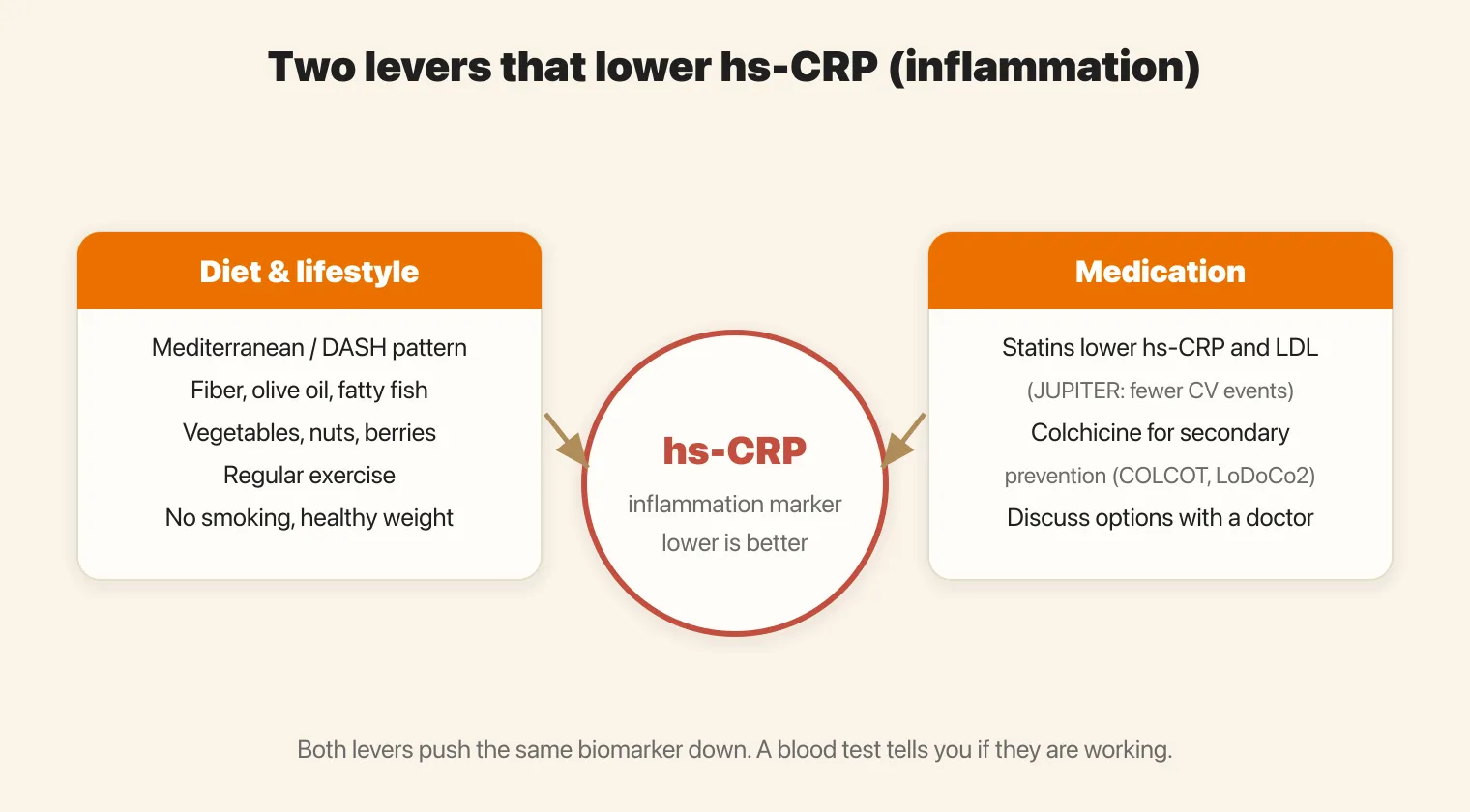 Diet and medication push the same biomarker (hs-CRP) in the same direction. A blood test tells you whether they are working.
What is inflammation and why does it matter for the heart?
Chronic, low-grade inflammation roughly doubles your risk of heart disease. Inflammation is measured with a blood test for high-sensitivity C-reactive protein, or hs-CRP, a protein your liver makes. A good hs-CRP is below 1 mg/L. An hs-CRP above 3 mg/L is considered high risk. Measurin ginflammation is especially useful for people whose cholesterol is already well controlled, because inflammation is one of the strongest remaining predictors of events in that group. We go deeper on the ranges and the science in inflammation and heart health.
The good news is that hs-CRP responds to both diet and medication, so it is a number you can actually move.
Foods that lower inflammation
There is no single anti-inflammatory food. The evidence is strongest for an overall eating pattern, and the two patterns with the most support are the Mediterranean diet and DASH. These patterns share the same building blocks:
- Soluble fiber from vegetables, fruits, beans, oats, and other whole grains. The same fiber that lowers LDL also associates with lower hs-CRP. More in dietary fiber reduces all-cause mortality.
- Fatty fish like salmon, sardines, and mackerel, which supply omega-3 fats (EPA and DHA).
- Extra-virgin olive oil in place of butter and tropical oils.
- Nuts, seeds, and berries, which are rich in polyphenols.
- Leafy greens and colorful vegetables, eaten in volume.
Foods that raise inflammation
The main foods that push hs-CRP up are ultra processed foods and refined carbohydrates, sugar-sweetened beverages, excess alcohol, and processed red meats (like bacon and deli meats). You don’t have to eliminate these perfectly. Inflammation responds to the overall pattern, so steady substitution toward whole foods does most of the work.
Exercise lowers inflammation
Regular physical activity lowers hs-CRP over time, partly through its effect on body fat and partly through direct effects on the immune system. Losing excess weight and quitting smoking also lower inflammation, and smoking cessation is one of the largest single changes most people can make.
Statins lower inflammation
Statins lower hs-CRP, not just LDL. The clearest evidence comes from the JUPITER trial. It enrolled about 18,000 people with normal LDL (under 130 mg/dL) but elevated hs-CRP (2 mg/L or higher). A statin reduced cardiovascular events substantially in this group, even though their cholesterol was already in a normal range. The benefit tracked with the drop in inflammation, not just the drop in LDL.
The mechanism is part of how statins work. Beyond blocking cholesterol production, they have anti-inflammatory effects on the artery wall. This is why two people on the same statin can see both their LDL and their hs-CRP fall.
None of this means a statin is the right choice for any particular person. Whether to start one depends on your overall risk, your other biomarkers, and a conversation with your doctor. The point is narrower: statins are the best-documented way to lower inflammation, and that effect is real.
Other medications studied for inflammation
The American College of Cardiology reviewed a range of anti-inflammatory drugs, and the results were mixed.
- Colchicine is a low-cost anti-inflammatory that reduced recurrent events in people with established heart disease (COLCOT and LoDoCo2), and it is now FDA-approved as an add-on for secondary prevention in stable cardiovascular disease. It is avoided in people with significant kidney or liver disease.
- Canakinumab, an injectable that blocks the IL-1β inflammatory pathway, reduced events in the CANTOS trial, confirming that lowering inflammation itself lowers risk. It is not used routinely for this purpose.
What did not work is just as informative. Methotrexate, TNF inhibitors, and corticosteroids failed to reduce cardiovascular events in major trials. Lowering inflammation helps, but only through the right pathways. Any medication decision here belongs with your physician.
Do anti-inflammatory supplements work?
Most anti-inflammatory supplements do not have strong outcome evidence. Fish oil supplements are the most studied, and high-dose prescription omega-3s have shown benefit in specific high-risk groups, but over-the-counter products are inconsistent. Turmeric, curcumin, and similar supplements are popular but lack the trial evidence that statins, colchicine, and diet have. Eating fatty fish and a Mediterranean-style diet is the better-supported path.
How to track your inflammation
Because inflammation is invisible, the only way to know your level and whether your changes are working is a blood test. hs-CRP costs about $69 on its own, or $190 as part of a comprehensive panel that also includes ApoB, Lp(a), HbA1c, and other key heart markers.
The useful pattern is to test, make a change (a diet shift, more exercise, or a medication started with your doctor), and retest in a few months. Diet and lifestyle changes show up in hs-CRP over weeks to months. Testing before and after tells you whether the change is working for your body, rather than guessing.
Lower your inflammation through diet first, talk to your doctor about whether medication fits your risk, and confirm the result with a blood test.
Get your free 30-day heart health guide
Evidence-based steps to optimize your heart health.