Traditionally, medicines were either small molecules or biologics. Small molecules like aspirin or atorvastatin can be taken as pills. Biologics are highly versatile (they’re large enough to cover an entire protein surface) but must be injected.
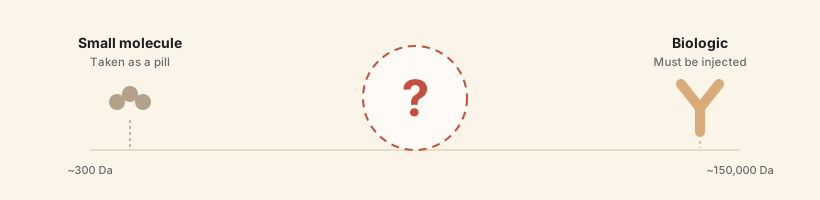
What if there were a middle category? Now there is. Macrocyclic peptides are large peptides (like GLP-1s) folded into a ring structure. The first oral PCSK9 inhibitor, enlicitide (brand name Lipfendra), was approved by the FDA last week. It’s a pill form of PCSK9 inhibitor that lowers LDL cholesterol by about 60%, giving the precise targeting of a biologic with the stability of a pill.
Enlicitide (Lipfendra) was discovered without AI (the program began 13 years ago). The discovery involves some novel chemistry, and so it’s an interesting real-world stress test to understand where AI in drug discovery would actually help (or not). In this article, I’ll cover what makes PCSK9 a difficult target in the first place, how in vitro screening narrowed down one trillion peptides to the initial hit, and the difficult parts of turning that initial hit into a usable drug. Within each section, we’ll discuss how much AI would have helped.
Why PCSK9 is a difficult target in the first place
Enlicitide works by blocking PCSK9, a protein that destroys the liver’s LDL receptors. Those receptors are what pull cholesterol out of your blood, so blocking PCSK9 lowers LDL. There are three sub-problems that make PCSK9 an especially difficult target for a pill vs a biologic:
- The obvious target is flat. The surface where PCSK9 grips the LDL receptor sits more than 20 angstroms from the natural pocket.
- PCSK9’s enzyme activity is a red herring. PCSK9 is a protease, so the obvious move is to jam its active site. But McNutt and colleagues built a catalytically dead version in 2007, and found it still destroyed LDL receptors.
- Its natural deep, well-shaped cavity is already plugged by its own prodomain.
In 2019, Merck published a paper describing its own failure to find a conventional pill for this target. In contrast, targeting PCSK9 is “great for antibodies because they’re huge” (as explained by Douglas Johns, a clinical director on the team that developed enlicitide).
Below is the final designed structure of enlicitide:
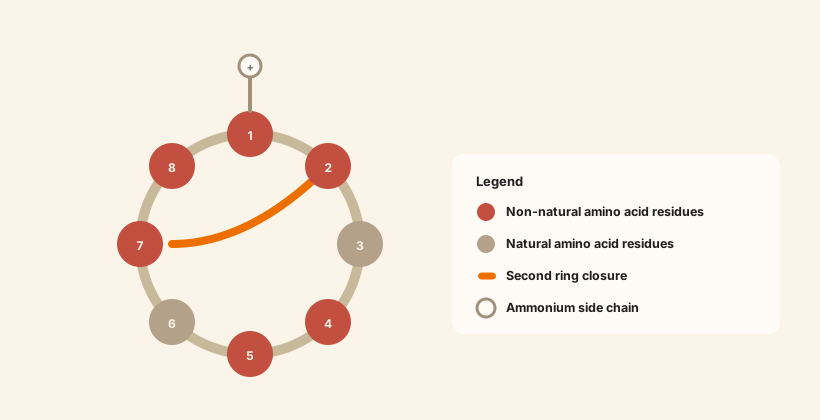 Enlicitide diagram. 6 of the 8 amino acids don’t occur in nature. Rings are used to stabilize the structure. Source: American Peptide Society, Lipfendra prescribing information.
It consists of 8 amino acid residues (6 of which are artificial), and two ring closures that help stabilize the molecule (helps with binding affinity). How did we reach this endpoint? We’ll go through the process of how this structure was derived. The story really unfolds in four stages.
Enlicitide took 13 years over four main stages. Where would AI have helped?
Going from conception to FDA approval required 13 years of development. Those were divided into four stages: 1. find an initial molecule that binds a flat surface, 2. increase binding potency so that molecule becomes usable as a drug, 3. get it across the gut wall, and 4. manufacture it at scale.
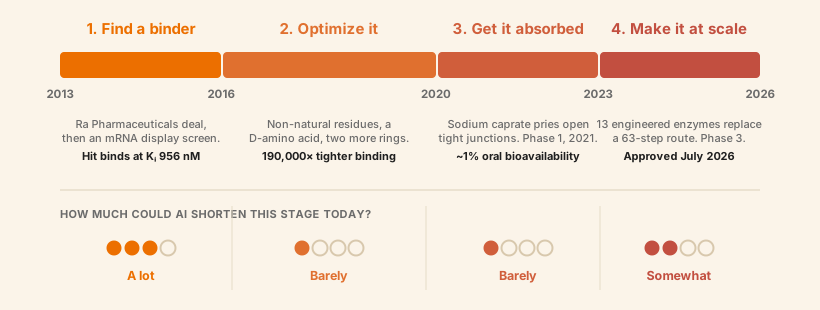 Four stages of enlicitide’s development, along with a rough rating of how much AI would have helped.
Stage 1: how mRNA display found the starting molecule
In 2013, Merck licensed an mRNA display technology from a startup, Ra Pharmaceuticals. Ra is a Cambridge company built around Nobel laureate Jack Szostak’s work. The terms were $4.5 million up front and up to $56 million in milestones, which for a drug now forecast at multibillion-dollar peak sales is one of the better options anyone has bought. UCB ultimately acquired Ra for $2.1 billion in 2020.
mRNA display is an in vitro technology. It essentially runs directed evolution in a test tube rather than a cell. Directed evolution needs two things: a population of variants, and a way to read the winners’ instructions back out. Nature uses cells and all their machinery for this. mRNA display does it in a test tube with a “leash” (puromycin) that links each peptide to the mRNA encoding it. This means the binders that survive a wash step can be reverse transcribed, amplified, mutated, and run again.
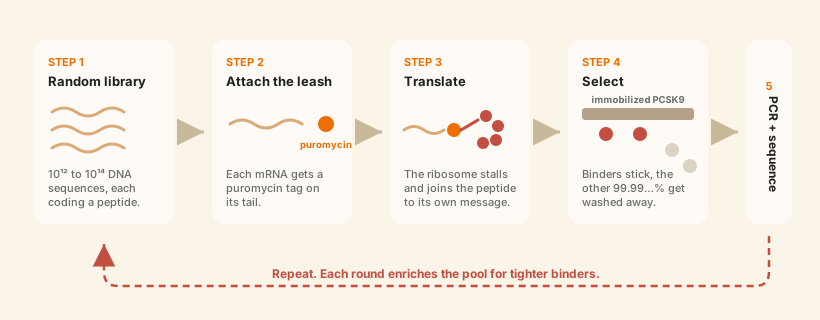 mRNA display runs directed evolution in a test tube, using an mRNA leash to amplify survivors at each step.
Would AI have sped this up? More than any later stage, yes. De novo macrocycle design genuinely works now. David Baker’s lab published RFpeptides in June 2025: they synthesized 77 designs, tested 39, and got 12 binders, including one at 9.4 nM against a bacterial protein the authors call “considerably flatter and difficult to target.” Latent Labs reports hit rates of 91% to 100% against standard benchmarks. So you can now run stage 1 on a laptop.
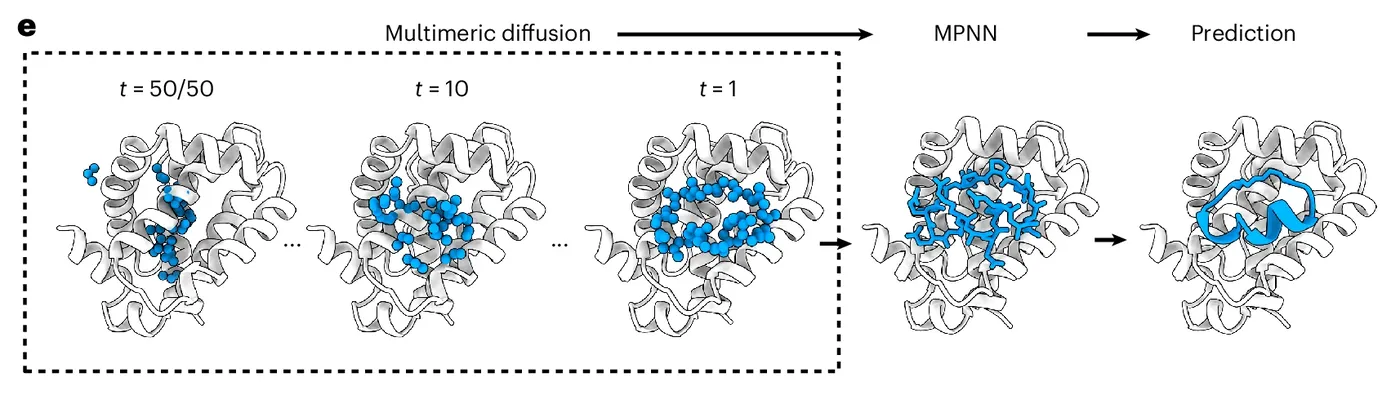 RFpeptides is an AI model that starts from random atoms and denoises them into a ring that fits the target (t = 50/50 to t = 1). Source: Nature Chemical Biology 2025, CC BY 4.0.
One practical limitation is that RFpeptides only uses the 20 natural amino acids. Enlicitide needed six non-natural residues; mRNA display handles that today. Tellingly, the AI-first shops like Unnatural Products still start by screening with display, then apply computation to optimize the resulting hits. As yet, no AI-designed macrocyclic peptide has entered a clinical trial.
Stage 2: 190,000x tighter binding
The initial hit that came out of the mRNA screen was a good start, but it wouldn’t have been an effective drug on its own. It bound PCSK9 only weakly, and its half life in whole blood was only an hour. After optimization, the approved drug binds 190,000x more tightly and has a half-life closer to 8 hours:
| mRNA display hit | Optimized lead | Enlicitide | |
|---|---|---|---|
| Binding affinity (Kᵢ) | 956 nM | 0.0024 nM | 0.005 nM |
| Surviving 1 hr of trypsin | 1.2% | 96.8% | — |
| Half-life in whole blood | 63 min | 7.6 hr | — |
The gap between the initial hit and the optimized drug. Source: ACS Med Chem Lett 2022 and Circulation 2023.
That potency change didn’t come from finding new points of contact with PCSK9. The chemists added a second and third ring, which improved potency roughly 500-fold by taking away the molecule’s freedom to wobble. (A floppy chain has to “freeze” into one shape to bind, and pays for that out of its binding energy, whereas a ring is more rigid.) Jan Kihlberg, a medicinal chemist at Uppsala University, puts it simply: “Instead of being a floppy piece of string, you make it into a donut.”
The rest of the work was a slog of hard-won small victories. For example, two protease cuts improved rigidity (which improves potency). Using 5-fluorotryptophan (a non-natural amino acid residue) to stick its fluorine into a shallow dent on PCSK9 increased potency further. And then a series of changes reduced oxidation from 98% to 2.9%, making the drug last longer in blood.
The first human data was presented at an American Heart Association meeting. A single dose wiped out more than 93% of the free PCSK9 in people’s blood. At the time one of the researchers said: “That’s when I got goosebumps. We reduced free PCSK9 to levels that were basically to zero, which is what the antibodies do. And then we knew we had something.”
Would AI have sped this up? Less than you’d hope. Latent-X’s affinities against protein-protein targets are 5-72 micromolar, RFpeptides’ is 6 nanomolar, and enlicitide is 5 picomolar. So we’re still three orders of magnitude short of where we’d need to be.
Stage 3: making enlicitide get absorbed
The next challenge is absorption. Every Lipfendra tablet contains sodium caprate, which loosens the tight junctions in your intestinal cells. So the drug doesn’t “cross” through gut cells, it squeezes between them. The other lever for absorption is just sheer potency: at 5 picomolar affinity, absorbing 1% of a 20 mg dose is plenty.
This is partly why Lipfendra has to be taken on an empty stomach with water, black coffee, or plain tea, and requires you to wait at least 30 minutes before eating. Food interferes with the enhancer. (The rules may not be permanent, though: David Baker’s group has designed macrocycles that reach 40% oral bioavailability in mice with no enhancer at all.)
Would AI have sped this up? Not really. AstraZeneca’s Molecular AI group reported in 2026 that when generative models wander outside their training data, permeability predictions “reduce to random outputs.” And no model handles the paracellular absorption “trick” which worked here.
Stage 4: scaling manufacturing
A ring with eight amino acids, six of which are non-natural, isn’t easy to make in bulk. The first synthetic route took 63 steps and leaned on chromatography. Producing a single 100 kg batch would have required more than 170 metric tons of intermediates (this makes even node_modules look efficient). In May 2026, Merck’s process chemists published a route in Science using 13 engineered enzymes, which cut the number of steps in half.
Would AI have sped this up? Yes, in part. Merck’s route depends on 13 enzymes engineered to catalyze reactions they didn’t evolve to run, and ML-guided protein engineering is genuinely good for that job.
Where AI actually helps in drug discovery
Macrocyclic peptides do genuinely seem like a new and interesting category of medicine, with the capabilities of a biologic in the form factor of a pill.
Would AI have helped? It’s strongest at the two ends and weakest in the middle of the process. Stage 1 is the clear win. What took a trillion-member library in a test tube now takes a few dozen designs on a laptop. Stage 4 is a partial win, because the new manufacturing route depends on 13 engineered enzymes, and ML-guided protein engineering is routine for that job.
Stages 2 and 3 are the bottleneck. They are also where most of the 13 years went. Turning a nanomolar binder into a picomolar drug is still about three orders of magnitude past what published de novo methods reach, and permeability prediction falls apart outside its training data. Neither is a small gap, and neither is obviously closing.
AI can design the molecule. Turning it into a drug is still the slow part.
See also: Lipfendra, the first oral PCSK9 inhibitor, Lipfendra vs Repatha, and PCSK9 inhibitors vs statins.
Get your free 30-day heart health guide
Evidence-based steps to optimize your heart health.