Heart disease is the leading cause of death among Medicare beneficiaries. Medicare spends more on cardiovascular care than any other condition category. This guide summarizes what Medicare covers for cardiovascular health in 2026, and links to our detailed coverage guides for each area: disease screenings, medications, and treatment through ACCESS.
The three pillars of Medicare cardiovascular coverage
1. Cardiovascular disease screenings
Medicare covers basic lipid panels (free every 5 years), diagnostic cardiac imaging (stress tests, echocardiograms, cardiac CT), and diagnostic EKGs. All diagnostic tests are subject to the Part B deductible ($283 in 2026) and 20% coinsurance.
In general, Medicare doesn’t cover advanced lipid biomarkers like Lp(a) and ApoB.
2. Cardiovascular medications
Medicare Part D covers all the major cardiovascular drug classes, but access and cost vary dramatically:
| Drug class | Monthly cost | Access barriers |
|---|---|---|
| Generic statins | $0-$10 | None |
| Ezetimibe | $0-$15 | Minimal |
| PCSK9 inhibitors | Capped at $2,100/year total | Extensive prior auth + step therapy |
| GLP-1s (for diabetes) | Plan-dependent | Prior auth |
| GLP-1s (for CV risk) | Plan-dependent | Prior auth; must have established CVD |
| GLP-1s (for weight loss) | Not covered | Statutory exclusion |
The Inflation Reduction Act transformed cardiovascular medication costs. Medicare now has a $2,100 annual out-of-pocket cap, elimination of the coverage gap, and negotiated prices for Eliquis, Entresto, Xarelto, Jardiance, and Farxiga (effective 2026) and Ozempic, Rybelsus, and Wegovy (effective 2027). The Bridge program launches July 2026 to offer GLP-1s for $50/month GLP-1s for eligible beneficiaries.
Read the full guide to Medicare cardiovascular medication coverage —>
3. Medicare’s new ACCESS program
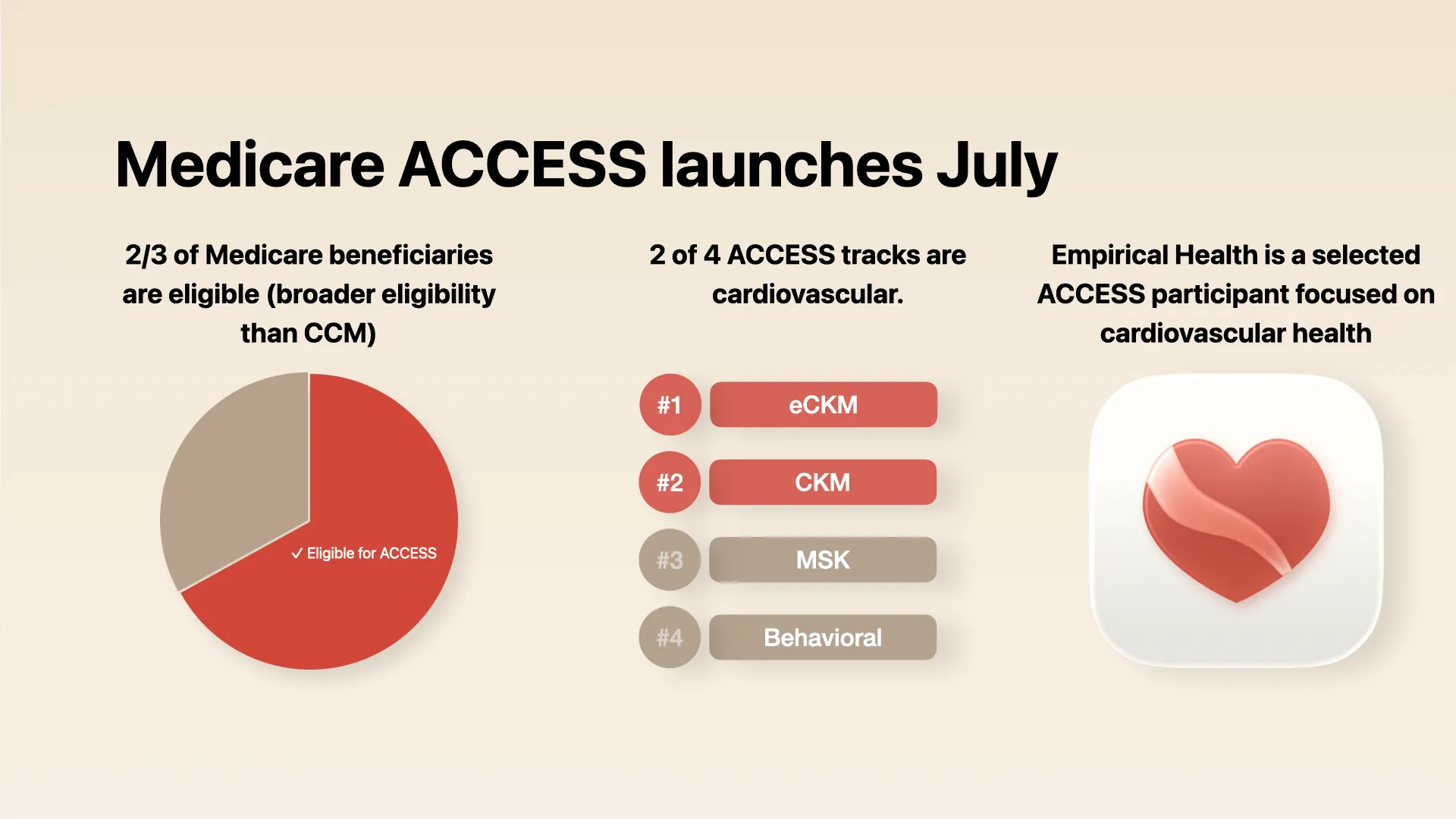
Medicare is launching ACCESS in July 2026 with two cardiovascular tracks: Early Cardio-Kidney-Metabolic (eCKM), which covers hypertension, dyslipidemia, obesity, and prediabetes, and Cardio-Kidney-Metabolic (CKM), which covers diabetes, chronic kidney disease, and atherosclerotic cardiovascular disease.
ACCESS pays for remote monitoring, virtual consultations, digital coaching, and medication management. Some ACCESS providers, like Empirical Health, offer $0 patient copays.
If you’re a referring physician, read our guide to the ACCESS model and referrals here.
What’s changing about Medicare cardiovascular coverage in 2026-2027
| Development | Timing | Impact |
|---|---|---|
| ACCESS model launch | July 2026 | Outcome-based payment for cardiovascular chronic conditions, $0 copays |
| BALANCE GLP-1 bridge | July 2026 | $50/month GLP-1s for eligible Medicare beneficiaries |
| Negotiated drug prices (round 1) | January 2026 | Lower prices for Eliquis, Entresto, Xarelto, Jardiance, Farxiga |
| Negotiated drug prices (round 2) | January 2027 | Lower prices for Ozempic, Rybelsus, Wegovy |
| BALANCE full Part D integration | January 2027 | GLP-1 coverage within Part D benefit structure |
| Part D OOP cap | $2,100 (2026) | Hard annual cap on prescription drug out-of-pocket costs |
The combination of the ACCESS model, BALANCE program, drug price negotiation, and Part D redesign represents the most significant expansion of Medicare cardiovascular coverage since the ACA. The shift from paying for activities to paying for outcomes (ACCESS) and from list prices to negotiated prices (IRA) are structural changes that will shape cardiovascular care for years to come.
Get your free 30-day heart health guide
Evidence-based steps to optimize your heart health.