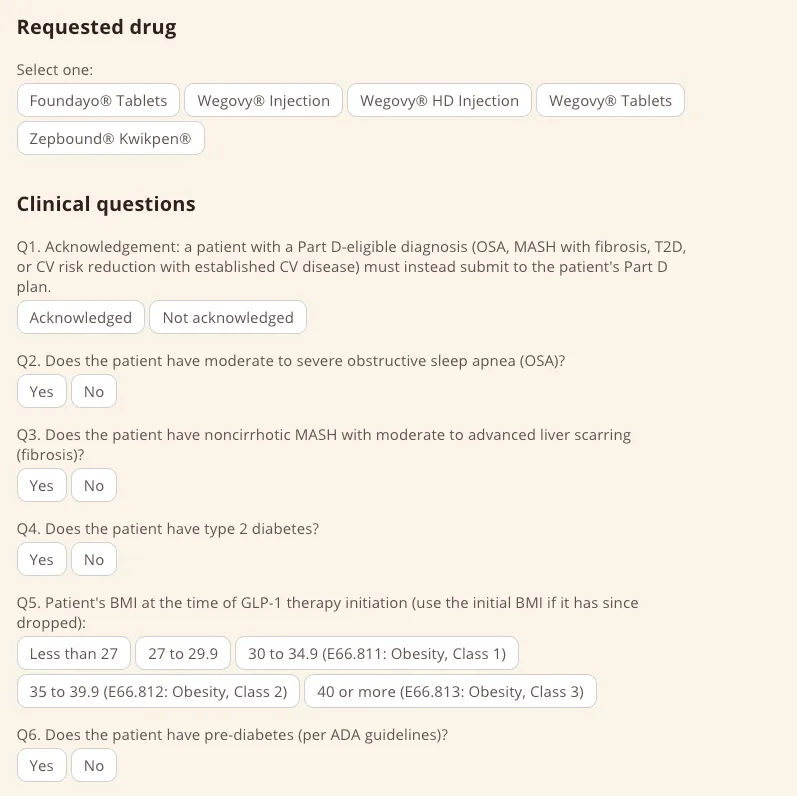
Medicare covers GLP-1s for $50/month starting July 1, but requires prior authorization. The Medicare GLP-1 Bridge prior authorization form is a PDF with one page of contact fields and twelve yes/no questions that determine patient eligibility based on their BMI, medical history, and eligibility for GLP-1s through Part D.
Medicare GLP-1 bridge prior auth form filler
You can download the PDF of Medicare’s GLP-1 prior auth form here. You can also use the below generator to fill in the MedicareGLP-1 prior auth PDF so that it’s ready to fax or send electronically:
You can also just use the direct link to the Medicare GLP-1 Prior auth PDF generator.
For the policy background (who’s eligible, what the Bridge costs, and how it sunsets at the end of 2027), see Medicare covers GLP-1s for $50/month.
Patient eligibility for GLP-1 Bridge prior auths
About 4 million Medicare beneficiaries are likely to be eligible for GLP-1 bridge. To be eligible for a prior auth, patients need to: 1. have a BMI >=35 or >= 27 with other qualifying chronic conditions, 2. Not have GLP-1 coverage through Part D, 3. have a denied pharmacy claim. We’ll cover each of these.
A denied claim has to come before the prior auth
Before you submit the prior authorization, the pharmacy has to transmit a claim to the GLP-1 Bridge billing channel and have it denied. The pharmacy should use the Medicare GLP-1 Bridge BIN (028918) and PCN (MEDDGLP1BR). Have the pharmacy run the claim first, then file.
Step 2: complete the GLP-1 Bridge prior auth form
The top of the form is standard contact information: patient name, Medicare Beneficiary Identifier (MBI), date of birth, and address, plus your name, NPI, tax ID, and practice contact details. Then you select one requested drug and answer twelve questions.
The first four questions are a filter. The Bridge only covers GLP-1s prescribed purely for weight loss. If the patient has a Part D-eligible diagnosis, the request belongs with their Part D plan instead, not the Bridge:
| Q | Question | If yes |
|---|---|---|
| Q1 | Acknowledge that Part D-eligible diagnoses route to the Part D plan | Acknowledge to continue |
| Q2 | Moderate-to-severe obstructive sleep apnea? | Submit to Part D plan |
| Q3 | Noncirrhotic MASH with moderate-to-advanced fibrosis? | Submit to Part D plan |
| Q4 | Type 2 diabetes? | Submit to Part D plan |
If none of those apply, you continue to the weight-management questions:
| Q | Question |
|---|---|
| Q5 | Patient is 18+, using the drug for weight reduction and maintenance alongside lifestyle modification, and which BMI range applies at GLP-1 initiation |
| Q6 | Pre-diabetes (ADA criteria)? |
| Q7 | Previous myocardial infarction? |
| Q8 | Previous stroke? |
| Q9 | Symptomatic peripheral artery disease? |
| Q10 | Heart failure with preserved ejection fraction? |
| Q11 | Uncontrolled hypertension (>140 systolic or >90 diastolic despite two antihypertensives)? |
| Q12 | Chronic kidney disease stage 3a or above? |
Q5 is worth some explanation. Medicare GLP-1 coverage is based on BMI at the time the patient initiated GLP-1 therapy. It notes explicitly that if BMI has dropped since starting, you select the initial range. For example, a patient who started at a BMI of 37 and is now at 32 is recorded as the higher range. In other words, your patients using GLP-1s for maintenance are likely eligible Medicare’s Bridge program.
Patient eligibility requirements for GLP-1 bridge
The specific eligibility requirements for Medicare Bridge depend on the patient’s BMI, with different requirements at 35+, 30-25, and 27-30. This table shows the exact requirements by BMI; the prior auth will be denied if they don’t meet these requirements:
| Patient BMI | What else they need |
|---|---|
| 35 or higher | Nothing else required |
| 30 or higher | Heart failure with preserved ejection fraction, uncontrolled high blood pressure, or chronic kidney disease (stage 3a or higher) |
| 27 or higher | Pre-diabetes, a prior heart attack, a prior stroke, or symptomatic peripheral artery disease |
Step 3: submit the prior auth PDF via CoverMyMeds or fax
Once the form is complete and a denied claim is on file, submit it one of two ways: an electronic prior authorization through CoverMyMeds, or by fax to the number printed on the form.
Which specific GLP-1 drugs Medicare Bridge covers
Medicare Bridge covers Foundayo (orforglipron) tablets, Wegovy (semaglutide) injection, HD injection, and tablets, and Zepbound (tirzepatide) KwikPen. The single-dose vial and single-dose pen formulations of Zepbound are not covered by Medicare Bridge.
Things that delay a Bridge prior authorization
Most holdups trace back to the same handful of issues: submitting the prior authorization before a denied claim is on file (the pharmacy must first run and have the claim denied to BIN 028918 / PCN MEDDGLP1BR); listing the patient’s current BMI on Q5 instead of their BMI at initiation, which may mistakenly disqualify them if their BMI has improved; routing a Part D-eligible diagnosis such as sleep apnea, MASH, type 2 diabetes, or established cardiovascular disease to the Bridge instead of the Part D plan; or leaving any form fields incomplete, since submissions are limited to clinicians and partial forms will be rejected.
This post is part of our series on Medicare coverage for cardiovascular health. See also: Medicare covers GLP-1s for $50/month and how patients enroll in the GLP-1 Bridge.
Get your free 30-day heart health guide
Evidence-based steps to optimize your heart health.