The American Heart Association and American College of Cardiology released new cholesterol guidelines in Mar 2026. These new guidelines redefine what counts as normal cholesterol levels. Depending on your medical history, a normal LDL level for you might be <100 mg/dL, <70 mg/dL, or <55 mg/dL.
As Dr. Roger Blumenthal, chair of the guideline writing committee and director of the Johns Hopkins Ciccarone Center for the Prevention of Heart Disease, put it: “We know 80% or more of cardiovascular disease is preventable and elevated LDL cholesterol, sometimes referred to as ‘bad’ cholesterol, is a major part of that risk.”
Let’s break down how the 2026 AHA/ACC guidelines define normal cholesterol, and the various factors (CAC, Lp(a), ApoB) that might define your specific cholesterol levels.
Normal cholesterol levels are defined as LDL, non-HDL, and ApoB
When you get cholesterol test, the results are broken into various components: LDL (bad cholesterol), HDL (good cholesterol), ApoB (more accurate marker of cholesterol particles that cause heart disease), and non-HDL cholesterol. The AHA defines normal cholesterol levels primarily in terms of LDL and non-HDL.
ApoB is also used to define targets. Experts like Thomas Dayspring would advocate replacing LDL entirely with ApoB, but that will need to be saved for future guidelines.
What’s a normal cholesterol level?
For most people without heart disease, a normal cholesterol level is LDL below 100 mg/dL. For people with cardiovascular risk factors, a normal LDL is 70 mg/dL or 55 mg/dL. The following chart explains how to determine the which LDL levels are right for you:
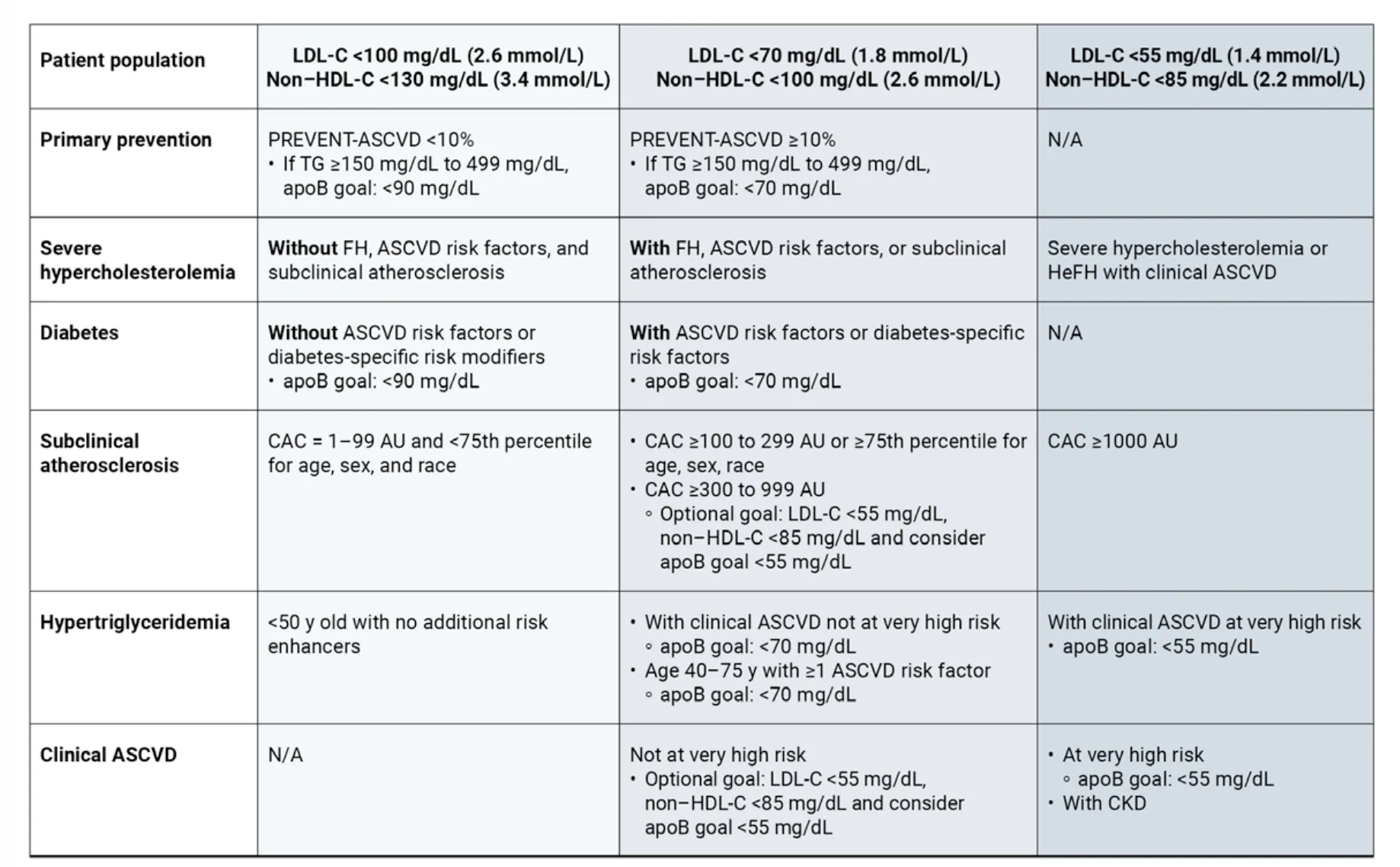 Normal cholesterol levels chart. This chart defines three buckets of normal cholesterol levels (<100, <70, <55) and criteria for who should be in each bucket. Source: 2026 AHA/ACC guidelines.
For example, somebody who has never had a previous heart attack should use the PREVENT equations to calculate their risk of heart disease. If it’s less than 10%, then the LDL target is <100 mg/dL. If higher than 10%, it’s 70 mg/dL. Other factors at play include the results of a CAC scan (cardiac imaging that measures the amount of calcium in your arteries), conditions like diabetes, or family history.
Normal cholesterol levels in mmol/L
Some cholesterol tests measure the number of particles in units of mmol/L. A normal cholesterol level is either <2.6 mmol/L, <1.8 mmol/L, or <1.4 mmol/L (using the same categories above).
ApoB target levels
In addition to providing LDL targets, the AHA/ACC guidelines also give targets in terms of ApoB: <90, <70, or <55 mg/dL. ApoB is more accurate than LDL cholesterol for measuring risk of heart disease, so we usually recommend setting an ApoB target. Among Empirical Health patients, we’ve found ApoB and LDL disagree 11% of the time.
Do normal cholesterol levels for men vs women vary?
Nrmal cholesterol levels use the same clinical cutoffs for both men and women. This means that targets like an LDL-C of <100 mg/dL applies equally regardless of sex.
That said, some important sex-specific factors can influence cholesterol levels and risk for heart disease. Men typically have higher LDL-C and lower HDL-C than women, and develop heart disease about a decade earlier—partly due to hormonal differences (testosterone tends to raise LDL and lower HDL). For women, estrogen provides a protective effect before menopause, resulting in higher HDL and lower LDL. After menopause, cholesterol patterns shift (LDL often rises 10–20%, HDL may fall), and cardiovascular risk increases. Other considerations: cholesterol typically rises during pregnancy and returns to baseline postpartum, and both men and women should be aware of their Lp(a) levels, since elevated Lp(a) is genetic and not sex-specific. Because men’s lifetime risk accumulates earlier, guidelines note that men often benefit from earlier statin therapy.
Why “normal” may not be optimal
Standard lipid panel ranges define “normal” based on population averages. But population-average cholesterol levels aren’t necessarily healthy since heart disease is still the leading cause of death. Among Empirical Health patients, 61% have an LDL level above the guideline-recommended targets.
As Dr. Steven Nissen of the Cleveland Clinic explained: “We’ve known for some time that the time-averaged LDL over your lifetime is one of the strongest predictors of cardiovascular disease.” The 2026 AHA/ACC guidelines reflect a shift toward more aggressive targets:
- LDL-C < 70 mg/dL for patients at elevated risk (diabetes, family history, elevated Lp(a), or high coronary artery calcium scores)
- LDL-C < 55 mg/dL for patients with established cardiovascular disease
- ApoB measurement is now recommended alongside LDL-C, because ApoB is a more accurate predictor of cardiovascular risk than LDL-C alone
Beyond LDL: biomarkers the 2026 guidelines now emphasize
The 2026 AHA/ACC guidelines now emphasize several advanced markers that go beyond the standard lipid panel. ApoB is recommended because ApoB reflects the total number of atherogenic particles. Testing Lp(a) has become a Class 1 (strongest) recommendation. Since Lp(a) levels are determined genetically and don’t fluctuate with lifestyle, a single test can reveal your lifetime risk. The guidelines also include hsCRP (high-sensitivity C-reactive protein), a marker of inflammation that independently predicts heart disease risk (a factor standard cholesterol tests don’t measure).
Get your free 30-day heart health guide
Evidence-based steps to optimize your heart health.