For decades, confirming Alzheimer’s required a PET scan costing thousands of dollars or a lumbar puncture. Most people got neither. In a 2024 primary care study, doctors correctly identified Alzheimer’s 61% of the time. A blood test for p-tau 217 was right 91% of the time.
This post explains what p-tau 217 measures, how it compares with other Alzheimer’s biomarkers, who should get tested, and how to order a test in 2026.
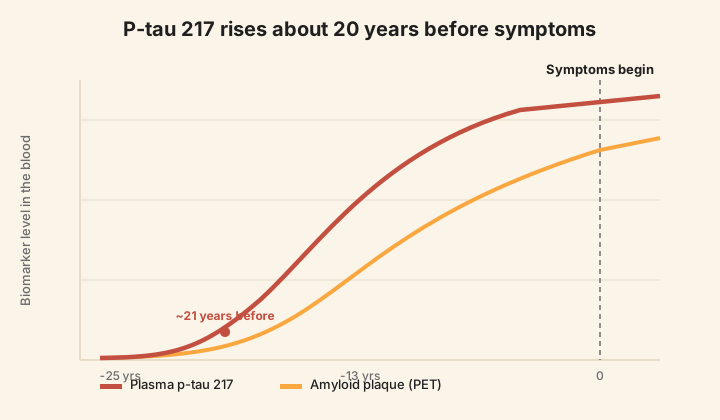 Plasma p-tau 217 starts climbing about two decades before symptoms, tracking the disease earlier than most markers.
What is p-tau 217?
Tau is a protein that supports the internal structure of neurons. The “217” refers to threonine at position 217, where a phosphate group can attach. In Alzheimer’s, tau becomes over-phosphorylated and clumps into neurofibrillary tangles, one of the disease’s two defining pathologies.
P-tau 217 reflects both defining pathologies of Alzheimer’s. Amyloid plaques build up first, prompting neurons to release phosphorylated tau before tangles spread. One study found that p-tau 217 statistically accounted for 60% of the relationship between amyloid plaque density and tau tangle density.
The 2024 Alzheimer’s Association criteria place an accurate plasma p-tau 217 test in the same “Core 1” tier as amyloid PET and spinal-fluid tests. An abnormal Core 1 biomarker strongly predicts that both plaques and tangles will be found at autopsy.
Why p-tau 217 beats other Alzheimer’s blood tests
P-tau 217 has a cleaner signal than other Alzheimer’s blood markers. Its level is roughly three to four times higher in people with Alzheimer’s pathology than in people without it. The blood Aβ42/40 ratio, a direct measure of amyloid, differs by only about 1.2 times. A larger gap means less overlap and fewer ambiguous results.
| Blood marker | What it reflects | Fold-change (positive vs negative) |
|---|---|---|
| P-tau 217 | Amyloid-driven tau, the AD cascade | ~2.9–3.8x |
| P-tau 217 / Aβ42 ratio | Same, with amyloid normalization | ~4.6x |
| P-tau 181 | Same idea, weaker signal | smaller range |
| GFAP | Astrocyte activation (not AD-specific) | non-specific |
| Neurofilament light (NfL) | General nerve injury (not AD-specific) | non-specific |
| Aβ42/40 ratio | Amyloid plaque burden | ~1.2x |
Sources: fold-change comparison, head-to-head marker study.
GFAP and NfL rise in Alzheimer’s, but also after head injury and in conditions such as multiple sclerosis and ALS. They measure nerve injury without identifying its cause. In a head-to-head study of 786 people, p-tau 217 alone, or combined with age, sex, and APOE status, outperformed p-tau 181, p-tau 231, GFAP, NfL, and the amyloid ratio.
How accurate is the p-tau 217 test?
Plasma p-tau 217 reaches an AUC of about 0.94 to 0.97 for detecting Alzheimer’s pathology, similar to spinal-fluid tests. An AUC of 1.0 is perfect; 0.5 is no better than chance.
| Study | What it measured | Result |
|---|---|---|
| Palmqvist, JAMA 2020 | AD vs other neurodegenerative disease | AUC 0.96 |
| Ashton, JAMA Neurology 2024 | Elevated amyloid on PET | AUC 0.92–0.96 |
| Pilotto, Brain 2024 | AD vs controls (two assays) | AUC ~0.94 |
| Palmqvist, JAMA 2024 | Symptomatic patients in clinic | ~91% accuracy |
The 2024 JAMA study tested 1,213 Swedish patients with memory complaints in primary care and specialty clinics. Using their usual workup, primary-care doctors diagnosed Alzheimer’s correctly 61% of the time and dementia specialists 73% of the time. The blood test was correct 91% of the time in both settings.
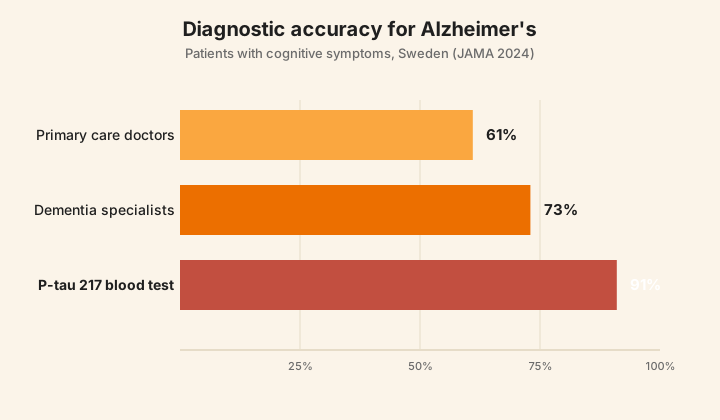 In the 2024 JAMA primary-care study, the blood test outperformed both generalists and specialists.
In families with inherited Alzheimer’s, where researchers can estimate when symptoms will start, p-tau 217 in spinal fluid began rising about 21 years before symptoms, earlier than amyloid appeared on PET scans.
Is there an FDA-approved Alzheimer’s blood test?
The FDA cleared the first Alzheimer’s blood test in May 2025: Fujirebio’s Lumipulse G pTau217/β-Amyloid 1-42 Plasma Ratio. It’s for adults 55 and older with signs of cognitive decline, not for screening healthy people. The test agreed with PET or spinal-fluid results about 92% of the time when positive and 97% when negative. Roughly 20% of results fell into an indeterminate range requiring confirmation.
Most p-tau 217 testing still runs through lab-developed tests, which are validated by the lab under CLIA rules rather than cleared by the FDA. The notable ones:
| Test | Company | Status |
|---|---|---|
| Lumipulse pTau217/Aβ42 ratio | Fujirebio | FDA-cleared (May 2025) |
| PrecivityAD2 | C2N Diagnostics | Lab-developed test |
| AD-Detect p-tau 217 | Quest Diagnostics | Lab-developed test |
| p-tau 217 | Labcorp | Lab-developed test |
| pTau217 (Simoa) | ALZpath | FDA Breakthrough designation |
A separate Roche test cleared in October 2025 measures p-tau 181, not 217. Roche’s p-tau 217 test is approved in Europe but not in the U.S. The results in this post apply specifically to p-tau 217.
What experts say about p-tau 217
Researchers broadly agree that p-tau 217 detects Alzheimer’s pathology accurately. They disagree about testing people without symptoms.
Oskar Hansson, who led much of the validation work, says p-tau 217 could complement cognitive screening in memory clinics without access to PET or spinal-fluid testing. UCSF neurologist Adam Boxer said it would make diagnosis much easier.
Eric Topol objects to labeling an asymptomatic person with an elevated result as having “Stage 1 Alzheimer’s” and doesn’t expect these biomarkers to help people at low risk. Suzanne Schindler at WashU emphasizes assay quality: some blood tests are accurate and others aren’t. In her studies, p-tau 217 tests met the 90% accuracy standard of approved spinal-fluid tests, while several other blood markers didn’t.
The 2025 Alzheimer’s Association clinical guideline recommends blood biomarkers for patients with objective cognitive impairment who are being evaluated by a trained clinician. It doesn’t recommend screening healthy adults.
Why early Alzheimer’s diagnosis matters more now
An Alzheimer’s diagnosis now can change treatment. The FDA approved the anti-amyloid antibodies lecanemab in 2023 and donanemab in 2024 for early-stage disease. Both require confirmed amyloid pathology, which previously meant a PET scan or lumbar puncture. A blood test can make that confirmation easier. These drugs can cause brain swelling and bleeding, so treatment decisions belong with a neurologist.
How to get a p-tau 217 test
A primary-care physician or neurologist can order p-tau 217 through Quest or Labcorp, use the FDA-cleared Fujirebio test, or order C2N’s PrecivityAD2. Testing is most appropriate when a clinician is evaluating cognitive symptoms. Out-of-pocket prices range from about $300 to $1,450, and insurance and Medicare coverage remains limited. Ask about the price before testing.
Before testing, consider four limits:
- The test supports a diagnosis; it doesn’t make one alone. A positive result in someone without symptoms doesn’t predict whether or when symptoms will begin.
- Kidney function can skew the result. Reduced kidney function (low eGFR) raises p-tau 217 and can cause false positives. In one analysis, the standard cutoff was only about 48% accurate in people with significant kidney impairment. Clinicians should interpret p-tau 217 alongside eGFR.
- The direct-to-consumer version is different. The test Quest sells directly to consumers without a doctor measures the amyloid ratio, not p-tau 217, and experts have criticized its use in healthy people, where most positives would be false.
- Decide how you’d use the result. Federal law (GINA) protects against genetic discrimination in health insurance and employment, but not in life, long-term-care, or disability insurance. An early result may help with treatment and planning, but can also cause anxiety when no clear action follows.
For people with memory symptoms, p-tau 217 can detect Alzheimer’s pathology about as accurately as PET or spinal-fluid tests. For healthy people without cognitive impairment, clinical guidelines don’t recommend testing yet.
Get your free 30-day heart health guide
Evidence-based steps to optimize your heart health.