Traditionally, the only way to know your Alzheimer’s risk was a spinal tap, a PET scan, or waiting for symptoms. A new blood biomarker called p-tau217 detect signs of Alzheimer’s before symptoms even start.
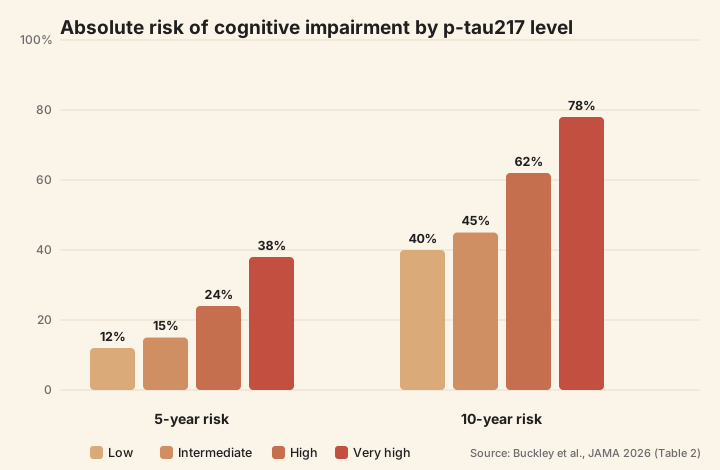
However, current medical guidelines advise against testing p-tau217 in people who feel fine since a positive result has no clear meaning for someone without symptoms. A July 2026 JAMA study is starting to fill the evidence gap and might be a first step to recommending more screening. Across 2,684 adults followed for up to 13.5 years, people with very high p-tau217 had a 38% chance of progressing to cognitive impairment within 5 years, versus 12% for those with low levels.
This article covers what p-tau217 is, how elevated p-tau217 raises your Alzheimer’s risk, and the currnet limits of testing someone who has no symptoms.
What is p-tau217?
P-tau217 is a form of the tau protein that’s been phosphorylated at position 217.
That’s a mouthful! So let’s step back a bit. Tau normally helps hold the internal scaffolding of neurons together. In Alzheimer’s disease, tau gets chemically modified and starts to misbehave. Phosphorylation at threonine 217 is one of the earliest of those changes associated with Alzeimer’s. Here’s what the structure looks like:
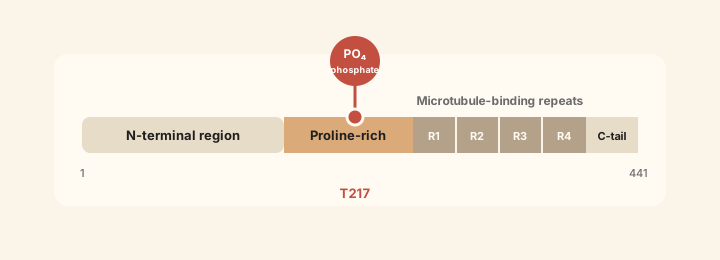 P-tau217 structure. This is a rough schematic. Redrawn from this source.
P-tau217 can be detected well before any memory problems appear and can be measured from an ordinary blood draw.
How much does high p-tau217 raise your risk of Alzheimer’s?
Each standard-deviation increase in p-tau217 is associated with a 38% higher risk of progressing to cognitive impairment (hazard ratio 1.38, 95% CI 1.30 to 1.46). Surprisingly, the association holds even after adjusting for amyloid PET, the current reference standard for brain amyloid. This suggests p-tau217 has prognostic information beyond amyloids alone.
People with very high ptau217 levels had 4.7 times the risk of Alzeimer’s disease (vs those in the low group).
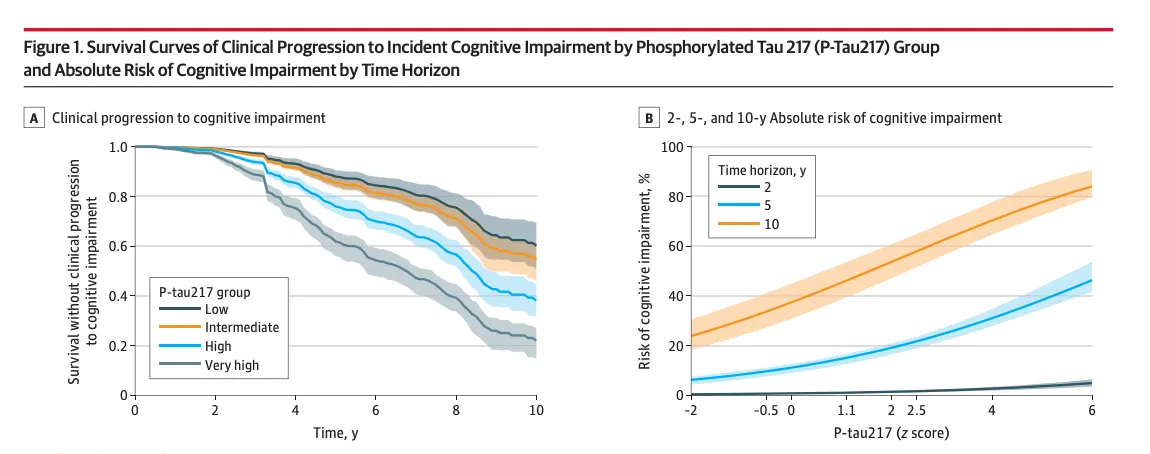 Over 10 years, the very high p-tau217 group (light blue) drops toward a 1-in-4 chance of staying cognitively healthy, while the low group (dark) stays near 6 in 10. Panel B: modeled absolute risk climbs steeply with p-tau217 at every time horizon. Source: JAMA 2026.
5-year and 10-year risk of cognitive impairment by p-tau217 level
What’s your absolute risk, given a p-tau217 level? Over 2 years, risk was low for everyone (1% to 4%). The groups pull apart at 5-10 years:
| P-tau217 level | 5-year risk | 10-year risk |
|---|---|---|
| Low | 12% | 40% |
| Intermediate | 15% | 45% |
| High | 24% | 62% |
| Very high | 38% | 78% |
Sex affects the interpretatio of p-tau217 numbers. In the very high group, men had a 43% risk and women 36%, and older baseline age raised absolute risk at every level.
What counts as a “high” p-tau217 level?
The study didn’t use a single universal cutoff. It sorted people into four groups by how far their p-tau217 sat from the average, anchored to matching amyloid PET thresholds:
| Group | p-tau217 (standard deviations) | Approximate amyloid PET |
|---|---|---|
| Low | below -0.5 SD | under ~10 Centiloids |
| Intermediate | -0.5 to 1.1 SD | ~10 to 24 Centiloids |
| High | 1.1 to 2.5 SD | ~25 to 60 Centiloids |
| Very high | above 2.5 SD | above ~60 Centiloids |
The reason the paper works in standard deviations rather than a specific number (in pg/mL) is that different labs run different p-tau217 assays that don’t share a common scale yet. Harmonizing those assays into one clinically usable cutoff is one of the open problems the authors flag.
Should cognitively healthy people get p-tau217 tested?
The study is pretty careful about not to recommend universal p-tau217 testing; the science is close but not quite there.
But, we now know that ptau217 has prognostic signal in symptom-free people, the groundwork for eventually using it in prevention trials and personalized risk scores. You can think about it similarly to ApoB or Lp(a): as the evidence builds up for this biomarker, and as we get interventions that let you do something about it, the balance shifts toward screening. The science isn’t quite there yet, but it might be soon.
Get your free 30-day heart health guide
Evidence-based steps to optimize your heart health.