If you see Medicare patients, the ACCESS model gives you a new option for 2/3 of your patients. Most patients with high blood pressure, cholesterol, diabetes or prediabetes, or established cardiovascular disease qualify.
ACCESS pays a separate organization to co-manage those conditions, and pays that organization based on whether the patient’s numbers actually improve. You keep the relationship, and Medicare pays clinicians a co-management fee.
This post is for referring clinicians. It covers what ACCESS is, which of your patients are eligible, how the referral works, and what it costs your patients (often $0).
What is the Medicare ACCESS model?
ACCESS (Advancing Chronic Care with Effective, Scalable Solutions) is a CMS Innovation Center model that launches July 5, 2026. ACCESS pays technology-enabled organizations to manage chronic conditions using connected devices, virtual visits, and coaching, instead of counting in-person office visits. Payment is outcomes-based: it’s tied to whether the patient’s measures improve, not to the volume of services.
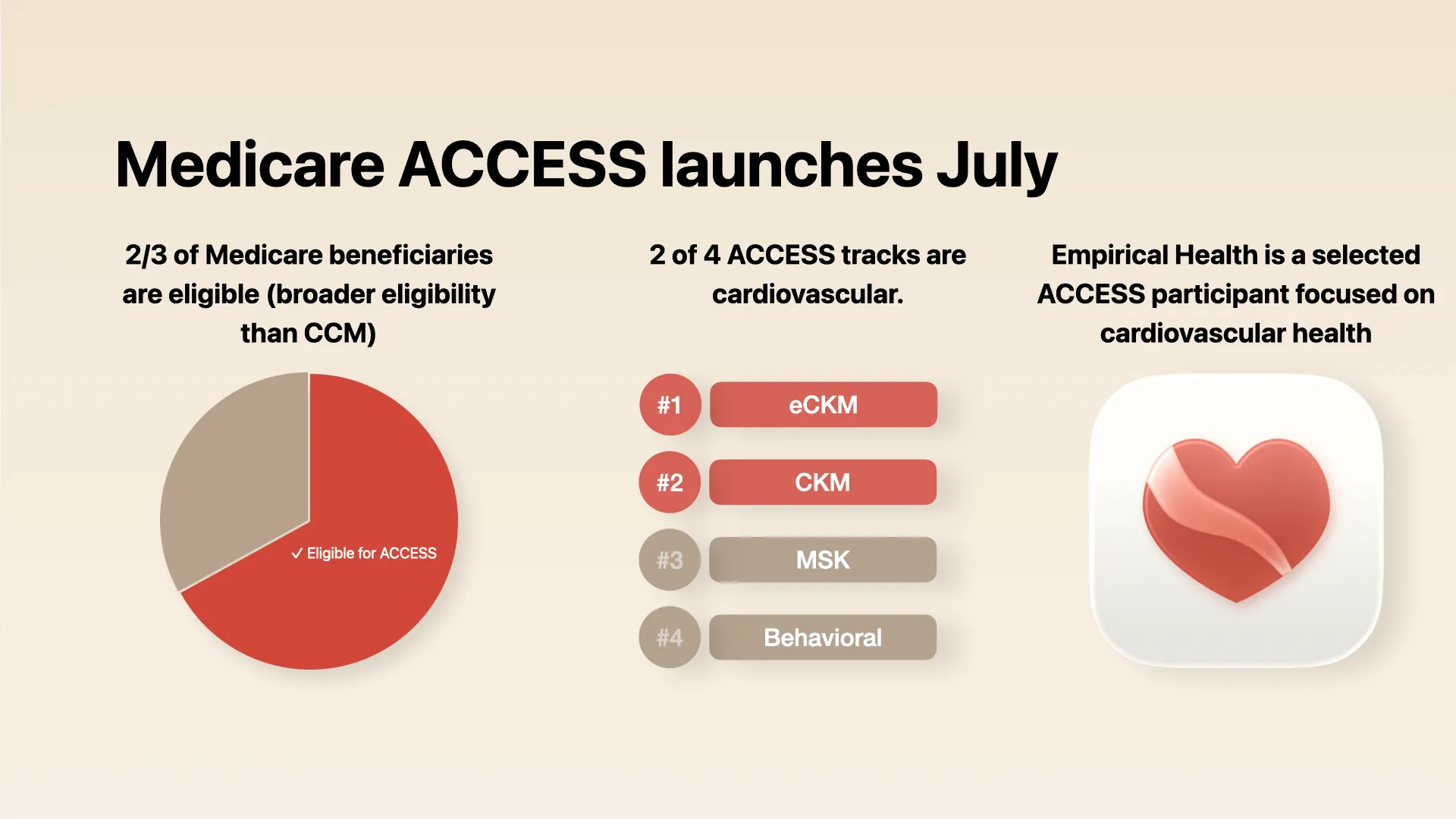 Two-thirds of Medicare beneficiaries are eligible. Two of the four ACCESS tracks are cardiovascular.
A few things make ACCESS different from how Medicare usually pays:
- Outcomes-based pricing. Participating organizations are paid in part on whether biomarkers and disease control improve.
- Four clinical tracks. Two are cardiovascular (eCKM and CKM), one is musculoskeletal (MSK), and one is behavioral health (BH).
- $0 copays in some cases. CMS allows participants to waive cost-sharing, so the co-management services can be free to the patient.
- Referral, not participation, for FFS providers. Fee-for-service Medicare providers can’t enroll in or bill the model directly, but they can refer eligible patients to a participant and bill a co-management payment to Medicare.
Two thirds of Medicare patients are eligible for ACCESS
The two cardiovascular tracks, eCKM and CKM, reach patients earlier than traditional Chronic Care Management (CCM). CCM requires two or more established chronic conditions. ACCESS qualifies patients on a single early risk factor like hypertension, so about two in three Medicare beneficiaries are eligible.
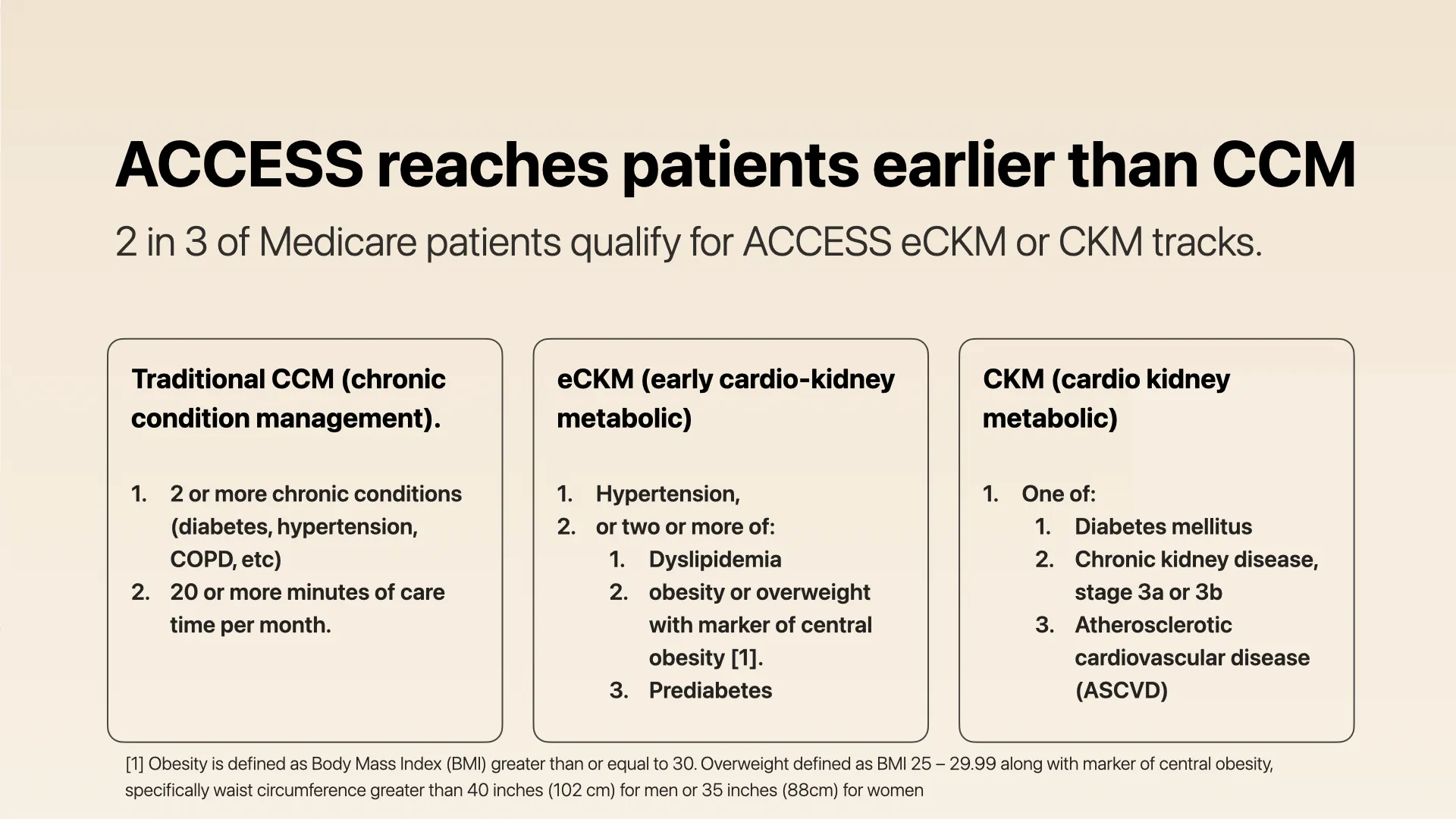 Traditional CCM needs two or more chronic conditions. The eCKM track qualifies a patient on hypertension alone, so it reaches people earlier.
Patients must be on Original (fee-for-service) Medicare and meet the criteria for one of the cardiovascular tracks:
| Track | Qualifying conditions |
|---|---|
| eCKM (early cardio-kidney-metabolic) | Hypertension, or two or more of: dyslipidemia, overweight or obesity with a marker of central obesity, prediabetes |
| CKM (cardio-kidney-metabolic) | One of: type 2 diabetes, chronic kidney disease (stage 3a or 3b), or atherosclerotic cardiovascular disease (ASCVD) |
Obesity here means a BMI of 30 or above. Overweight means a BMI of 25 to 29.9 plus a marker of central obesity (waist circumference over 40 inches for men or 35 inches for women). A single organization can manage conditions across both tracks, so a patient with hypertension and type 2 diabetes can be covered for both.
How does an ACCESS referral work?
Providers don’t have to enroll in ACCESS to refer. Fee-for-service providers stay outside the model and keep their patient relationship. You identify an eligible beneficiary and refer them to an ACCESS participant, who does the day-to-day co-management.
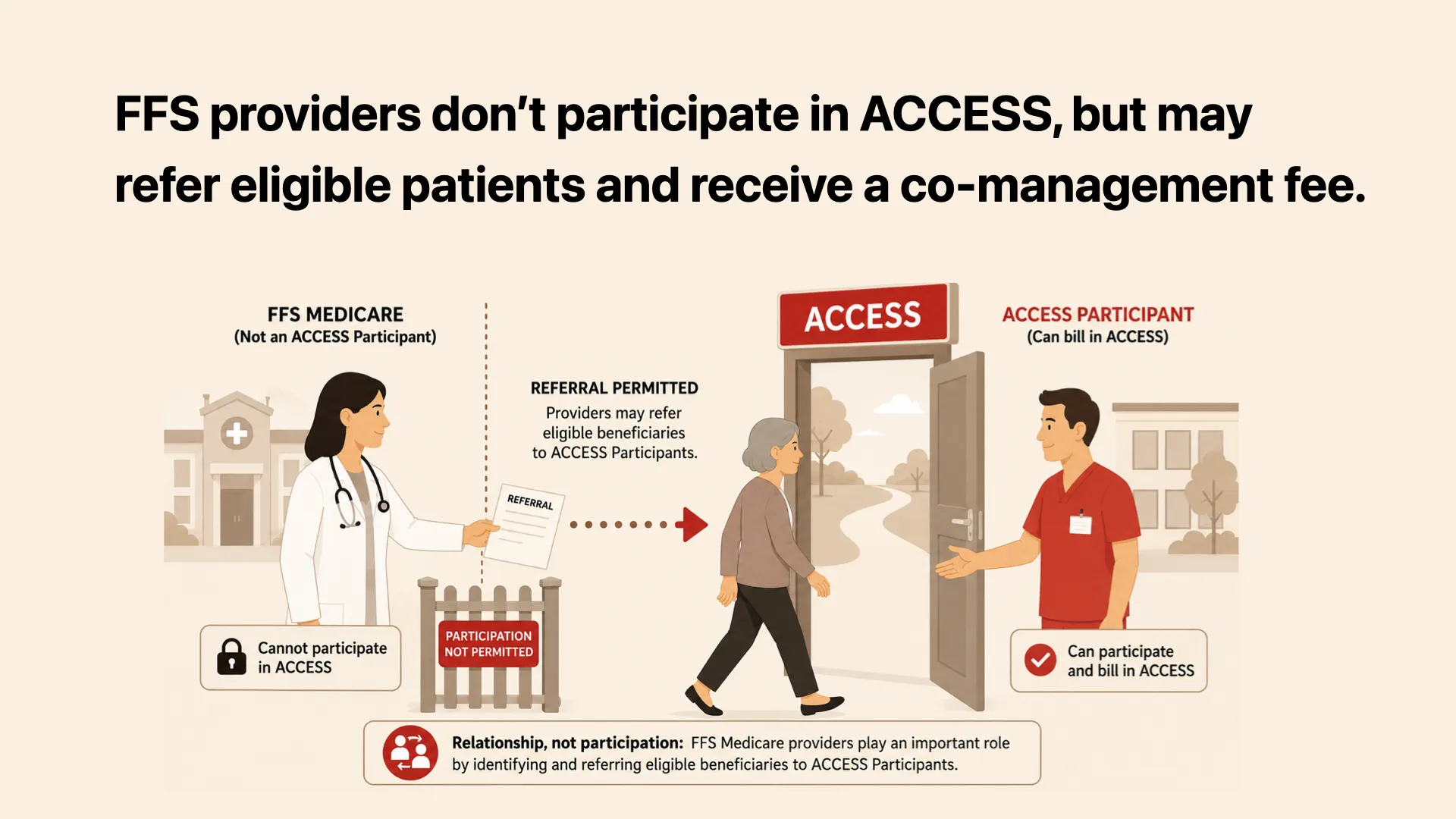 FFS Medicare providers can’t bill ACCESS directly. They refer eligible patients to an ACCESS participant and keep the relationship.
The participant shares clinical data back to you at three points: care initiation (the care plan and baseline measures), care escalation (if clinical needs change or care is transitioned), and care completion (a summary at the end of the care period). That data lands in your EHR workflow through the CMS Aligned Network or a Health Information Exchange.
What you can bill: the co-management payment
For care updates you review and act on, you can bill a Co-Management Payment (CMP) directly to Medicare, up to four times per year. Enrollment in ACCESS isn’t required for this. The co-management payment is a standard part of Original Medicare.
How much does ACCESS cost the patient?
With some participants, including Empirical Health, the patient’s copay is $0. CMS created a patient-incentive safe harbor that lets participants waive cost-sharing for ACCESS co-management services, so there are no copays and no deductibles for the services those participants deliver. Cost is a known barrier to staying engaged with chronic care, and ACCESS is built on continuous engagement, so removing that friction is the point.
Referral cheat sheet
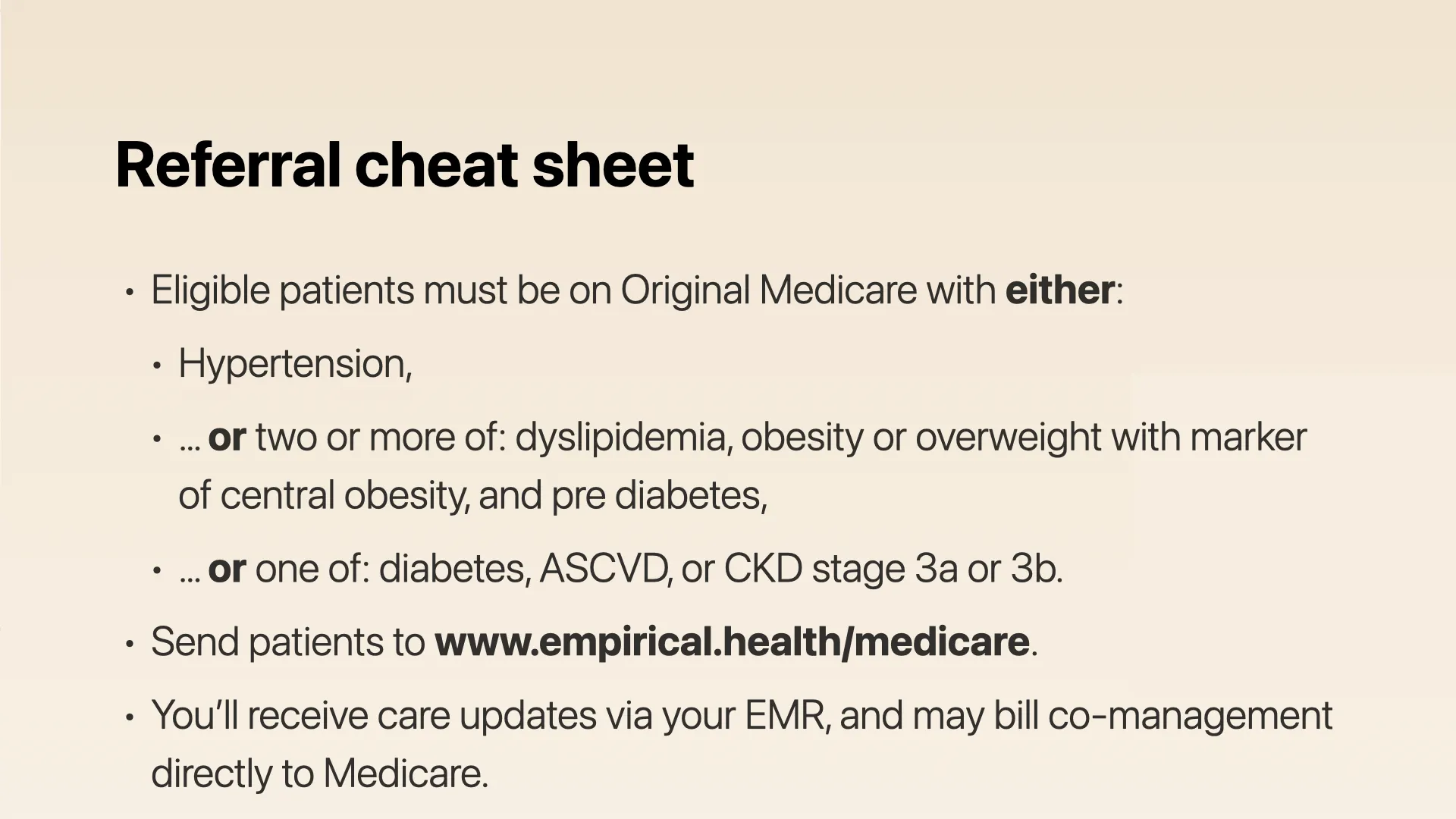
- Eligible patients must be on Original Medicare with either:
- Hypertension,
- or two or more of: dyslipidemia, overweight or obesity with a marker of central obesity, and prediabetes,
- or one of: diabetes, ASCVD, or CKD stage 3a or 3b.
- Send patients to empirical.health/medicare.
- You’ll receive care updates via your EMR, and may bill co-management directly to Medicare.
See also our patient-facing guide to the ACCESS cardiovascular model, part of our series on Medicare coverage for cardiovascular health.
Get your free 30-day heart health guide
Evidence-based steps to optimize your heart health.