An optical heart sensor has to distinguish your pulse from the movement of your wrist. On a bicycle or under a barbell, that gets harder. Measuring all day adds another constraint: battery life.
Apple redesigned the sensors on Series 12 and Ultra 4 to support background heart rate readings every five seconds. Below, we’ll examine the new layout, the applications it enables, and Apple’s accuracy study against six competing wearables.
How does the new Apple Watch heart rate monitor work?
Apple’s Health Sensing System combines the new optical heart sensor with a second-generation electrical heart sensor, blood oxygen sensing, and temperature sensing. The specifications call the optical sensor “always-on.”

The new sensor assembly on Apple Watch Series 12. Source: Apple’s September 2026 announcement.
Apple describes three hardware changes in its September keynote, around 37:36:
| Component | New layout or design | Purpose |
|---|---|---|
| Green LEDs | Larger and more power-efficient | Support frequent readings during movement |
| Photodiodes | Light detectors arranged in a ring | Collect reflected light more efficiently |
| Electrodes | More surface area within the same footprint | Improve skin contact during ECG readings |
The LEDs shine light into the wrist; photodiodes measure how much returns. Blood absorbs light, so each pulse changes the reflected signal. This is photoplethysmography, or PPG.
Movement also changes the signal by shifting the watch against the skin. The redesign aims to collect a clearer pulse signal while limiting power use.
The electrodes record electrical activity. Touching the Digital Crown closes a circuit across the arms and chest for an ECG recording.
Does Apple Watch measure heart rate continuously?
Apple reports 60 times more frequent background heart rate readings and 24 times more frequent heart rate variability (HRV) measurements than Series 11. The interval depends on which data you’re looking at:
| Measurement or record | Reported interval |
|---|---|
| Background heart rate shown on the watch | Every 5 seconds |
| Background heart rate written to HealthKit | Every 30 seconds |
| HRV measurement | As often as every 5 minutes |
Apple’s accuracy study explains that background readings are saved to HealthKit every 30 seconds to manage memory. Apps reading those records won’t receive every five-second value shown on the watch.
The optical sensor samples much faster than the display updates: Apple’s sensor explanation describes LEDs flashing hundreds of times per second to detect the pulse.
An HRV update every five minutes also doesn’t specify how long each recording lasts. Recording duration affects the result, so update frequency alone can’t tell us whether two HRV measurements are comparable.
What features use Apple Watch heart rate data?
Apple’s health announcement connects the measurements to six applications:
| Application | How it uses the measurements |
|---|---|
| Heart Rate app and complications | More frequent views of heart rate throughout the day |
| Recovery HRV | Variability intended to reflect stress and recovery |
| Overall HRV | Variability for broader health insights |
| Vitals | Recovery HRV against a personal baseline, plus a daytime view |
| Readiness | A 0–10 score combining recent activity, vitals, and sleep |
| Health Age | An age score that can use resting heart rate, HRV, and other inputs |
Readiness updates throughout the day. Health Age arrives with the redesigned Health app later in 2026 and has its own compatibility requirements.
Earlier watches already measured continuously during workouts and briefly afterward. Denser background readings could capture an unlogged walk or show when a racing heart starts and settles. Our continuous heart rate guide explores these potential applications.
How accurate is the Apple Watch Series 12 heart rate monitor?
Apple’s September 2026 study enrolled 1,460 adults; 1,254 contributed usable paired measurements. Participants wore Series 12 alongside another wearable, with a Polar H10 ECG chest strap as reference. Wrist assignment was randomized.
The six competitors were Garmin Forerunner 970, Pixel Watch 4, Huawei Watch 5, Galaxy Watch 8, WHOOP 5, and Oura Ring 5. Testing covered workouts and everyday activities.
Series 12 had significantly lower overall mean absolute error (MAE) and root mean square error (RMSE) than all six competitors in both settings. Session-average accuracy favored Apple significantly in 11 of 12 comparisons; the workout comparison with Huawei was inconclusive.
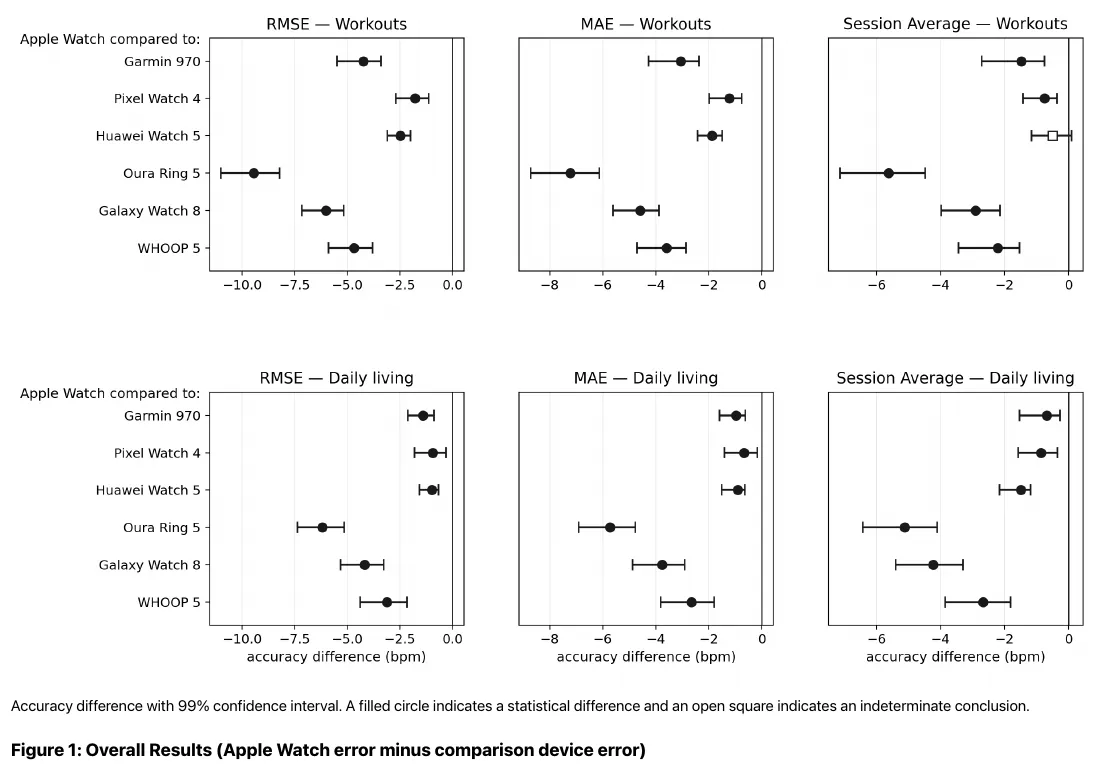
Figure 1 from Apple’s accuracy study. Points show differences in error; bars show 99% confidence intervals. Image credit: Apple.
MAE measures the average size of errors; RMSE gives more weight to large mistakes. Session averages measure whether the mean heart rate over an activity is correct. A device could get that average right while missing a short spike.
The chart shows differences in error. For example, if Apple had an MAE of 2 bpm and a competitor had 5 bpm, the plotted difference would be −3 bpm. That would mean Apple’s error was 3 bpm smaller.
What are the limits of Apple’s heart rate accuracy study?
The study compares finished products, combining hardware and algorithms. It doesn’t isolate the sensor redesign or compare Series 12 with Series 11, so it can’t quantify the improvement over the previous generation.
The error differences also don’t establish what percentage of Series 12 readings fall within 5 bpm of the reference.
The protocol used short, supervised sessions. It excluded beta-blocker users, people with exercise contraindications, and those with tattoos or large moles beneath the devices. Results may differ during unsupervised wear or in those populations.
Results varied by activity: Pixel Watch 4 was slightly more accurate at rest, and its cycling comparison with Apple was inconclusive.
The study tests heart rate accuracy. HRV depends on beat-to-beat timing; ECG interpretation and scores such as Readiness and Health Age require their own validation.
Which Apple Watches have the 4th-generation heart rate sensor?
The new Health Sensing System is built into Series 12 and Ultra 4. The redesigned LEDs, photodiodes, and electrodes require one of these models.
Get your free 30-day heart health guide
Evidence-based steps to optimize your heart health.