Apple’s documentation describes three different algorithms to measure heart rate: foreground, background, and tachogram. The watch picks between them depending on whether you’re working out, going about your day, or sitting still while it checks your rhythm.
No single algorithm is best at everything. Measuring heart rate from light involves tradeoff between power draw, frequency of measurement, and fidelity of beat-to-beat measurements. A method that works while you run drains the battery. A method that uses little power struggles when you’re in motion.
In this post, we’ll break down the three algorithms (foreground, background, and tachogram), the optical hardware sensor they run on, and how the Apple Watch’s heart rate algorithm shifted shifted from hand-tuned signal processing to a neural network.
How Apple Watch’s optical heart rate sensor works
The Apple Watch shines LED light through your skin and measures what reflects back off your blood with an array of photodiodes. This is called photoplethysmography, or PPG. As your heart beats, blood volume in your wrist rises and falls, and the reflected light changes with it.
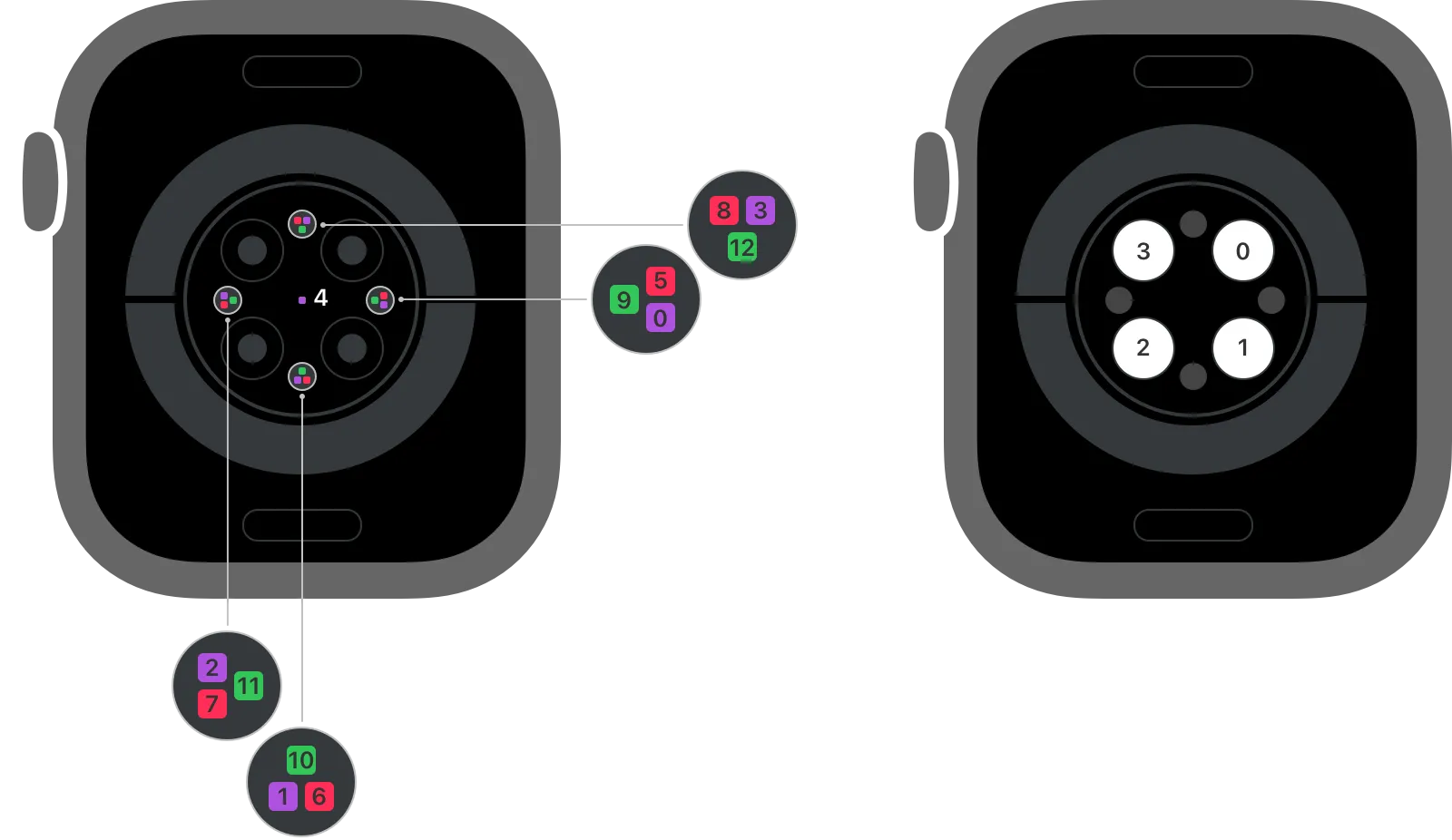 Apple Watch uses green, infrared, and red light. Green and infrared measure pulse; red measures blood oxygen.
The heart rate sensor uses three wavelengths: green (525 nm), infrared (850 to 940 nm), and red (660 nm). Green and infrared measure your pulse. Red measures blood oxygen. The choice of which light to use is the first thing that separates the three algorithms.
The three Apple Watch heart rate algorithms
The three Apple Watch heart rate algorithms are foreground, background, and tachogram. Apple detailed them in a 2024 white paper. The behavior and accuracy figures below describe that earlier system, before the fourth-generation sensor announced September 9, 2026. Let’s go through each one.
Foreground algorithm
The foreground algorithm runs when you open the Heart Rate app or start a workout. It uses bright green LEDs, and aims for one reading roughly every five seconds. Green light is the most accurate choice during motion because it is absorbed strongly by blood and is less sensitive to movement than infrared. In that earlier system, the power cost limited this frequent sampling to foreground use. It is accurate to within 5 bpm about 98% of the time at rest, and within 5 bpm about 87% of the time during exercise.
Background algorithm
The background algorithm runs throughout the day when you are not actively looking at your heart rate. It uses infrared light instead of green. Infrared draws less power, which is why it is the right choice for all-day monitoring. The tradeoff is accuracy under movement, so the background algorithm is accurate to within 5 bpm about 89% of the time, and within 10 bpm about 98% of the time. The watch also leans on the accelerometer to discard readings taken while you move, then fills in around them.
Tachogram algorithm
The tachogram is the most precise of the three, but it only runs while you are still. It uses green PPG to capture the exact timing between consecutive beats rather than just a rate.
That beat-to-beat timing is what heart rate variability (HRV) is built from, and it is what feeds irregular rhythm notifications. Tachograms are within 5 bpm of the truth 99.6% of the time in normal rhythm, and 95% of the time during atrial fibrillation (Apple arrhythmia detection). The previously documented cadence was every four hours by default, every two hours with irregular rhythm notifications, or every 15 minutes with AFib History. The fourth-generation sensor now enables HRV measurements every five minutes; that does not establish an identical change to rhythm-detection cadence.
From a heart rate path optimizer to a neural network
The original Apple Watch heart rate algorithm was a hand-engineered “heart rate path optimizer.” HRPO used the accelerometer to suppress motion artifacts, then traced the most probable path of heart rate values through the noisy optical signal, choosing each beat based on the likelihood of the values around it.
With Apple Watch Series 6, Apple introduced a heart rate neural network (HRNN). The heart rate neural network was more accurate: measurements within 10bpm of the truth went from 85% to 97% when Apple replaced the hand-engineered algorithm with a neural network.
Little direct information is available about what type of neural network is used for heart rate estimation (ConvNet, LSTM, etc). However, Apple has subsequently published work on wearable foundation models. In December 2025, Apple researchers showed a foundation model trained on optical sensor data could pull richer cardiac signal from the same sensor than the standard pipeline (9to5Mac, Dec 2025).
Fourth-generation heart rate sensor: more frequent measurements
On September 9, 2026, Apple announced a fourth-generation optical sensor in Series 12 and Ultra 4, with background heart rate readings every 5 seconds and HRV every 5 minutes. Apple also announced HRV in Vitals and a Readiness score. These announcements establish more frequent measurements, but do not identify which of the algorithms above changed or whether the foundation model research is part of the new system.
Why three HR algorithms matter for your health metrics
Each heart rate algorithm produces the inputs for a different set of health metrics on Apple Watch. The background algorithm drives your resting heart rate and all-day trends. The foreground algorithm covers workouts and cardio recovery. The tachogram drives HRV and rhythm detection. Knowing which one produced a number tells you how much to trust it, which is why we wrote a companion post on Apple Watch heart rate accuracy.
Get your free 30-day heart health guide
Evidence-based steps to optimize your heart health.