Finding out you have high Lp(a) can feel like a verdict. Lp(a) is genetic, it’s set by about age 5, statins don’t budge it, and there’s no approved drug exclusively for Lp(a) (yet!). If you get your result and conclude there’s nothing to be done, you’d be forgiven for misunderstanding — but you actually have a lot of options to address high Lp(a).
The 2026 AHA/ACC guidelines recommend people with elevated Lp(a) lower ApoB harder, consider PCSK9 inhibitors, aspirin. And in 2026, there are four trials of Lp(a)-lowering drugs with approvals likely in the next couple of years.
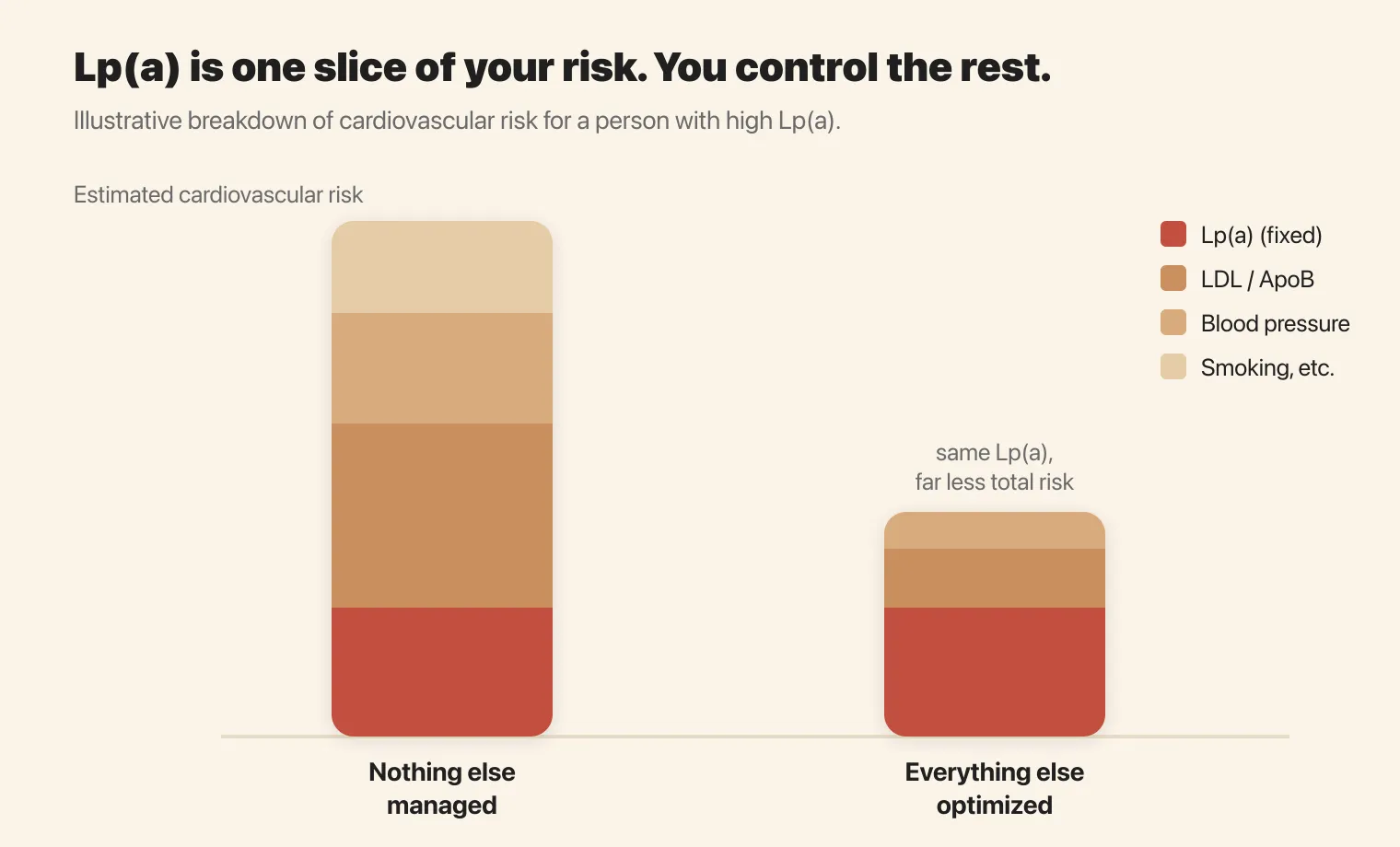 Lp(a) is a one slice of your risk, not a death sentence. Illustrative example; your specific numbers will vary
Lp(a): one risk factor among many which are modifiable
Cardiovascular risk is multiplicative. Lp(a) raises it, but so do LDL, blood pressure, smoking, and diabetes, and they compound. Elevated Lp(a) (≥125 nmol/L, or ≥50 mg/dL) is associated with roughly 1.4-fold higher risk; very high levels (≥250 nmol/L, ~100 mg/dL) with about 2-fold. That’s a meaningful multiplier on your baseline risk, which means shrinking the baseline shrinks the absolute danger that Lp(a) adds.
There’s also a particle-counting way to view this. Lp(a) is an ApoB particle, so it’s already included in your total atherogenic particle burden. Every LDL particle you clear lowers that burden, even though the Lp(a) fraction stays put. That’s why the 2026 AHA/ACC guidelines take elevated Lp(a) as an indication to intensify LDL lowering and manage every other risk factor earlier and harder.
Lower your ApoB and LDL more aggressively
If you have high Lp(a), your LDL and ApoB targets get stricter, and you pursue them sooner. The 2026 AHA/ACC guidelines brought back specific LDL targets. For people at high risk, that generally means getting LDL under 55 mg/dL, and lower still if you already have cardiovascular disease. Several drugs lower LDL without touching Lp(a), and they stack:
| Approach | Typical LDL reduction | Effect on Lp(a) |
|---|---|---|
| High-intensity statin | ~50% | None (may rise slightly) |
| Ezetimibe (added on) | ~15–20% more | None |
| Bempedoic acid | ~15–25% | None |
| PCSK9 inhibitor (added on) | ~60% more | ~25% lower |
None of these change your genetics, but they do change the total particle load hitting your artery walls (which is what actually drives plaque).
Do PCSK9 inhibitors lower Lp(a)?
PCSK9 inhibitors lower Lp(a) by about 25% on top of cutting LDL by roughly 60%. For high-risk or very-high-risk patients on a maximally tolerated statin whose Lp(a) is ≥125 nmol/L (≥50 mg/dL), adding a PCSK9 inhibitor is considered reasonable if on-treatment LDL is still ≥70 mg/dL. The 25% Lp(a) drop is smaller than what the dedicated Lp(a) drugs achieve in trials (up to 94%), but it’s available now, and it comes bundled with a large LDL reduction. Whether it’s right for you is a conversation with your clinician about your overall risk and insurance coverage.
Manage blood pressure, smoking, and diabetes
Unglamorous risk factors matter more when Lp(a) is high, because Lp(a) multiplies whatever risk they create. Bringing blood pressure into range, never smoking, and keeping blood sugar controlled each shrink the baseline that Lp(a) amplifies. None of this is specific to Lp(a), which is exactly the point: with one risk factor locked, you press harder on all the others.
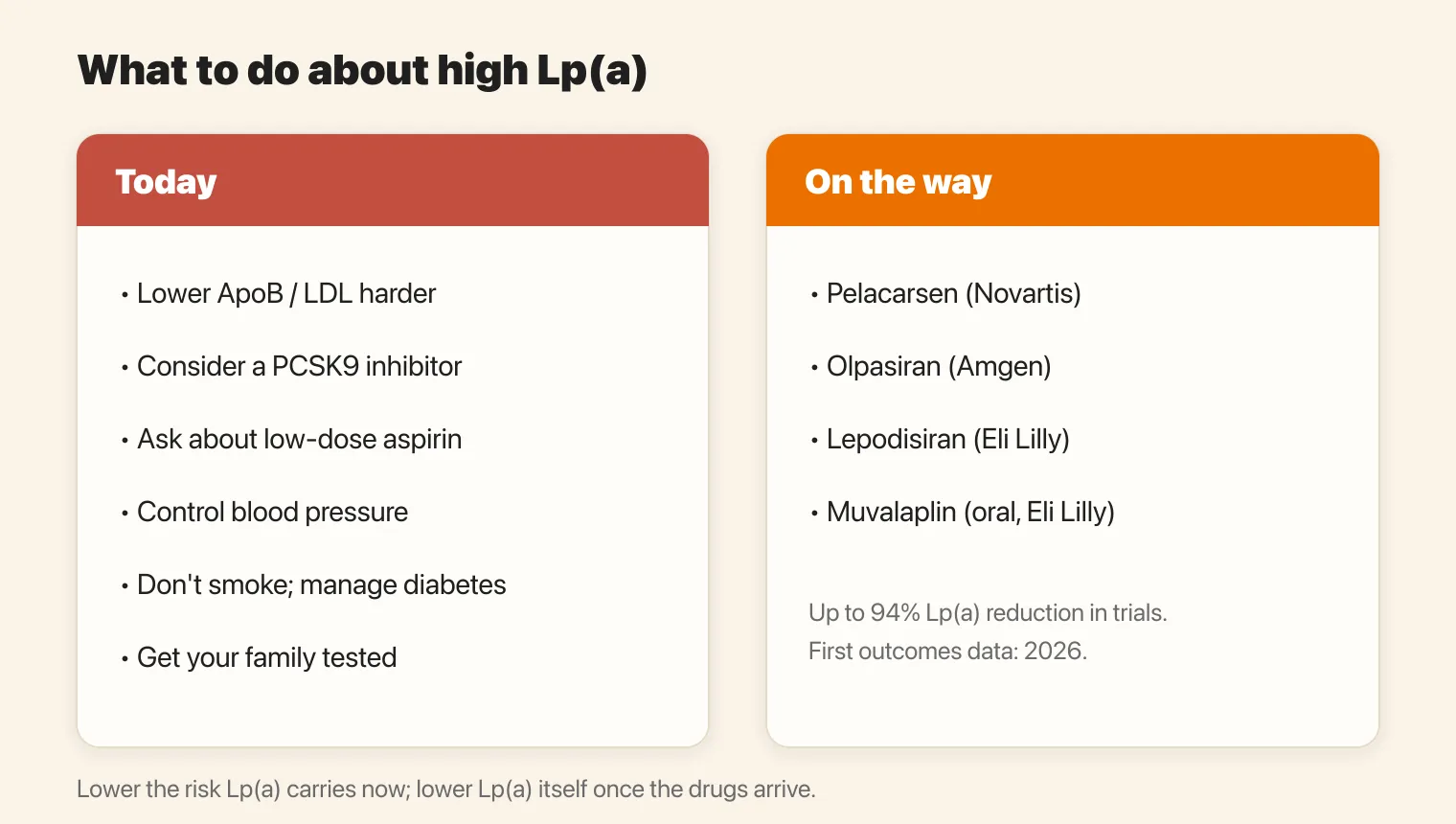 Lower the risk Lp(a) carries now; lower Lp(a) itself once the drugs arrive.
Get your family tested
Lp(a) is inherited, so a high result is a flag for your blood relatives, not just for you. Each first-degree relative (parents, siblings, children) has roughly a 50% chance of also having elevated Lp(a). Cascade screening (testing the family once someone tests high) is how most people with high Lp(a) get found, and many of them have no symptoms until an event. A single test settles it for life, since levels barely change.
Lp(a)-lowering drugs are coming
The reason to get everything else in order now is that the number itself may not be fixed for much longer. Four drugs that lower Lp(a) by up to 94% are in trials: pelacarsen, olpasiran, lepodisiran, and the oral muvalaplin. Novartis’s Lp(a) HORIZON trial has completed follow-up, but no results have been announced as of August 31, 2026. Its eventual readout will be the first real test of whether specifically lowering Lp(a) prevents heart attacks and strokes. We cover all four in Lp(a)-lowering medications.
Knowing your number now means you’re already managing your risk, and ready to act the day those drugs arrive. If you haven’t measured it, our Lipoprotein(a) page covers what counts as high and how to get tested.
Get your free 30-day heart health guide
Evidence-based steps to optimize your heart health.