Lp(a) is the strongest inherited risk factor for heart disease, and about one in five people carry a high level. Most never find out, because a standard cholesterol panel doesn’t measure it. Your Lp(a) is set almost entirely by genetics, so a single test tells you your lifetime risk, and the 2026 AHA/ACC guidelines now recommend that every adult get it once.
This page covers what Lp(a) is, what counts as a high level, whether you can lower it, and how often to test.
Lp(a) at a glance
| Measure | Value |
|---|---|
| Normal level | Below 75 nmol/L (about 30 mg/dL) |
| High risk | Above 125 nmol/L (about 50 mg/dL) |
| Very high | Above 200 nmol/L |
| How common | About 1 in 5 adults |
| Risk when high | 114% higher rate of cardiovascular events above 100 mg/dL (214 nmol/L) |
| Atherogenicity | Roughly 6x ordinary LDL, particle for particle |
| How often to test | Once in a lifetime for most people |
| What moves it | Almost nothing. It’s 80-90% genetic, and statins don’t lower it |
| Who should test | Every adult at least once, per the 2026 AHA/ACC guidelines |
| Cost | About $40 on its own, or $190 with 100+ biomarkers at Empirical |
What is Lp(a) and why does it matter?
Lp(a) is an LDL-like particle wrapped in an extra protein called apolipoprotein(a). That structure lets it do double damage: like LDL it drives plaque, and its tail promotes clotting and inflammation on top. Risk climbs with the level. People with Lp(a) at or above 100 mg/dL (about 214 nmol/L) had more than double the rate of major cardiovascular events compared with those in the normal range.
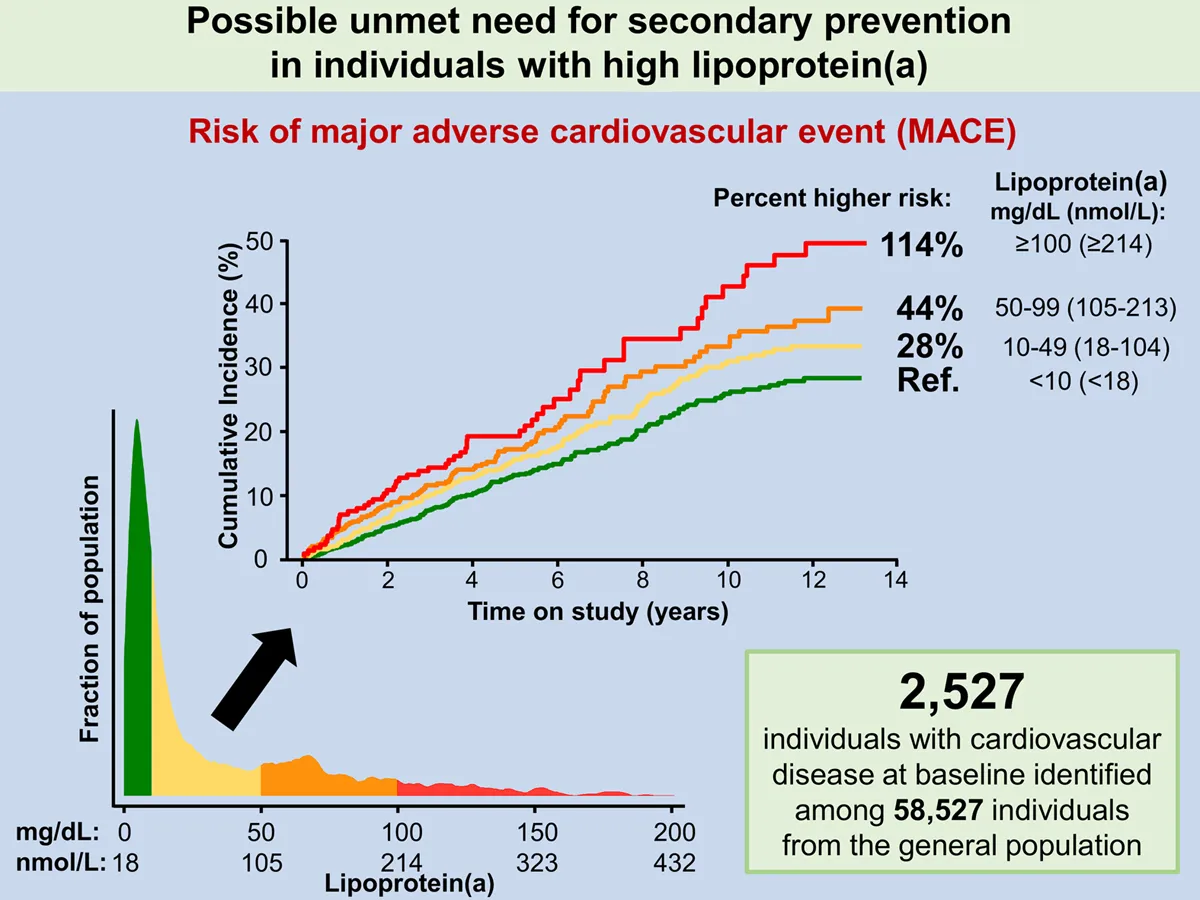 Cardiovascular event rates rise with Lp(a). At or above 100 mg/dL (214 nmol/L), risk was 114% higher than the reference group. Both mg/dL and nmol/L are shown because labs report either.
What is a good Lp(a) level?
A normal Lp(a) is below 75 nmol/L, or roughly 30 mg/dL. Above 125 nmol/L (about 50 mg/dL) is high risk, and above 200 nmol/L is very high. Units matter here: nmol/L counts particles while mg/dL measures their mass, and the two don’t convert cleanly because particle size varies between people. The 2026 AHA/ACC guidelines prefer nmol/L for that reason, so check which unit your lab used before comparing to a threshold.
How does Lp(a) change with age?
Lp(a) tends to rise with age (correlation with age, r = +0.10), but the change is small. Diet and exercise barely move it, which is why Lp(a) is treated as a fixed, once-in-a-lifetime number. The chart below shows the median by 5-year age bin and a linear trend line.
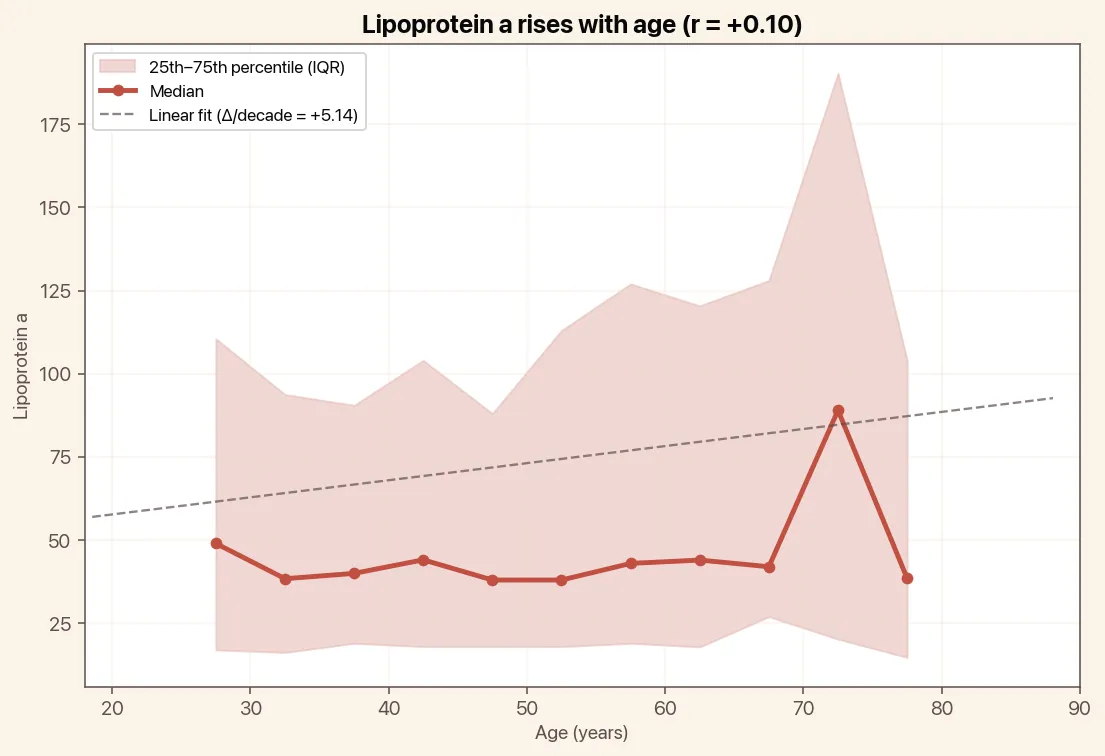 Median Lp(a) by 5-year age bin, with a linear trend line. The rise with age is modest.
Can you lower Lp(a)?
For now, no lifestyle change or standard cholesterol drug meaningfully lowers Lp(a). Diet and exercise don’t move it, statins can nudge it slightly up, and PCSK9 inhibitors lower it by about 25–27%. Several RNA-based drugs that cut Lp(a) by 80% or more are in late-stage trials, but none has yet proven it reduces heart attacks. On September 4, 2026, Novartis announced that pelacarsen’s Lp(a)HORIZON trial did not meet its primary cardiovascular endpoint, with more details expected around the AHA Scientific Sessions in November. A high Lp(a) isn’t a verdict, though. Because it’s only one part of your total risk, controlling everything else (ApoB, LDL, blood pressure, and smoking) sharply lowers your odds even when Lp(a) stays high.
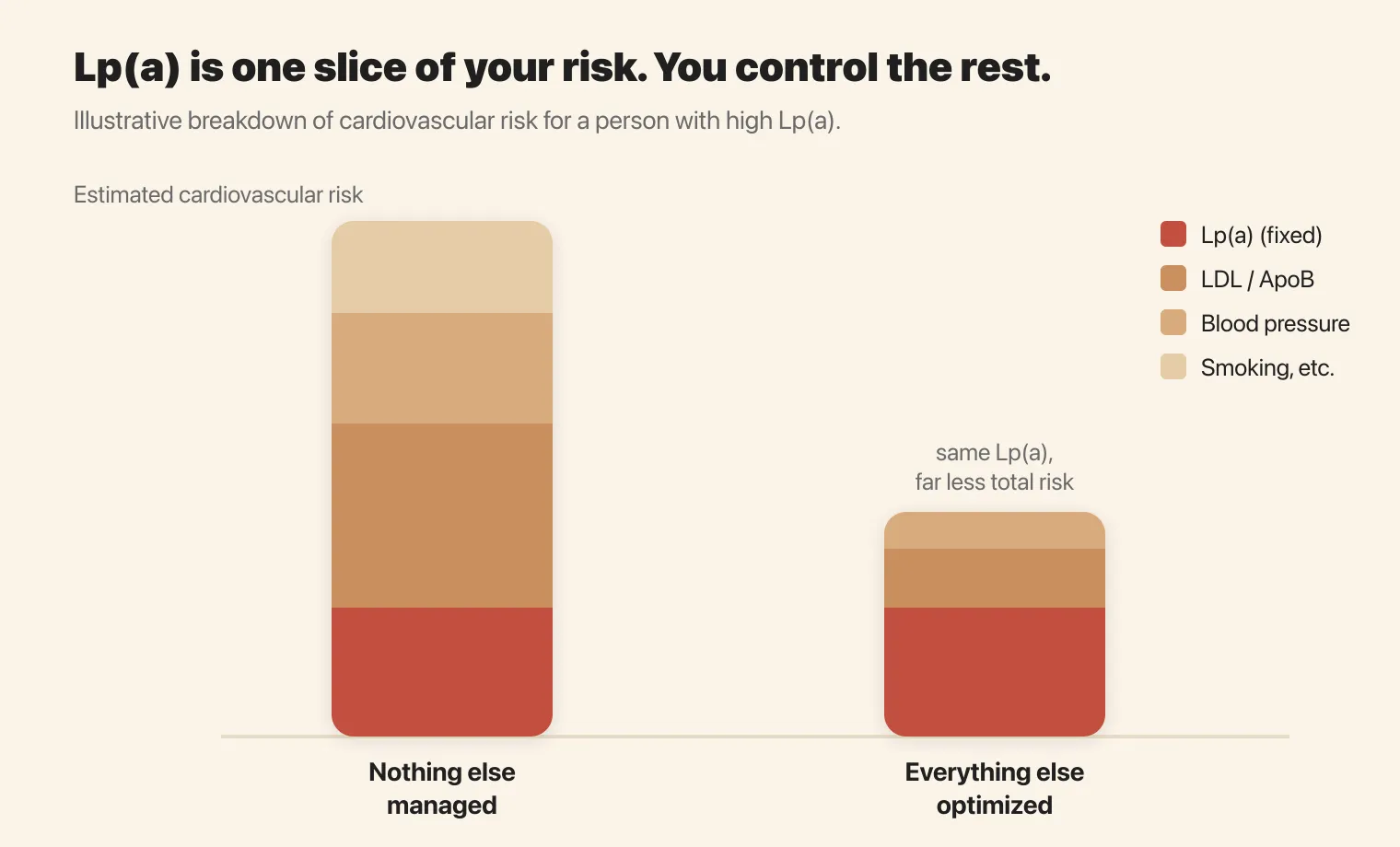 Lp(a) is fixed, but LDL and ApoB, blood pressure, and smoking aren’t. Optimizing everything else cuts total risk even when Lp(a) stays high.
For more, see why a high Lp(a) isn’t a death sentence and Lp(a)-lowering medications. Talk to your clinician before starting or changing any medication.
How often should you test Lp(a)?
Most people only need to test Lp(a) once, because a genetic level stays essentially constant for life. The 2026 AHA/ACC guidelines give this their strongest recommendation, and they add cascade testing: if yours is high, your first-degree relatives should be tested too. Testing appears to change outcomes, not just knowledge:
Patients with ASCVD who underwent testing for Lp(a) had lower mortality than those who did not get tested, likely due to more intensive lipid-lowering and antihypertensive treatment.
Retesting makes sense only in a few cases, such as kidney disease or starting an Lp(a)-lowering therapy. See the AHA’s Lp(a) testing recommendation and what to expect from the test.
What to test alongside Lp(a)
Lp(a) is one piece of a particle-based risk picture. ApoB counts all your atherogenic particles and gives you a number you can actually lower, which matters most when Lp(a) is high. LDL cholesterol is the standard lipid measure, and hs-CRP adds the inflammation angle. For how these combine, see ApoB vs Lp(a) and adding Lp(a) and hs-CRP to PREVENT.