About 15-20% of people have high ApoB but a normal result on a standard cholesterol panel. Those people look fine on the test most doctors order, while the particles that drive plaque keep building up. That gap is why the 2026 AHA/ACC guidelines introduced ApoB targets alongside LDL and total cholesterol, the first time a major U.S. guideline has put ApoB on the same footing as the cholesterol numbers you already know.
This page covers what ApoB measures, the difference between a “normal” and an optimal level, why it predicts heart disease better than LDL, how often to test it, and what moves it.
What is ApoB and why does it matter?
ApoB is a protein that sits on the surface of every cholesterol particle that can lodge in an artery wall. Each of those particles carries exactly one ApoB, so measuring ApoB counts the particles directly instead of estimating the cholesterol inside them. A high count means more particles are available to enter the artery wall, form plaque, and eventually cause a heart attack or stroke. Every 10 mg/dL of ApoB is worth about 9% more heart disease risk.
Standard cholesterol tests measure the weight of cholesterol, not the number of particles. Two people can carry the same LDL cholesterol while one has far more particles than the other. The person with more particles is at higher risk, and ApoB is what reveals it.
What is a good ApoB level?
There’s no single ApoB level that’s right for everyone, because the goal depends on your cardiovascular risk. The 2026 AHA/ACC guidelines set an ApoB goal of under 70 mg/dL for high-risk adults and under 55 mg/dL for those at very high risk, such as people who already have cardiovascular disease. Both goals sit well below the population median, which is the point: “normal” on a lab report reflects what’s common, not what’s protective.
For lower-risk adults there’s no formal ApoB target. Labs flag 0 to 100 mg/dL as normal, but normal isn’t the same as optimal, and the data suggest optimal is probably below 80 mg/dL. Lower is better across the whole range. Knowing your number, and where it lands in the distribution below, helps you and your clinician decide whether to act.
What is a normal ApoB by age?
In NHANES 2015-2016, the median ApoB was about 76 mg/dL for adults aged 18-29 and 88 mg/dL for adults aged 70 and older. The chart below shows the full distribution by age and sex.
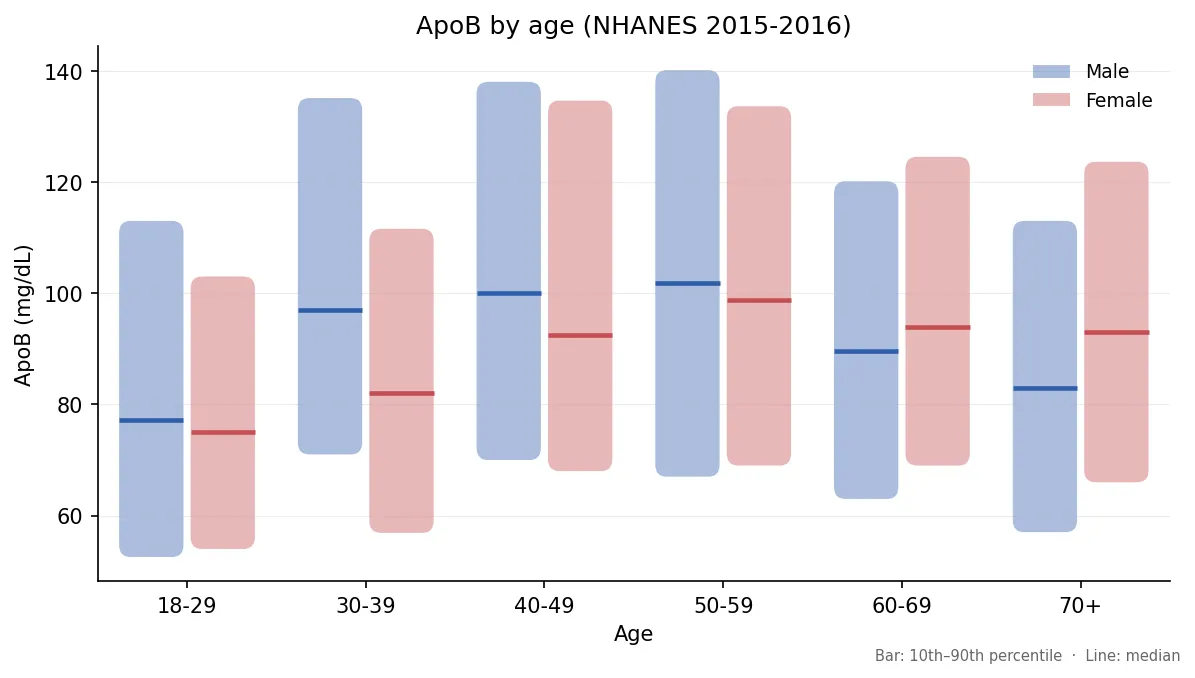 Median ApoB by age and sex, with the 10th to 90th percentile band. Source: NHANES 2015-2016 (weighted estimates).
ApoB vs LDL cholesterol: which is the better test?
ApoB predicts heart attack risk better than LDL cholesterol because it counts atherogenic particles instead of the cholesterol they carry. A 2025 review found all 9 of the studies it examined favored ApoB over LDL. Allan Sniderman, professor of cardiology at McGill University, has spent decades making the case:
At the moment, apoB is the accurate sum of all the atherogenic particles, and that’s the most important measure you can make.
— Allan Sniderman, in CAP Today
When the two disagree, ApoB is the one that tracks your actual risk. In the CARDIA study, young adults with high ApoB and low LDL cholesterol had 55% higher odds of coronary artery calcification 25 years later. This disagreement is called discordance, and it’s most common in people with high triglycerides, diabetes, or metabolic syndrome, where particles are small and cholesterol-poor, so LDL reads reassuringly low while the particle count stays high.
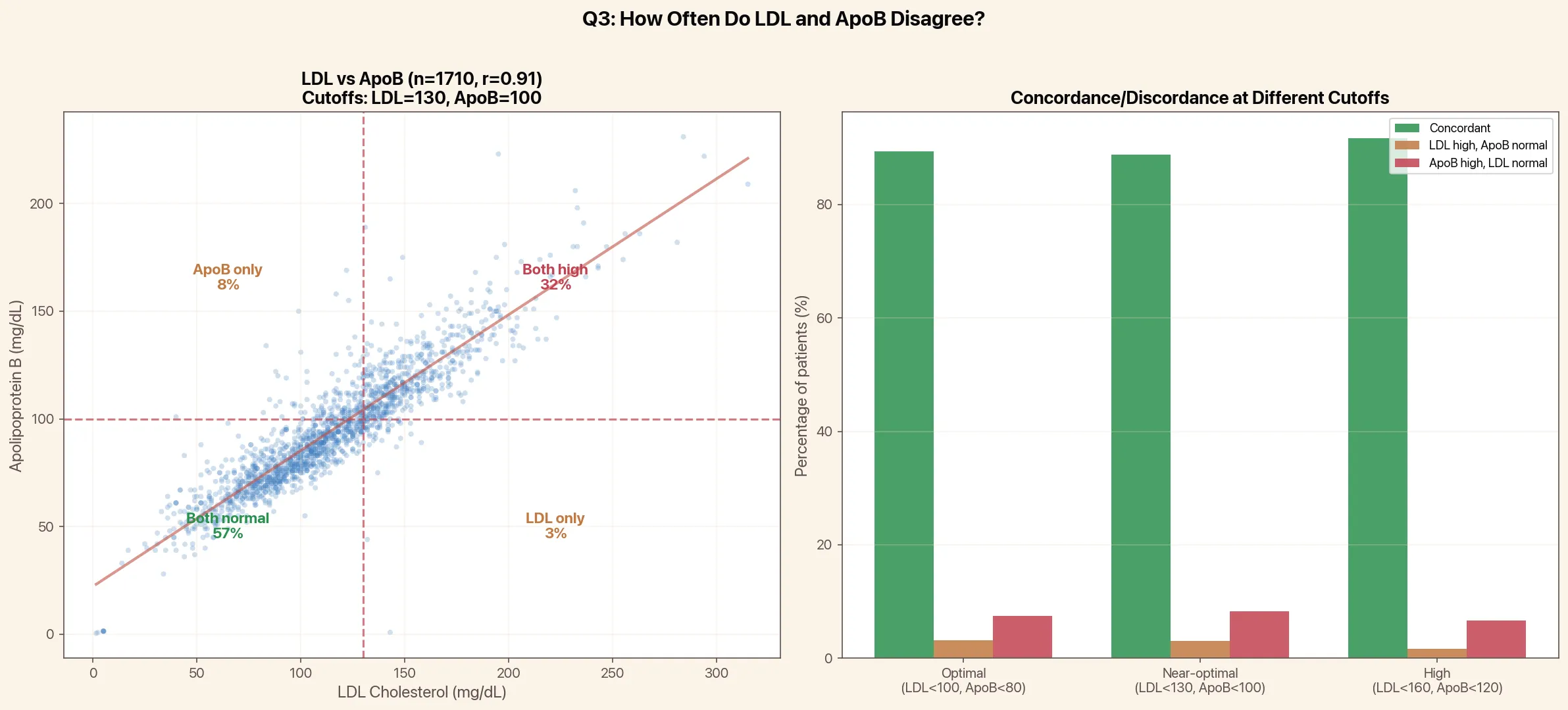 At the same LDL cholesterol, ApoB (particle count) can vary widely. The people on the high-ApoB side carry more risk than their LDL suggests.
For the full comparison, see ApoB vs LDL cholesterol and whether modern LDL formulas replace ApoB. It’s also worth measuring LDL cholesterol and non-HDL cholesterol alongside ApoB, since the pattern between them is informative.
How often should you test ApoB?
Most adults should test ApoB at least once to establish a baseline, then every one to two years if the result is optimal and stable. The 2026 guidelines are most emphatic about the people whose standard panel looks fine:
Measuring apoB may be used to assess any residual ASCVD risk and guide treatment among people with cardiovascular-kidney-metabolic syndrome, Type 2 diabetes, high triglycerides or known cardiovascular disease who have reached their LDL-C and non-HDL-C goals. ApoB may be a more accurate risk marker than LDL-C in these groups of people.
— American Heart Association, on the 2026 ACC/AHA dyslipidemia guideline
Test more often if your ApoB is elevated, if you’ve started or changed a medication that affects it, or if you have diabetes or a family history of early heart disease. Because ApoB responds within weeks to diet and medication, a follow-up test six to twelve weeks after a change shows whether it’s working. See how the ApoB blood test works for what to expect, and Medicare and ApoB testing for coverage.
What causes high ApoB?
A diet high in saturated fat and refined carbohydrate is the most common driver of high ApoB. Insulin resistance, type 2 diabetes, and metabolic syndrome raise it by increasing VLDL production, which is also why ApoB and triglycerides tend to move together. Hypothyroidism slows LDL clearance from the blood, leaving particles in circulation longer, and some medications (including certain diuretics, beta-blockers, and anabolic steroids) push ApoB up as a side effect.
Genetics set the floor. Familial hypercholesterolemia affects about 1 in 250 people and produces very high ApoB from birth, even on a good diet. A family history of heart attack or stroke before age 55 in men or 65 in women is the usual clue.
How to lower ApoB
ApoB drops when you lower the number of atherogenic particles, through diet, exercise, and when needed, medication. Reducing saturated fat and refined carbohydrate, adding soluble fiber, and losing excess weight all lower particle count. When lifestyle changes aren’t enough, the drug classes that lower ApoB stack: a high-intensity statin cuts it by about 40-45%, and adding ezetimibe and a PCSK9 inhibitor gets to roughly 80%, which would take a typical 130 mg/dL down near 26 mg/dL.
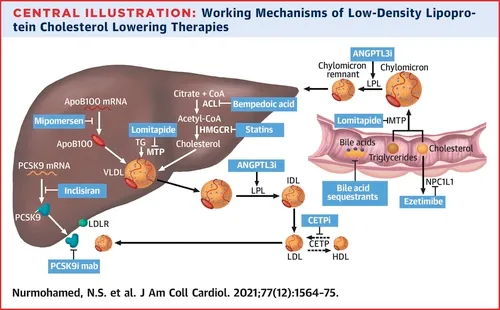 The main levers that lower ApoB, from diet to medication.
For specifics, see how to lower ApoB and ApoB-lowering medications. Talk to your clinician before starting or changing any medication.
What to test alongside ApoB
ApoB is most useful read next to a few related markers. Lp(a) is an inherited, ApoB-containing particle that adds risk your standard panel misses, so it’s worth measuring once in your life. ApoA1 is the protein on protective HDL particles, and the ApoB/A1 ratio compares harmful to protective particles in a single number. Together these give a fuller picture than cholesterol alone. For the bigger strategy, see reducing your heart attack risk.