Test your Ferritin and 100+ other biomarkers for $190

Ferritin

Normal range: 20 – 250 ng/mL (higher is better)

Ferritin is your body's iron storage protein. Think of it as your iron savings account. It is the most reliable single marker of iron stores and often drops before any other sign of deficiency appears. The tricky part: ferritin is also an inflammation marker. It rises when the body is fighting infection or dealing with chronic inflammation, which can mask true iron deficiency.

Test your Ferritin

How much does a Ferritin test cost?

On its own, Ferritin costs about $45 but is usually measured in a panel alongside Vitamin D ($75), hs-CRP ($69), ApoB ($50), and ApoA1 ($50). You can test Ferritin and 100 other biomarkers for $190 as part of an Empirical membership.

Ferritin is typically billed under CPT 82728, which is the code to give your insurer when you check coverage. Empirical is FSA/HSA eligible, so you can pay with pre-tax dollars. Fast for 8-12 hours beforehand for the most accurate lipid and metabolic results, and expect results in days rather than weeks.

Get tested for $190

Ferritin is your body’s iron storage protein. Think of it as your iron savings account. It is the most reliable single marker of iron stores and often drops before any other sign of deficiency appears. The tricky part: ferritin is also an inflammation marker, so it can be misleadingly high when the body is fighting infection or dealing with chronic inflammation.

How does Ferritin change with age?

Ferritin stays relatively flat across adult ages (correlation with age, r = +0.05). Most of the spread in the chart below comes from differences between people rather than from age.
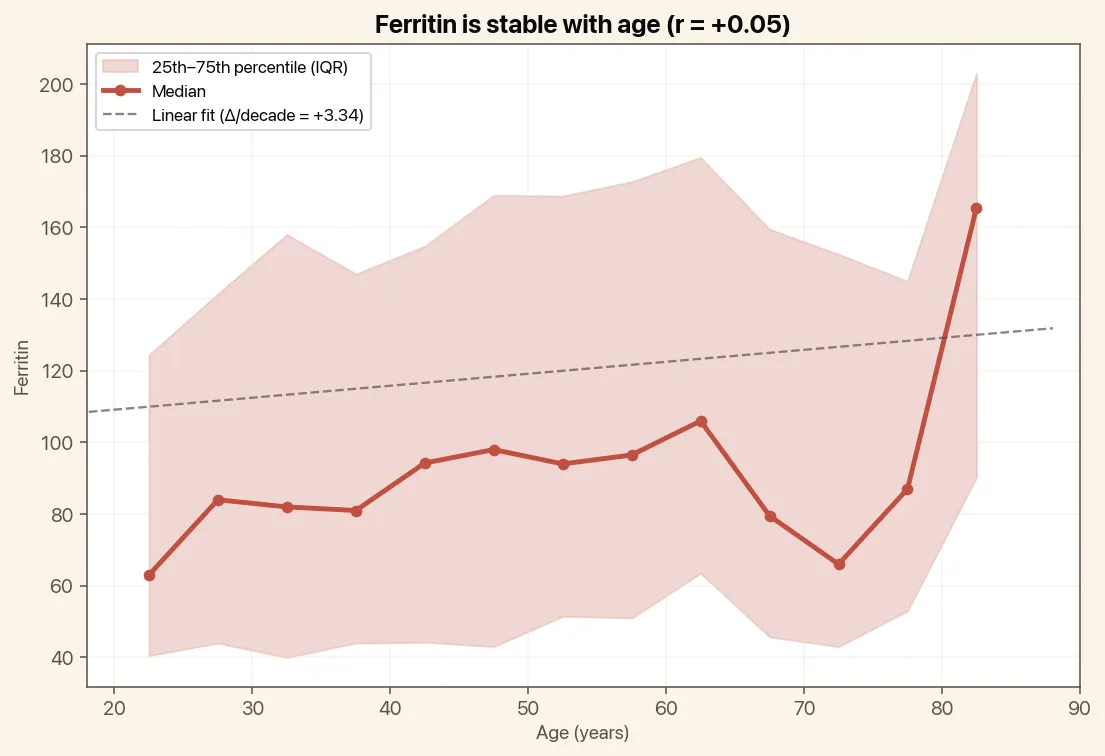

Ferritin is stable with age, chart with median and linear trend

What can cause low Ferritin?

A normal Ferritin is 20 – 250 ng/mL. Higher is better.

Low ferritin is the earliest marker of iron deficiency. It drops before hemoglobin or MCV change, making it useful for catching deficiency early. Blood loss (menstruation, GI bleeding), poor dietary iron, celiac disease, and vegetarian or vegan diets without supplementation are common causes.

High ferritin can indicate iron overload (hemochromatosis), but is more commonly elevated by inflammation, infection, liver disease, or alcohol use. Because ferritin is an acute-phase reactant, it can be misleadingly high when someone is sick. Always interpret it alongside other iron markers like serum iron, TIBC, and iron saturation.

Eating iron-rich foods, supplementing if needed (especially for menstruating women, pregnant women, and vegans), and treating underlying causes of blood loss are the best ways to maintain healthy ferritin. If ferritin is high without an obvious inflammatory cause, genetic testing for hemochromatosis is reasonable.

Biomarkers related to Ferritin

Ferritin is most highly correlated with Iron binding capacity and ALT. Here are the top biomarkers correlated with Ferritin, based on 500,000 tests done by Empirical Health.

The percentage shows how strongly two biomarkers move together. A higher number means the relationship is stronger. Green = rises and falls together. Orange = one rises as the other falls.

Frequently asked questions about Ferritin

Where to get a Ferritin test near you

Ferritin is drawn at 2,200+ Quest and BioReference patient service centers across the US, so there's usually one within a short drive. Pick your state to see the metros we cover and every location in it.

Know your Ferritin. Know your health.

Test your Ferritin and 100+ other biomarkers in a single blood draw.

Image of a man on cellphone
Start testing