Test your BUN and 100+ other biomarkers for $190

Blood Urea Nitrogen (BUN)

Normal range: 7 – 20 mg/dL (lower is better)

BUN measures urea nitrogen, a waste product created when your body breaks down protein. Your kidneys filter it out, so BUN is a useful (though imperfect) marker of kidney function. Unlike creatinine, BUN is also influenced by diet, hydration, and liver function, which makes it less specific but still valuable as part of the bigger picture.

Test your BUN

How much does a BUN test cost?

BUN isn't sold on its own. It comes in a comprehensive metabolic panel, about $40. A fuller workup adds Vitamin D ($75), hs-CRP ($69), ApoB ($50), and ApoA1 ($50). You can test BUN and 100 other biomarkers for $190 as part of an Empirical membership.

Empirical is FSA/HSA eligible, so you can pay with pre-tax dollars. Fast for 8-12 hours beforehand for the most accurate lipid and metabolic results, and expect results in days rather than weeks.

Get tested for $190

Blood Urea Nitrogen (BUN) measures kidney function and protein metabolism.

What is a normal BUN by age?

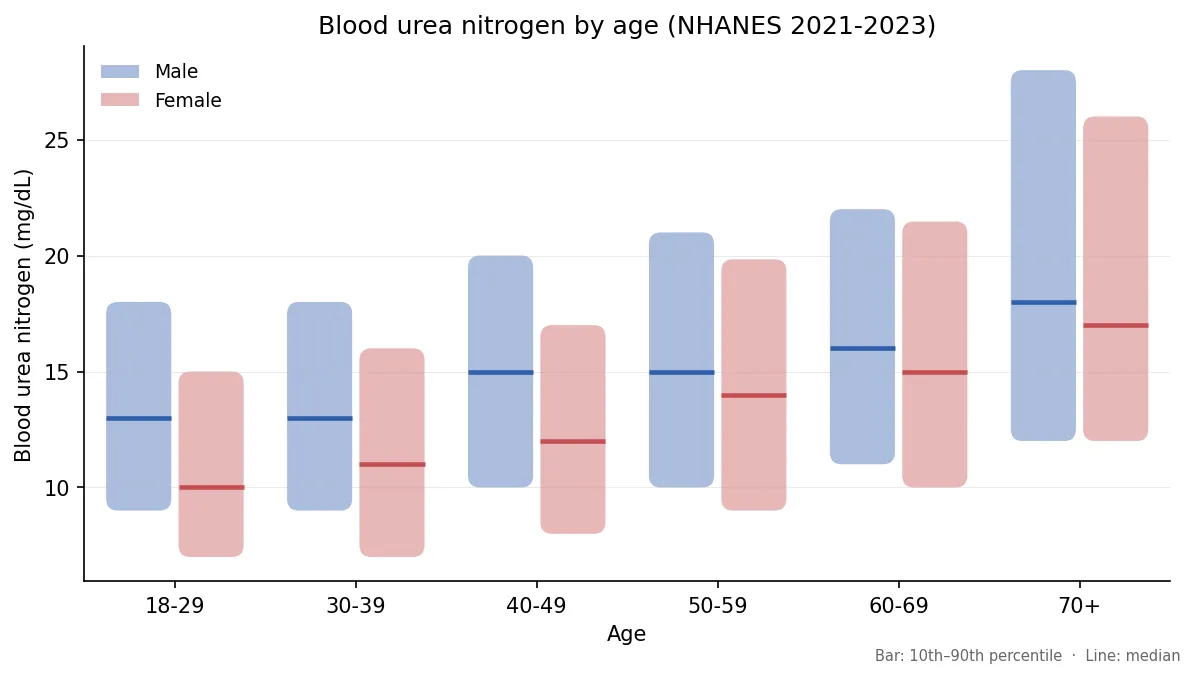
In NHANES 2021-2023, the median BUN was about 12 mg/dL for adults aged 18-29 and 18 mg/dL for adults aged 70 and older. The chart below shows the full distribution by age and sex.

Median and 10th to 90th percentile BUN by age and sex, NHANES 2021-2023 Median BUN by age and sex, with the 10th to 90th percentile band. Source: NHANES 2021-2023 (weighted estimates).

What can cause high BUN?

A normal BUN is 7 – 20 mg/dL. Lower is better.

Elevated BUN is most commonly caused by dehydration. Even mild dehydration before a blood draw can raise it. Kidney disease, high-protein diets, gastrointestinal bleeding (your body absorbs protein from digested blood), and heart failure are other common causes.

Several medications can raise BUN, including corticosteroids, tetracycline antibiotics, and certain diuretics. Low BUN can indicate liver disease (the liver converts ammonia to urea), malnutrition, overhydration, or pregnancy.

Staying well-hydrated is the simplest way to keep BUN in range. If you eat a very high-protein diet, expect your BUN to run on the higher side without it necessarily meaning kidney trouble. Your doctor will look at BUN alongside creatinine and eGFR to get the full picture.
Biomarkers related to BUN

BUN is most highly correlated with Estimated Glomerular Filtration Rate and Vitamin D. Here are the top biomarkers correlated with BUN, based on 500,000 tests done by Empirical Health.

The percentage shows how strongly two biomarkers move together. A higher number means the relationship is stronger. Green = rises and falls together. Orange = one rises as the other falls.

Frequently asked questions about BUN

Where to get a BUN test near you

BUN is drawn at 2,200+ Quest and BioReference patient service centers across the US, so there's usually one within a short drive. Browse the full directory to find the one closest to you.

Browse all testing locations

Know your BUN. Know your health.

Test your Blood Urea Nitrogen (BUN) and 100+ other biomarkers in a single blood draw.

Image of a man on cellphone
Start testing