Test your Potassium and 100+ other biomarkers for $190

Potassium

Normal range: 3.5 – 5 mmol/L (higher is better)

Potassium is the main electrolyte inside your cells and is critical for heart rhythm, muscle function, and nerve signaling. Both high and low potassium can cause dangerous cardiac arrhythmias, which is why your body regulates it carefully through the kidneys. Of all the electrolytes, potassium is the one most affected by common medications.

Test your Potassium

How much does a Potassium test cost?

Potassium isn't sold on its own. It comes in a comprehensive metabolic panel, about $40. A fuller workup adds Vitamin D ($75), hs-CRP ($69), ApoB ($50), and ApoA1 ($50). You can test Potassium and 100 other biomarkers for $190 as part of an Empirical membership.

Empirical is FSA/HSA eligible, so you can pay with pre-tax dollars. Fast for 8-12 hours beforehand for the most accurate lipid and metabolic results, and expect results in days rather than weeks.

Get tested for $190

Potassium helps maintain fluid balance, nerve signals, and muscle contractions, including heart function.

How does Potassium change with age?

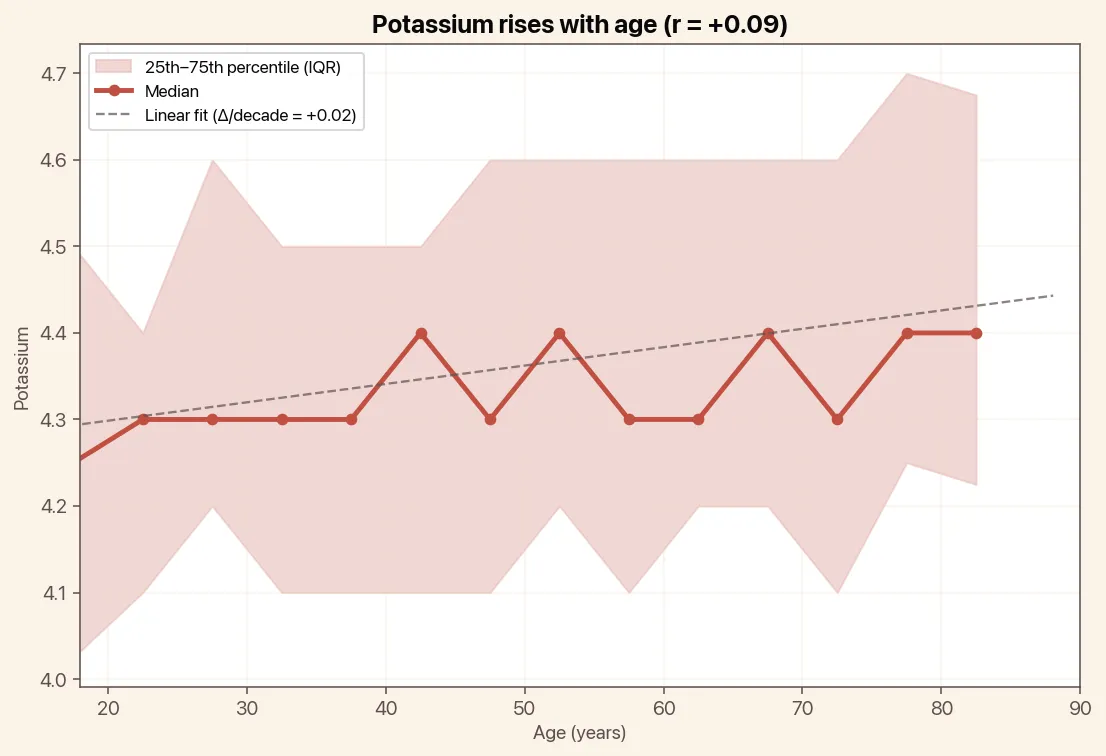
Potassium tends to rise with age (correlation with age, r = +0.09). The chart below shows the median by 5-year age bin and a linear trend line.

Potassium rises with age, chart with median and linear trend

What can cause low Potassium?

A normal Potassium is 3.5 – 5 mmol/L. Higher is better.

Low potassium (hypokalemia) is commonly caused by diuretics (especially thiazide and loop diuretics), vomiting, diarrhea, excess sweating, and low dietary intake. Chronic laxative abuse and excess licorice consumption are underappreciated causes. Insulin and albuterol (asthma inhalers) can shift potassium into cells temporarily.

High potassium (hyperkalemia) is most often caused by kidney disease (impaired excretion), ACE inhibitors, ARBs, potassium-sparing diuretics (like spironolactone), or potassium supplements. Hemolysis during the blood draw can falsely elevate the result, which is a common lab artifact.

Eating potassium-rich foods (bananas, potatoes, spinach, avocados) helps prevent low levels, especially if you take diuretics. If you have kidney disease, you may need to limit potassium-rich foods instead. Talk to your doctor before taking potassium supplements, as too much can be just as dangerous as too little.

Biomarkers related to Potassium

Potassium is most highly correlated with BUN and Estimated Glomerular Filtration Rate. Here are the top biomarkers correlated with Potassium, based on 500,000 tests done by Empirical Health.

The percentage shows how strongly two biomarkers move together. A higher number means the relationship is stronger. Green = rises and falls together. Orange = one rises as the other falls.

Frequently asked questions about Potassium

Where to get a Potassium test near you

Potassium is drawn at 2,200+ Quest and BioReference patient service centers across the US, so there's usually one within a short drive. Browse the full directory to find the one closest to you.

Browse all testing locations

Know your Potassium. Know your health.

Test your Potassium and 100+ other biomarkers in a single blood draw.

Image of a man on cellphone
Start testing