Normal range: 0.5 – 1 % (higher is better)
Basophils normally make up less than 1% of your white blood cells. They are the rarest circulating white cells, so their percentage is typically very small. An elevated basophil percentage is uncommon and may suggest an allergic reaction, a thyroid issue, or rarely, a myeloproliferative condition. Because the baseline count is so low, even tiny absolute changes can look like big percentage swings.
Basophils % isn't sold on its own. It comes in a complete blood count (CBC), about $35. A fuller workup adds Vitamin D ($75), hs-CRP ($69), ApoB ($50), and ApoA1 ($50). You can test Basophils % and 100 other biomarkers for $190 as part of an Empirical membership.
Empirical is FSA/HSA eligible, so you can pay with pre-tax dollars. Fast for 8-12 hours beforehand for the most accurate lipid and metabolic results, and expect results in days rather than weeks.
Basophils are the least common white blood cells that play a role in allergic reactions and inflammation.
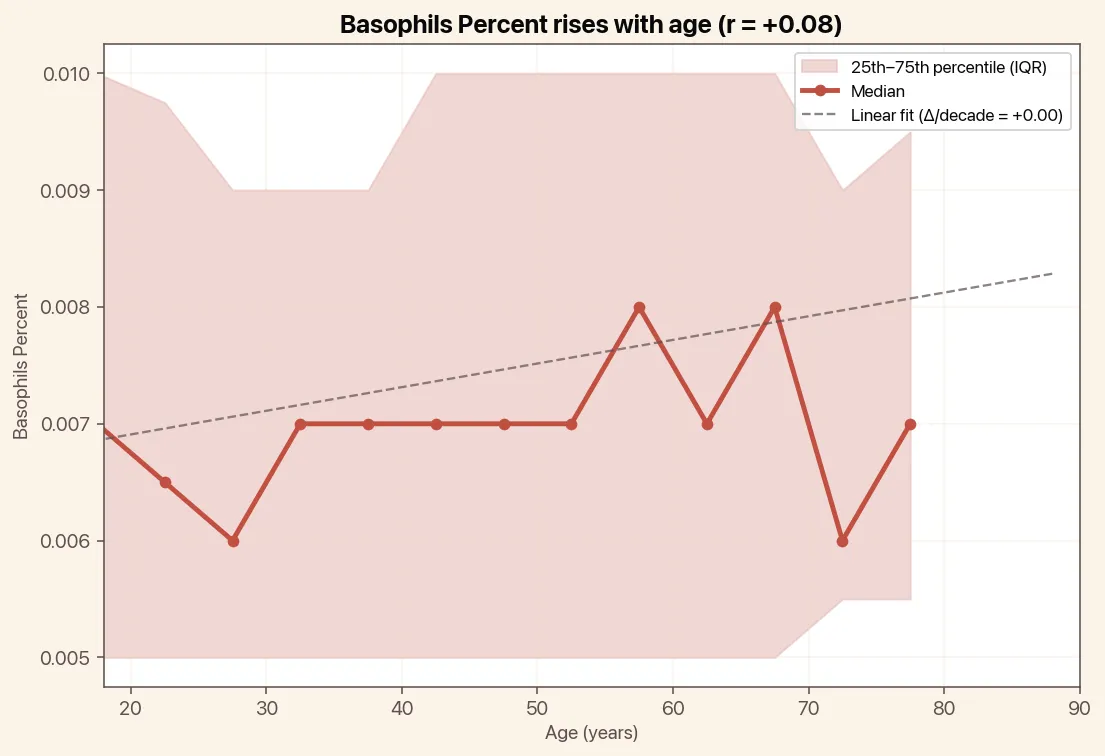
Basophils Percent tends to rise with age (correlation with age, r = +0.08). The chart below shows the median by 5-year age bin and a linear trend line.

A normal Basophils % is 0.5 – 1 %. Higher is better.
Elevated basophil percentage is rare and most commonly associated with allergic reactions, chronic myeloid leukemia, or hypothyroidism. Ulcerative colitis and chronic sinusitis are less common causes. Because the absolute count is so low, even small increases can appear as a large percentage shift.
Corticosteroids and acute stress can suppress basophils. Hyperthyroidism is also associated with lower basophil counts.
There are no specific lifestyle changes that target basophil percentage. Managing underlying allergies, treating thyroid disorders, and working with your doctor to investigate persistent elevation are the most relevant steps.
Basophils % is most highly correlated with Lymphocytes Percent and Monocytes Percent. Here are the top biomarkers correlated with Basophils %, based on 500,000 tests done by Empirical Health.
The percentage shows how strongly two biomarkers move together. A higher number means the relationship is stronger. Green = rises and falls together. Orange = one rises as the other falls.
Basophils % is drawn at 2,200+ Quest and BioReference patient service centers across the US, so there's usually one within a short drive. Browse the full directory to find the one closest to you.
Test your Basophils Percent and 100+ other biomarkers in a single blood draw.