Test your Chloride and 100+ other biomarkers for $190

Chloride

Normal range: 96 – 106 mmol/L (higher is better)

Chloride is an electrolyte that works hand-in-hand with sodium to maintain fluid balance and blood pH. It also helps form stomach acid. Chloride usually moves in parallel with sodium, so abnormal chloride levels often reflect the same underlying issue driving a sodium change. When chloride moves independently of sodium, it points to an acid-base problem.

Test your Chloride

How much does a Chloride test cost?

Chloride isn't sold on its own. It comes in a comprehensive metabolic panel, about $40. A fuller workup adds Vitamin D ($75), hs-CRP ($69), ApoB ($50), and ApoA1 ($50). You can test Chloride and 100 other biomarkers for $190 as part of an Empirical membership.

Empirical is FSA/HSA eligible, so you can pay with pre-tax dollars. Fast for 8-12 hours beforehand for the most accurate lipid and metabolic results, and expect results in days rather than weeks.

Get tested for $190

Chloride is an electrolyte that helps maintain proper hydration and acid-base balance.

How does Chloride change with age?

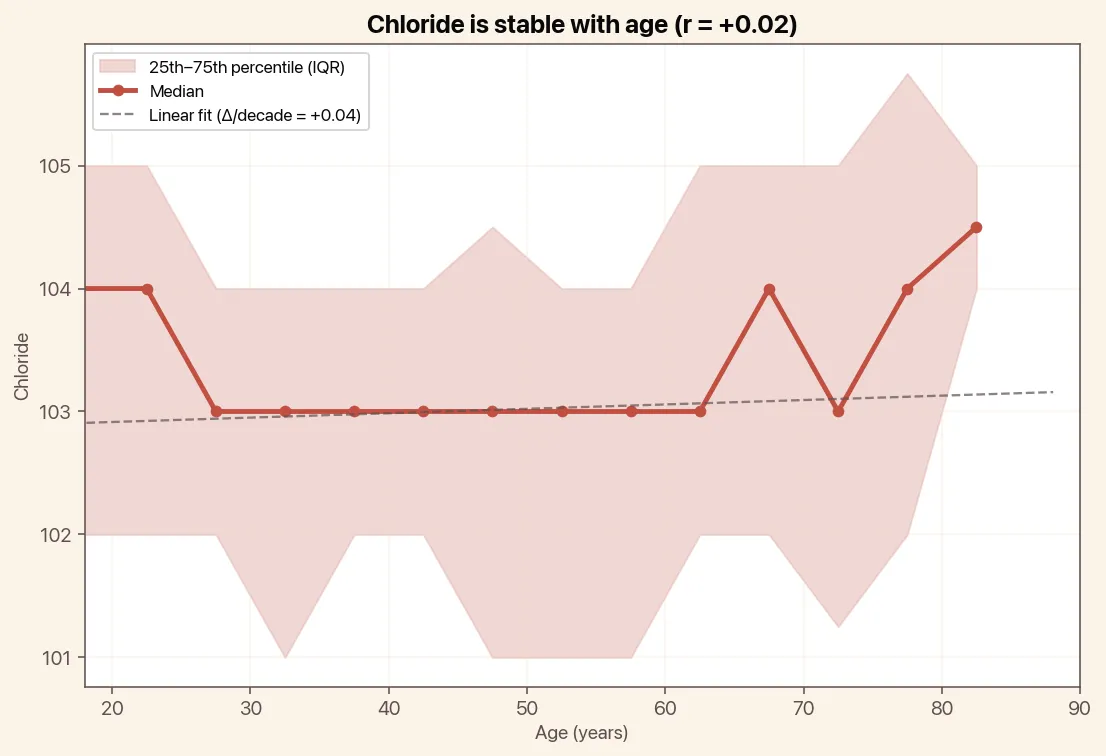
Chloride stays relatively flat across adult ages (correlation with age, r = +0.02). Most of the spread in the chart below comes from differences between people rather than from age.

Chloride is stable with age, chart with median and linear trend

What can cause low Chloride?

A normal Chloride is 96 – 106 mmol/L. Higher is better.

Low chloride is most commonly caused by prolonged vomiting (which depletes stomach acid), diuretic use, or metabolic alkalosis. High chloride typically accompanies dehydration, excessive saline infusion, kidney disease, or metabolic acidosis (such as from chronic diarrhea).

Diuretics are the most common medication cause. Loop diuretics (furosemide) and thiazides tend to lower chloride, while acetazolamide can raise it. Chronic bicarbonate or antacid use can also shift chloride levels.

For most people, chloride stays in range as long as sodium does. Staying hydrated and being aware of medication effects are the main considerations. There are no specific dietary interventions targeted at chloride alone.

Biomarkers related to Chloride

Chloride is most highly correlated with Sodium and Carbon Dioxide. Here are the top biomarkers correlated with Chloride, based on 500,000 tests done by Empirical Health.

The percentage shows how strongly two biomarkers move together. A higher number means the relationship is stronger. Green = rises and falls together. Orange = one rises as the other falls.

Frequently asked questions about Chloride

Where to get a Chloride test near you

Chloride is drawn at 2,200+ Quest and BioReference patient service centers across the US, so there's usually one within a short drive. Browse the full directory to find the one closest to you.

Browse all testing locations

Know your Chloride. Know your health.

Test your Chloride and 100+ other biomarkers in a single blood draw.

Image of a man on cellphone
Start testing