Test your ApoB/A1 and 100+ other biomarkers for $190

Apolipoprotein B/A1 Ratio

Normal range: 0 – 0.77 (lower is better)

The ApoB/ApoA1 ratio captures the balance between atherogenic (harmful) and cardioprotective particles in a single number. Several large studies have found it to be one of the strongest predictors of cardiovascular risk, often outperforming LDL or the standard cholesterol/HDL ratio. A lower ratio means your protective particles are winning the battle against the harmful ones.

Test your ApoB/A1

How much does an ApoB/A1 test cost?

ApoB/A1 is calculated rather than ordered on its own, so it comes with ApoB and ApoA1 testing (about $65). A fuller workup adds Vitamin D ($75), hs-CRP ($69), ApoB ($50), and ApoA1 ($50). You can test ApoB/A1 and 100 other biomarkers for $190 as part of an Empirical membership.

Empirical is FSA/HSA eligible, so you can pay with pre-tax dollars. Fast for 8-12 hours beforehand for the most accurate lipid and metabolic results, and expect results in days rather than weeks.

Get tested for $190

ApoB is a more accurate measure of “bad” cholesterol than LDL. ApoA1 is a more accurate measure of “good” cholesterol than HDL. The ratio of ApoB to ApoA1 is one of the strongest predictors of cardiovascular risk.

How does Apolipoprotein B/A1 Ratio change with age?

Apolipoprotein B/A1 Ratio tends to fall with age (correlation with age, r = -0.07). The chart below shows the median by 5-year age bin and a linear trend line.
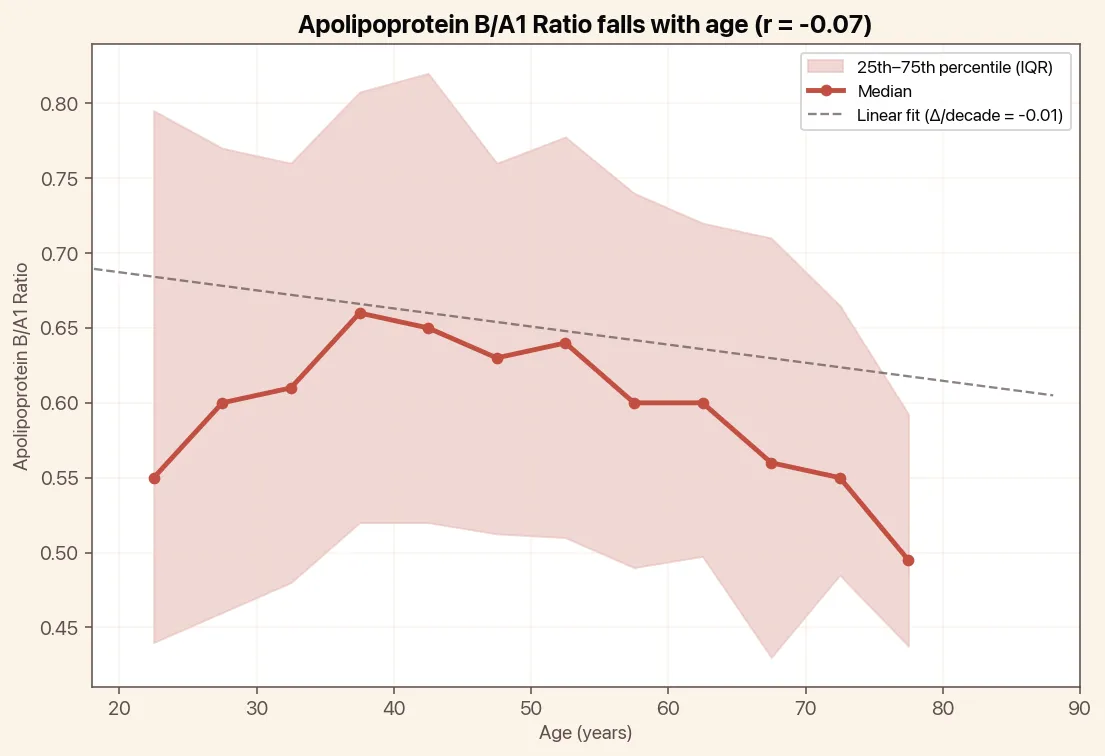

Apolipoprotein B/A1 Ratio falls with age, chart with median and linear trend

What can cause high ApoB/A1?

A normal ApoB/A1 is 0 – 0.77. Lower is better.

A high ApoB/A1 ratio means too many harmful particles relative to protective ones. The same factors that raise ApoB (poor diet, insulin resistance, genetics) or lower ApoA1 (sedentary lifestyle, smoking, obesity) push this ratio up. Addressing either side improves the balance.

Exercise is uniquely effective here because it both lowers ApoB and raises ApoA1, improving the ratio from both directions. Reducing saturated fat, quitting smoking, losing excess weight, and replacing unhealthy fats with unsaturated fats all help. Statins improve the ratio primarily by lowering the ApoB side.

Biomarkers related to ApoB/A1

ApoB/A1 is most highly correlated with Apolipoprotein B and Non-HDL Cholesterol. Here are the top biomarkers correlated with ApoB/A1, based on 500,000 tests done by Empirical Health.

The percentage shows how strongly two biomarkers move together. A higher number means the relationship is stronger. Green = rises and falls together. Orange = one rises as the other falls.

Frequently asked questions about ApoB/A1

Where to get an ApoB/A1 test near you

ApoB/A1 is drawn at 2,200+ Quest and BioReference patient service centers across the US, so there's usually one within a short drive. Browse the full directory to find the one closest to you.

Browse all testing locations

Know your ApoB/A1. Know your health.

Test your Apolipoprotein B/A1 Ratio and 100+ other biomarkers in a single blood draw.

Image of a man on cellphone
Start testing