PCSK9 inhibitors lower LDL cholesterol by an additional 45% to 64% on top of a statin, and they cut heart attacks and strokes. PCSK9 inhibitors are also expensive, so insurers wrap them in prior authorization. In one study, between 82% and 97% of patients needed a prior authorization, and many were denied on the first try. That reputation scares people off a drug that could help them.
I analyzed coverage rules for PCSK9 inhibitors across most major insurers: UnitedHealthcare, Aetna, Cigna, Anthem, and the Blue plans. Roughly 80% of the criteria for PCSK9 inhibitors are identical between insurers. This post starts with what these drugs actually cost, then walks through what every insurer requires for PCSK9 inhibitors, the handful of places carriers differ, how Medicare and Medicaid handle these drugs, and the specific gaps that get people denied. Coverage rules are about to get more interesting: the FDA approved the first oral PCSK9 inhibitor (Lipfendra) on July 16, 2026, and insurers are likely to wrap the pill in the same prior authorization they use for the injections until it earns its own formulary spot.
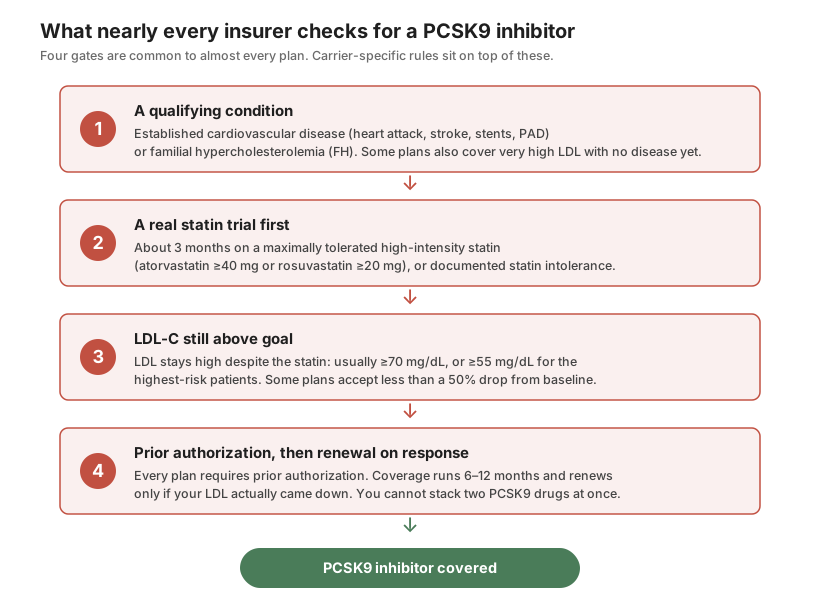 Four gates show up in almost every PCSK9 policy. Carrier-specific rules sit on top of these.
PCSK9 inhibitor price
The list price of a PCSK9 inhibitor is about $6,900 a year. That number is roughly the same for all three drugs. Repatha (evolocumab) and Praluent (alirocumab) both list around $6,900 a year, down from about $14,000 at launch after 60% price cuts in 2018 and 2019. Leqvio (inclisiran) runs about $3,250 per dose, given twice a year, for a similar annual total.
Almost nobody pays the list price. What you actually pay depends on your coverage. The clearest example is Medicare, because it now has a hard cap.
PCSK9 inhibitor cost on Medicare
A PCSK9 inhibitor sits on a Part D specialty tier, so you pay a percentage of the cost rather than a flat copay. For years that share was open-ended, and a bad stretch could run hundreds of dollars a month. That changed in 2025. Medicare Part D now caps your total out-of-pocket drug spending at $2,100 in 2026.
So the practical answer for a Medicare patient: the list price is about $6,900 a year, but you pay at most $2,100 out of pocket in 2026. That cap covers all of your Part D drugs combined, not just the PCSK9 inhibitor, so if you already take other expensive medications the PCSK9 inhibitor may add little once you hit it. You can also spread the $2,100 into level monthly payments through the Medicare Prescription Payment Plan.
If you have commercial insurance, the brand antibodies often come with a manufacturer copay card (Repatha and Praluent both advertise as little as $5 a month for eligible commercially insured patients; copay cards are not allowed on Medicare). And if you are paying cash, Amgen sells Repatha direct for about $239 a month, roughly $2,900 a year.
Does insurance cover PCSK9 inhibitors?
Most insurers cover PCSK9 inhibitors in limited situations. However, none of them cover it automatically. Your doctor has to submit paperwork showing you meet the plan’s criteria before the first fill.
The good news is that the coverage criteria are converging, and in 2026 they are loosening. UnitedHealthcare dropped its ezetimibe requirement in February 2026. Cigna dropped a similar requirement in May 2026. LDL thresholds have loosened. And for Medicare patients, a new out-of-pocket cap removes the cost barrier that used to matter more than any clinical rule.
What every insurer requires for a PCSK9 inhibitor
Nearly every insurer requires three things to cover PCSK9 inhibitors: a qualifying diagnosis, a real statin trial, and an LDL that stays too high after using less expensive drugs.
A qualifying diagnosis
Most insurers require one of two diagnoses to qualify for PCSK9 inhibitors:
- Established atherosclerotic cardiovascular disease (ASCVD). This typically means a prior heart attack, acute coronary syndrome, angina, a stent or bypass, an ischemic stroke, or peripheral artery disease.
- Familial hypercholesterolemia (FH), a genetic condition that causes very high LDL from birth.
Most plans add a third door for primary prevention, meaning very high LDL (typically untreated LDL of 190 mg/dL or more) or high calculated risk, even without a prior event.
A real statin trial, or documented intolerance
To cover a PCSK9 inhibitor, insurers want to see that you were already on a maximally tolerated high-intensity statin and still needed more. High-intensity has the same definition almost everywhere: atorvastatin 40 mg or higher, or rosuvastatin 20 mg or higher. Plans want roughly three months (8 to 12 weeks) at that dose.
If you cannot take statins, there is a parallel path. Most plans define statin intolerance as failing at least two different statins (e.g., muscle symptoms that go away when you stop).
An LDL that stays too high
Being on a statin is not enough. Your LDL has to remain above the plan’s threshold despite the statin. Specific LDL thresholds for PCSK9 inhibitors cluster in a narrow band. For patients with established cardiovascular disease, PCSK9 inhibitors are often covered when LDL is 70 mg/dL or higher. For the highest-risk patients (multiple prior events), the LDL threshold drops to 55 mg/dL or higher. Some plans (like Anthem), accept a different test: less than a 50% reduction in LDL from your starting point.
UnitedHealthcare and Cigna use the more permissive 55 mg/dL threshold for cardiovascular patients. Aetna, Blue Shield of California, and most Blue plans use 70 mg/dL. The strictest by far is Texas Medicaid, which requires your LDL to stay above 130 mg/dL after a statin plus ezetimibe.
For familial hypercholesterolemia, the threshold is usually 70 mg/dL, and the diagnosis can be confirmed by genetic testing, a Dutch Lipid Clinic Network score, the Simon Broome criteria, or a very high untreated LDL (190 mg/dL or more, or 400 mg/dL or more for the homozygous form).
Where insurers vary in their coverage of PCSK9 inhibitors
Do you have to try ezetimibe before getting a PCSK9 inhibitor?
Ezetimibe (Zetia) is a cheap, well-tolerated add-on to statins. Some insurers require a documented ezetimibe trial before they will approve a PCSK9 inhibitor, including Blue Shield of California, Blue Cross Blue Shield of Massachusetts, Molina, and most Medicaid programs. Insurers that do not require ezetimibe include UnitedHealthcare, Aetna’s commercial lines, Anthem, Blue Cross Blue Shield of Alabama, and Wellmark. Cigna sits in the middle, requiring it under one policy family but not the other. This is one area that’s changing. For example, UHC dropped the ezetimibe requirement in 2026.
Which PCSK9 inhibitor will my plan cover?
There are three PCSK9 inhibitors. Different insurers cover different ones.
Repatha (evolocumab) and Praluent (alirocumab) are the two antibody drugs, given as a self-injection every two weeks or monthly. They have nearly identical clinical criteria. The main difference is that when an insurer names a preferred PCSK9 drug, it is almost always Repatha. Blue Cross Blue Shield of Alabama, Wellmark, Molina, and Blue Cross Blue Shield of Massachusetts all prefer Repatha. Anthem and Cigna’s national formulary treat Repatha and Praluent as equals.
Leqvio (inclisiran) is the newcomer, given as an injection in a clinic twice a year. Leqvio is usually treated as second-line, because it does not yet have cardiovascular outcomes data. Several plans require you to try Repatha first, and two commercial Leqvio policies require a specialist to prescribe it. Because Leqvio is often given in a doctor’s office, it can be billed differently from the others, which matters for Medicare (more below).
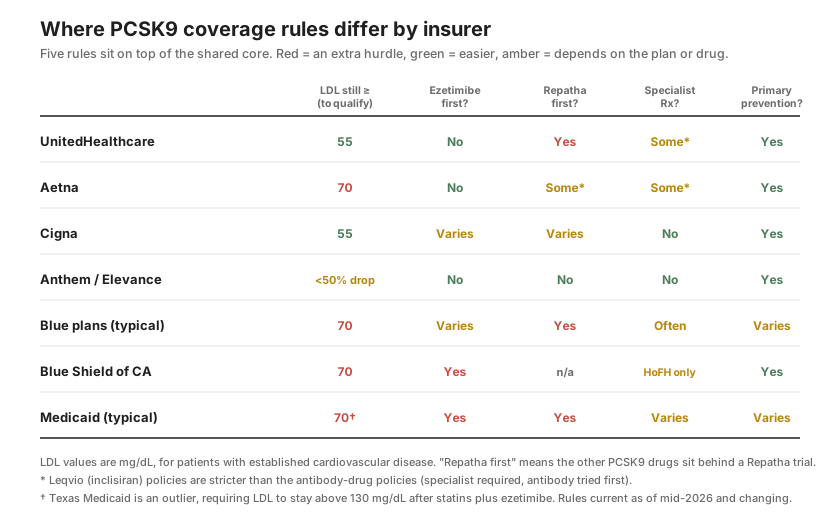 How PCSK9 inhibitor coverage rules differ by insurer.
Specific PCSK9 coverage details by insurer
The common core described above is broadly true across insurers. But there are some specific policies for each one:
UnitedHealthcare’s PCSK9 coverage uses the permissive 55 mg/dL LDL threshold for cardiovascular patients and dropped its ezetimibe requirement in 2026. It makes Repatha the preferred antibody (Praluent requires a Repatha trial first). Its Leqvio policy is stricter, requiring a cardiologist, endocrinologist, or lipid specialist.
Aetna’s PCSK9 coverage uses a 70 mg/dL LDL threshold and has the lightest documentation burden of the antibody policies (no ezetimibe step, no specialist requirement, no PCSK9-versus-PCSK9 step). Its Leqvio rules, both commercial and Medicare, are stricter.
Cigna runs two policy families. Its national formulary policies are lighter (no ezetimibe step, no preferred-drug step). Its drug coverage policies are stricter (ezetimibe required for primary prevention, Repatha tried first). Which one applies depends on your specific Cigna plan.
Anthem/Elevance’s PCSK9 policy is among the simplest. It treats Repatha and Praluent as equals, requires no ezetimibe step, and uses the “less than 50% LDL reduction” test. It grants a full year of coverage up front.
The Blue plans vary in their PCSK9 coverage. Most Blue Cross/Blue Shield insurers make Repatha preferred and require a specialist. Blue Cross Blue Shield of Massachusetts requires ezetimibe, a board-certified cardiologist or endocrinologist, recent labs, and only a 3-month initial approval. Blue Shield of California requires ezetimibe, but grants indefinite coverage once approved.
Medicaid programs tend to be the most prescriptive: ezetimibe required, Repatha preferred, shorter approval windows, and numeric reauthorization targets (Texas requires a 50% LDL reduction to renew). Texas also uses that unusually high 130 mg/dL entry threshold.
Does Medicare cover PCSK9 inhibitors?
Yes. There is no single national Medicare rule for PCSK9 inhibitors. Instead, each Part D drug plan sets its own prior authorization criteria, which closely mirror the commercial criteria above. About 97% of Part D plans require prior authorization, and PCSK9 inhibitors almost always sit on a specialty tier.
For years, the real Medicare barrier was not the clinical rules, it was cost. That changed in 2025, when Part D capped annual out-of-pocket spending at $2,100 (in 2026), removing the open-ended bills that used to push beneficiaries off these drugs. See PCSK9 inhibitor cost on Medicare above for what that means in dollars.
One wrinkle: Leqvio, when administered in a doctor’s office, is billed under Part B rather than Part D. That puts it under Part B step therapy rules, where Repatha is typically the preferred product.
Does Medicaid cover PCSK9 inhibitors?
Medicaid does have coverage for PCSK9 inhibitors, but tends to have the strictest criteria. Expect a required ezetimibe trial, Repatha as the preferred drug, current labs (within three months), and shorter initial approvals with numeric renewal targets. Texas Medicaid is the outlier on the demanding end, requiring LDL to remain above 130 mg/dL after both a statin and ezetimibe. Coverage exists, but the documentation bar is higher than most commercial plans.
Why PCSK9 inhibitors get denied, and how to avoid it
Most denials are not about whether you qualify, but rather about what was documented. Work through these with your doctor before the prior authorization goes in:
- The statin trial is missing or too short. Your medical record needs to show a maximally tolerated high-intensity statin (atorvastatin 40+ mg or rosuvastatin 20+ mg) for about three months, or a clear statin-intolerance history (two statins failed, or one episode of rhabdomyolysis).
- The LDL on the chart is below the threshold, or there is no recent value. Some insurers want a lab test that measures LDL within the last 3 to 12 months, drawn while on the statin.
- The plan wanted an ezetimibe trial that did not happen. If your insurer is one that requires it, a documented ezetimibe trial (or a reason you cannot take it) prevents this denial.
- The wrong drug was requested. If your plan prefers Repatha, a request for Praluent or Leqvio can bounce unless a Repatha trial is documented first.
- A specialist was required. A few plans, and most Leqvio policies, want a cardiologist, endocrinologist, or lipid specialist on the prescription.
In short, PCSK9 insurance coverage is far more predictable than its reputation suggests. The criteria are mostly shared between insurers, the differences are few, and the denials trace back to a short list of documentation gaps. Knowing your plan’s version of the list ahead of time is most of the battle.
Key references
| Document | Link |
|---|---|
| Prior authorization across US payers (AHA) | ahajournals.org |
| National Lipid Association PCSK9 patient sheet | lipid.org |
| UnitedHealthcare commercial Praluent policy | uhcprovider.com |
| Aetna inclisiran (Leqvio) policy, CPB 1004 | aetna.com |
| Cigna Repatha prior authorization policy | cigna.com |
| Anthem/Elevance PCSK9 clinical criteria | anthem.com |
| Blue Shield of California Repatha policy | blueshieldca.com |
This post is part of our series on heart health and coverage. See also: PCSK9 inhibitors explained, Medicare coverage of cardiovascular medications, and how to lower ApoB.
Get your free 30-day heart health guide
Evidence-based steps to optimize your heart health.