Most people think of statins as cholesterol drugs — which, of course, they are. But statins also lower inflammation. In the landmark JUPITER trial, a statin lowered hs-CRP (the main blood marker for inflammation) by 37%, almost as much as the 50% it lowered LDL.
This is one of the more useful facts in cardiology, because inflammation is roughly as strong a risk factor for heart disease as LDL. By taking a statin, you lower both inflammation and cholesterol simultaneously.
This post covers the JUPITER trial, how much other statins lowered inflammation, the mechanism behind why statins touch inflammation at all, how much dose matters, and how to check if it’s working in your own blood.
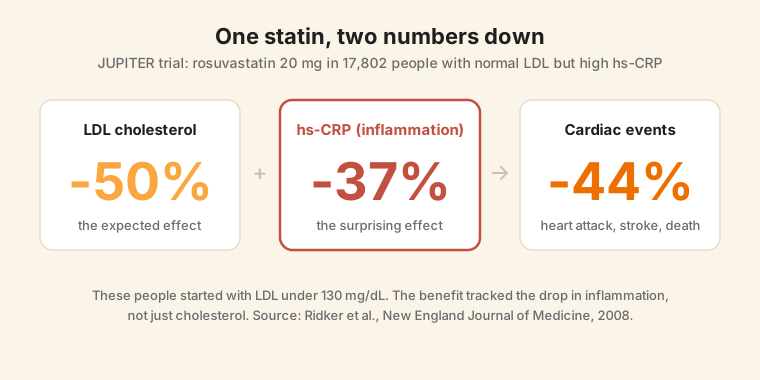 In JUPITER, the statin lowered LDL and hs-CRP. Source: Ridker et al., NEJM 2008.
The JUPITER trial: 37% lower inflammation
JUPITER is a trial that enrolled 17,802 apparently healthy people with LDL under 130 mg/dL (a normal level) but hs-CRP of 2 mg/L or higher (elevated inflammation). Half of participants got 20mg of rosuvastatin (a strong dose). The other half got a placebo.
In the statin group, median hs-CRP fell 37% and median LDL fell 50%. More importantly, their rate of heart attacks, strokes, and cardiovascular death dropped 44% (hazard ratio 0.56). The trial was stopped early because the benefit was so clear.
The design is what makes the inflammation story convincing. Everyone started with normal cholesterol, so the usual explanation (“the statin lowered LDL”) can’t account for all of the benefit. People whose hs-CRP fell the most got the most protection, which is why JUPITER is the trial that put inflammation on the map as a target you can treat.
hs-CRP reduction across statin trials
JUPITER isn’t an outlier. Statins have lowered inflammation in trial after trial, though the size of the effect depends on the drug and dose.
| Trial | Statin (dose) | hs-CRP reduction | LDL reduction | Source |
|---|---|---|---|---|
| JUPITER | Rosuvastatin (20 mg) | 37% | 50% | NEJM 2008 |
| REVERSAL | Atorvastatin (80 mg) | 36% | 46% | NEJM 2005 |
| PRINCE | Pravastatin (40 mg) | 17% | modest | JAMA 2001 |
| AFCAPS/TexCAPS | Lovastatin (20-40 mg) | 15% | 25% | NEJM 2001 |
| REVERSAL | Pravastatin (40 mg) | 5% | 25% | NEJM 2005 |
A 2024 meta-analysis of 15 statin trials pooled the average reduction at about 17% across all statins and doses. So 37% is the high-intensity, best-case figure; the typical patient on a moderate dose can expect something in the teens.
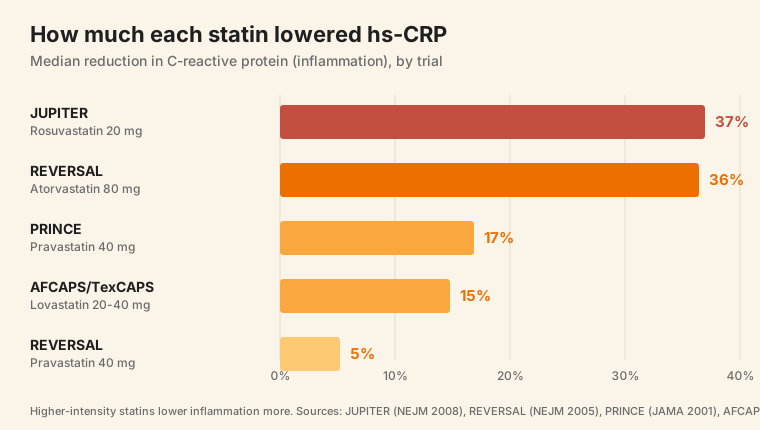 The same trial that put atorvastatin 80 mg against pravastatin 40 mg shows the gap clearly: 36% versus 5%. Source: REVERSAL, NEJM 2005.
Why do statins lower inflammation?
Statins work by blocking an enzyme (HMG-CoA reductase) your liver uses to make cholesterol. But that same pathway feeds into a set of “pleiotropic” effects beyond cholesterol, including calming the inflammatory response in the artery wall and the liver’s production of C-reactive protein.
The telling detail is that the LDL drop and the hs-CRP drop are only weakly related. In JUPITER and other trials, knowing how much someone’s LDL fell told you very little about how much their inflammation fell. Ridker, who led much of this research, has argued for years that the two are largely separate effects. (It’s a genuine debate: some later analyses find more overlap between the two than he did.) Either way, a statin can move both numbers, and the inflammation effect isn’t just a side effect of the cholesterol effect.
Do stronger statins lower inflammation more?
Yes, and the cleanest proof is a single trial. REVERSAL put high-intensity atorvastatin 80 mg head to head against moderate-intensity pravastatin 40 mg in the same patients. Atorvastatin cut hs-CRP by 36%. Pravastatin cut it by 5%.
That’s a seven-fold difference in the same study, and it roughly mirrors the gap in how much each drug lowers LDL. The intensity of the statin matters for inflammation much as it does for cholesterol. The right intensity for any individual is a separate question that depends on their overall risk, and it belongs with their doctor.
Does lowering inflammation actually prevent heart attacks?
The 37% figure would be a curiosity if inflammation were just a passive marker. The evidence says it isn’t. JUPITER’s 44% drop in events is the first clue. The stronger proof came from CANTOS, a trial of canakinumab, a drug that lowers inflammation without touching cholesterol at all. It still reduced cardiac events. That decoupled inflammation from LDL and showed that lowering inflammation, by itself, lowers risk.
Some new studies look at a different marker of inflammation, IL-6, and its relationship with Lipoprotein (a). One across the MESA and UK Biobank cohorts found that IL-6 predicts heart disease on its own, even after accounting for hs-CRP and the usual risk factors. A Mendelian randomization study of over 400,000 people found that genetically lower IL-6 signaling correlates with less heart disease, which is about as close as you can get to a lifelong anti-inflammatory drug without running a decades-long trial. Both studies found the benefit stacked on top of lowering Lp(a), a separate particle that drives risk through its own pathway. In other words, inflammation and Lp(a) are two independent levers.
How to know if your statin is lowering your inflammation
The only way to see the effect is to measure it. hs-CRP is a simple blood test, and the useful pattern is to check it before starting a change and again a few months later.
A good hs-CRP is under 1 mg/L. Above 3 mg/L is considered high risk. If you start a statin (a decision for you and your doctor), a follow-up test tells you whether your inflammation actually came down, the same way a lipid panel tells you whether your LDL did. Some people see a big drop and some see little, and the number is the only way to know which you are.
hs-CRP runs about $69 on its own, or $190 as part of a comprehensive panel that also includes ApoB, Lp(a), HbA1c, and other key heart markers. If you’re interested in learning how diet can help, see how to lower inflammation through diet and medication.
Get your free 30-day heart health guide
Evidence-based steps to optimize your heart health.