Vitamin D acts more like a hormone than a vitamin. Part of the reason is that the Vitamin D receptor acts as a transcription factor for more than 1,000 genes.
I was pretty surprised that Vitamin D is so pervasive. This post covers a bit of the science behind the vitamin D transcription network, why the number of vitamin D binding sites is much larger than actual number of genes affected, and some example pathways for rickets, gut, and immune system.
The Vitamin D gene network is multi-level
Vitamin D regulation isn’t one flat layer. VDR turns on a first wave of genes directly, and many of those first-wave genes are themselves transcription factors that go on to switch a second wave. One 2021 analysis mapped the full cascade. Of 3,631 responding genes, about 58% were direct VDR targets and the rest were driven indirectly through 47 transcription factors that VDR activates first.
Here’s the actual regulatory network:
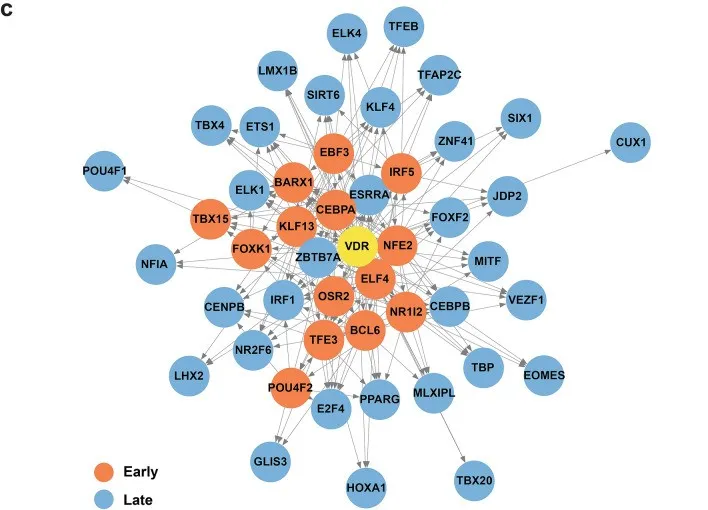 Vitamin D regulatory network. VDR (yellow) directly activates early transcription factors (orange), which then regulate later ones (blue). From Scientific Reports 2021
Example vitamin D pathways
Here are a few examples of individual circuits that have actually been mapped. They show how different vitamin D’s effects are.
Gut: turning on calcium absorption
Vitamin D was first discovered because it helps prevent rickets. In your intestines, vitamin D activates two genes: TRPV6, which brings calcium from food into your cells, and calbindin-D9k, which helps carry that calcium through the cell. Both of these genes have specific spots that the vitamin D receptor attaches to, turning them on directly. If one of these genes isn’t working, others can sometimes fill in, showing that vitamin D controls a whole system rather than relying on an individual switch.
Immune cells: making your own antibiotics
When certain immune cells (like macrophages) detect a germ, they boost their levels of the vitamin D receptor and the enzyme that activates vitamin D. The active form of vitamin D then turns on the CAMP gene, which makes cathelicidin (LL-37), a protein that helps kill bacteria like the one that causes tuberculosis. CAMP is switched on directly by vitamin D, and interestingly, the piece of DNA that allows this is only found in primates, making this defense trick quite human-specific.
Kidney: helping control blood pressure
Vitamin D doesn’t just turn genes on: it can turn them off too. In your kidneys, vitamin D receptor turns down the REN gene, which makes renin, a protein that starts a process to raise blood pressure. Mice that don’t have a working vitamin D receptor make too much renin and end up with high blood pressure. This effect happens even if calcium is normal, showing a direct link between vitamin D and blood pressure.
Why the exact number of genes depends on the cell and method of analysis
The 5% figure is a genome-wide average, not a fixed list. The specific genes vitamin D controls in a T cell differ from the ones it controls in bone or intestine. In fact, across 94 different cell models, only two genes (CYP24A1, which breaks vitamin D back down, and CLMN) showed up as shared targets everywhere.
VDR binding sites outnumber actual genes
The number of places the vitamin D receptor (VDR) exists on DNA is significantly larger than the number of genes it actually controls. Genome-wide ChIP-seq is a technique that maps every spot a protein binds across the genome. It found VDR at 5,000 to 20,000 sites once active vitamin D is present, but most of those sites have no assigned target gene. So “thousands of binding sites” and “around a thousand regulated genes” are both true.
Vitamin D regulates somewhere between 1,000 and 4,500 genes
The exact number of genes that vitamin D regulates depends a bit on the cell type and measurement method. Across most cell types, more than 1,000 genes change their expression after a day of exposure to active vitamin D. (There are 20,000 protein-coding genes in the genome, so this creates a lower bound of 5%) Some studies found more, e.g., one microarray sequencing study found between 3,372-4,532 genes were significantly regulated by vitamin D.
More on Vitamin D
For the bigger picture, see why vitamin D acts more like a hormone than a vitamin, why the D2 vs D3 form matters when you supplement, and what a randomized trial found about vitamin D and heart attack risk. To see where your own level sits, a standard vitamin D blood test measures it.
Get your free 30-day heart health guide
Evidence-based steps to optimize your heart health.