People often state that AI research can only be done in the big labs, but in my view, this is a myth.
The most recent instance of this controversy came when Paul Graham recently wrote that if he were 17, he would learn to build language models from scratch. The initial Hacker News reaction was that “an incredibly small minority of companies in the world do any real training or optimisation.” A recent study by John Ioannidis and colleagues actually looked at all 317 AI “unicorns” and found more than half had no qualifying scientific output, so rather unfortunately, the big AI labs are no longer publishing as much as they once did.
Here’s my evidence that “little tech” is actually a great place to advance the frontiers of AI, and to publish your work. I’ve found at least 20 YC startups who have recently published at NeurIPS, ICML, and ICLR. The work itself spans protein models, clinical trials, wearable data, computer-use agents, federated learning, model interpretability, and program synthesis. IMO, this is evidence that a small team can still make a useful contribution by choosing a specific problem, building proprietary data and evaluation system around it, and publishing what it learns.
I hope this post encourages more of this in the startup world. Onward to the actual details.
Which YC startups publish machine learning research?
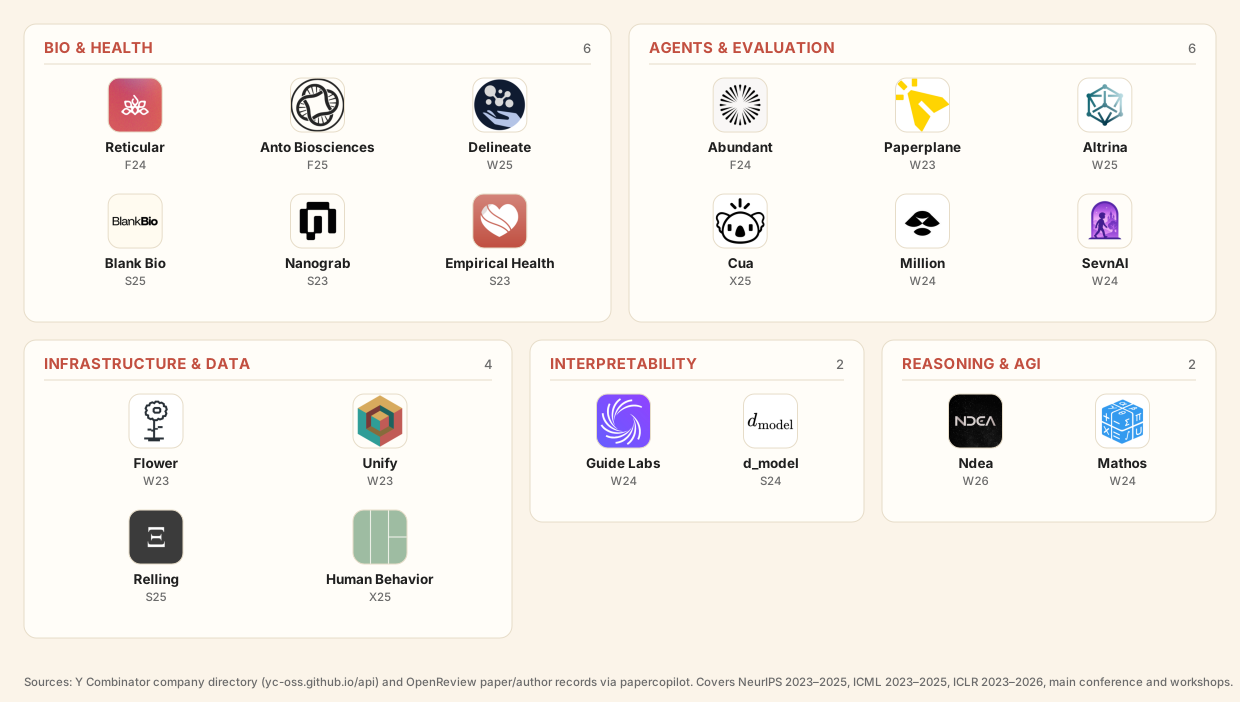
To build this list, I cross-referenced every Y Combinator company from the Winter 2023 batch onward against NeurIPS, ICML, and ICLR papers since 2023. I kept a paper only when an author’s email domain or stated affiliation was the startup itself (no prior academic work).
There are a couple of interesting trends and patterns.
Biology is the largest cluster
6 of 20 companies work in biology or health. Reticular studies sparse autoencoders for protein structure models. Anto Biosciences builds foundation models for the gut microbiome. Blank Bio works on RNA models, Nanograb on biomolecular design, Delineate on clinical trials, and Empirical Health on JEPA-based physiological time-series.
Biology is a good fit for startup research because the frontier is not set by scale alone, but by access to novel and proprietary data sets. Domain knowledge is also quite significant here. As a more practical concern, the research can support the product since peer-reviewed validation matters more in Bio & Health. For example, Reticular publishes methods for interpreting protein models, while its commercial work applies genomic AI to embryo selection. Empirical published JETS, a joint-embedding time-series model trained on 3 million person-days of wearable data, while the product uses wearable and clinical data to help prevent heart disease.
A protein model with interpretable controls
Most language models hide useful features inside millions or billions of learned parameters. Guide Labs’ Concept Bottleneck Language Models for Protein Design inserts a layer whose neurons correspond to more than 700 human-readable protein concepts — think things like helix, sheet, and turn structure. A scientist can change those concept values and steer the generated protein, rather than prompting a black box and hoping the desired property appears.
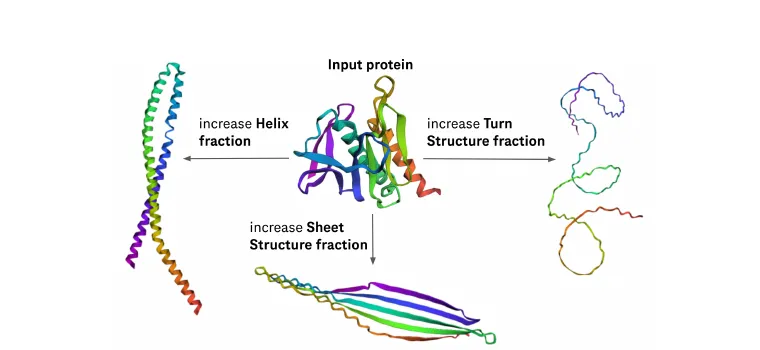
Changing named concepts produces different protein structures. Figure from Guide Labs’ Concept Bottleneck Language Models for Protein Design.
A JEPA-based model for health timeseries
Our own work, JETS, applied the joint embedding predictive architecture (JEPA) to sparse, irregular wearable data, training it to predict masked regions in a learned representation rather than reconstructing noisy sensor values. Despite coming from a small startup, JETS was trained on the same scale of wearable data as Google’s SensorLM and outperformed established baselines on several disease and biomarker-prediction tasks.
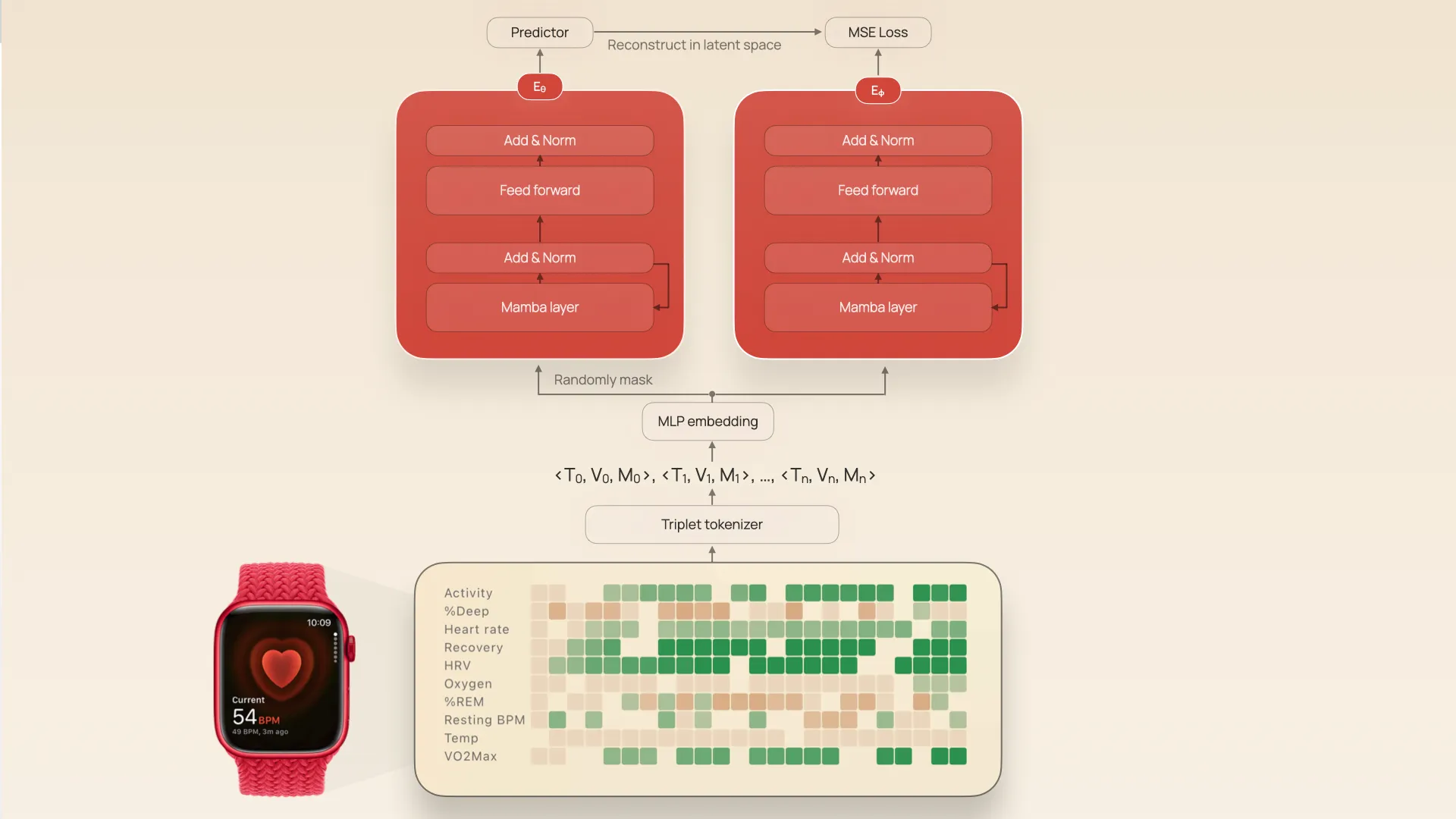
JETS learns from masked wearable time series by predicting their representations in latent space.
Searching for a program inside a neural network
Ndea’s Searching Latent Program Spaces asks: what if a neural network represented possible programs in a small continuous space, then searched that space when it encountered a new problem? Its Latent Program Network encodes input-output examples into a candidate program, improves that program with gradient search, and then uses a decoder to apply it to a new input.
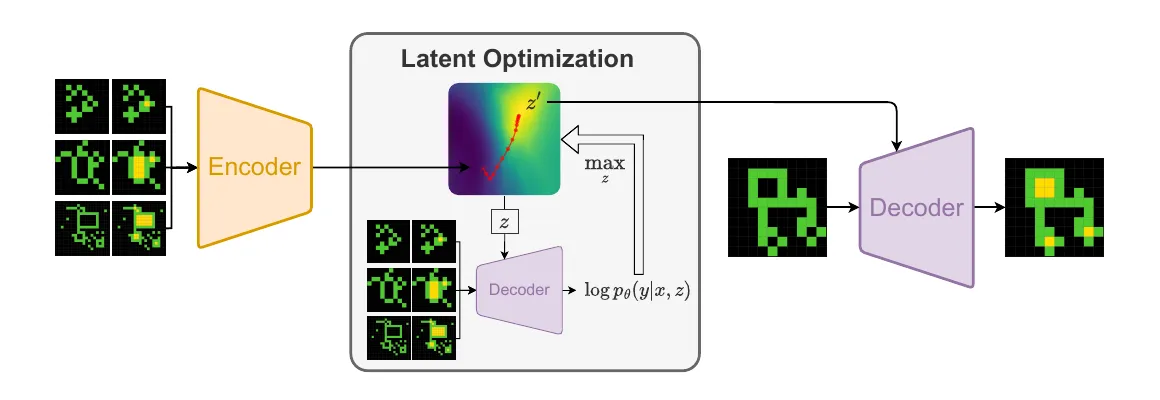
Latent Program Network searches a compact continuous representation of programs at test time. Figure from Ndea’s Searching Latent Program Spaces.
A more difficult agent benchmark
Paperplane’s Factorio Learning Environment replaces short question-answer benchmarks with an open-ended “factory” (cute name). Agents write Python to gather resources, place machines, inspect failures, and reuse code. The game’s technology tree creates a natural difficulty curve: each advance requires a larger and more coordinated production system. Better agents can build progressively larger “factories” instead of merely gaining another percentage point on a fixed test set.
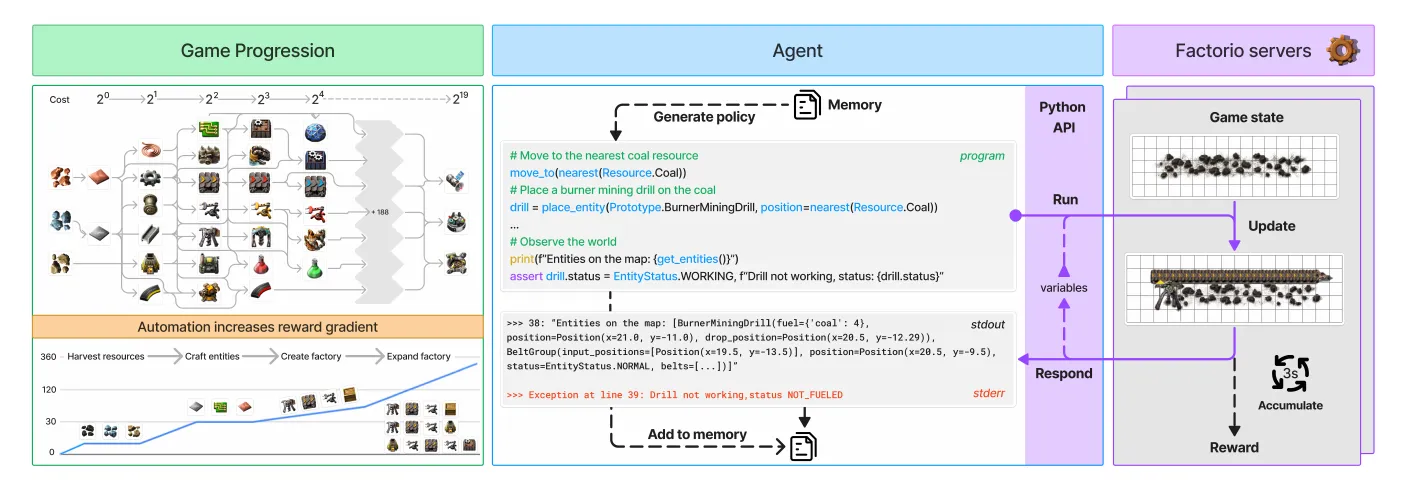
Agents write and debug Python while the factory accumulates state over long trajectories. Figure from Paperplane’s Factorio Learning Environment.
Raw list of recent ML papers by YC startups
| Company | Domain | Paper | |
|---|---|---|---|
| Abundant | Agents & evaluation | Verifying the Verifiers: Failure Attribution for Benchmark Diagnostics and Training Data Curation | |
| Abundant | Agents & evaluation | Verifying the Verifiers: Failure Attribution for Agentic Benchmark Diagnostics and Training Data Curation | |
| Altrina | Agents & evaluation | Real-Time Procedural Learning From Experience for AI Agents | |
| Anto Biosciences | Biology & health | Darwin-7B: A Multi-Omic Foundation Model for the Human Gut Microbiome via Sparsified Quality-Aware Tokenization | |
| Anto Biosciences | Biology & health | CausalOmics-10T: An Evolving Foundational Dataset to Enable Causal Modeling of Microbial Ecosystems | |
| Blank Bio | Biology & health | mRNABench: A curated benchmark for mature mRNA property and function prediction | |
| Cua | Agents & evaluation | Windows Agent Arena: Evaluating Multi-Modal OS Agents at Scale | |
| d_model | Interpretability | OMEGA: Can LLMs Reason Outside the Box in Math? Evaluating Exploratory, Compositional, and Transformative Generalization | |
| Delineate | Biology & health | ADAB: A Culturally-Aligned Automated Response Generation Framework for Islamic App Reviews by Integrating ABSA and Hybrid RAG | |
| Delineate | Biology & health | FlowNIB: An Information Bottleneck Analysis of Bidirectional vs. Unidirectional Language Models | |
| Empirical Health | Biology & health | JETS: A Self-Supervised Joint Embedding Time Series Foundation Model for Behavioral Data in Healthcare | |
| Flower | Infrastructure & data | FlowerTune: A Cross-Domain Benchmark for Federated Fine-Tuning of Large Language Models | |
| Guide Labs | Interpretability | Concept Bottleneck Generative Models | |
| Guide Labs | Interpretability | Concept Bottleneck Language Models For Protein Design | |
| Guide Labs | Interpretability | Generative property enhancer: implicit guided generation through conditional density estimation | |
| Guide Labs | Interpretability | Are Easier or Harder Examples Better? Rethinking Data Selection for Reward Models and Preference Optimization | |
| Human Behavior | Infrastructure & data | Relational Graph Transformer | |
| Mathos | Reasoning & AGI | StateFlow: Enhancing LLM Task-Solving through State-Driven Workflows | |
| Million | Agents & evaluation | VerMCTS: Synthesizing Multi-Step Programs using a Verifier, a Large Language Model, and Tree Search | |
| Nanograb | Biology & health | Programming co-folding to design binders for intrinsically disordered epitopes | |
| Ndea | Reasoning & AGI | Searching Latent Program Spaces | |
| Ndea | Reasoning & AGI | Searching Latent Program Spaces | |
| Ndea | Reasoning & AGI | Gradient-Based Program Synthesis with Neurally Interpreted Languages | |
| Paperplane | Agents & evaluation | Factorio Learning Environment | |
| Paperplane | Agents & evaluation | Language Models Rate Their Own Actions As Safer | |
| Relling | Infrastructure & data | EGO-FLIGHT: Egocentric Grounding of Order for Frame-Level Inference in General Human Timelines | |
| Reticular | Biology & health | Towards Interpretable Protein Structure Prediction with Sparse Autoencoders | |
| Reticular | Biology & health | Scaling Sparse Autoencoders for Interpreting Protein Structure Prediction | |
| Reticular | Biology & health | Towards Interpretable Structure Prediction With Sparse Autoencoders | |
| Reticular | Biology & health | Enforcing Orderedness in SAEs to Improve Feature Consistency | |
| Reticular | Biology & health | Mechanistic Interpretability of Antibody Language Models Using SAEs | |
| SevnAI | Agents & evaluation | Agentic Uncertainty Reveals Agentic Overconfidence | |
| Unify | Infrastructure & data | Accelerating Deep Learning using Ivy |
Some papers appear more than once because a later version was accepted at another venue. The full dataset includes venues, decisions, authors, and the affiliation behind every match.
Appendix: methodology details
The company list is from the yc-oss API: 2,271 companies in batches from Winter 2023 through Fall 2026. The papers were derived from OpenReview author records via papercopilot, which include each author’s self-reported affiliation and email domain. The search included NeurIPS 2023 to 2025, ICML 2023 to 2025, and ICLR 2023 to 2026, including main conferences and workshops.
Matching on company name alone didn’t’t work because startup names collide with research institutions. YC’s Units is not the University of Trieste (units.it). YC’s Vector is not the Vector Institute. YC’s Valence is not Recursion’s Valence Labs. We reviewed those collisions by hand. ICML 2026 hadn’t published affiliation data when we ran the search, so nothing from it appears here. Founders who publish under a university affiliation are excluded by design, which probably undercounts the real number of YC startups doing research since some are legitimately academic spinouts.
Get your free 30-day heart health guide
Evidence-based steps to optimize your heart health.