How often does Apple Watch flag possible high blood pressure? In Empirical Health’s sample, 2.7% of actively tracked users had a hypertension notification recorded per month, roughly 1 in 40.
| Month | Users notified | Users tracked | Percentage |
|---|---|---|---|
| June 2026 | 88 | 3,504 | 2.5% |
| July 2026 | 101 | 3,465 | 2.9% |
| August 2026 | 85 | 3,237 | 2.6% |
We started with 3,783 users age 22 and older with at least 30 days of Apple Watch resting-heart-rate data during June–August 2026. Each month’s denominator required at least 14 days of data that month. We counted each user once per month; 85 users were notified in multiple months. Empirical reads notifications shared through Apple Health, so these figures depend on what users share with us.
Resting heart rate and age were the clearest correlates. In a separate analysis of any recorded alert before September 8, 1,152 participants had all four measurements. Higher resting heart rate, by 10 bpm, was associated with 1.78 times the odds of a recorded notification, after accounting for age, BMI, and heart rate variability (HRV). Older age and higher BMI also had positive associations. HRV’s independent association was less consistent across models.
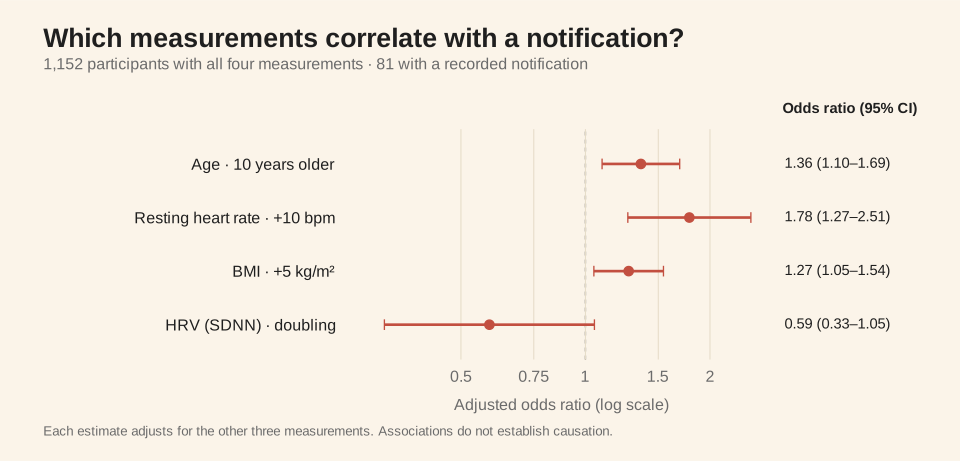 Exploratory logistic regression, with each measurement adjusted for the other three. BMI was calculated from height and weight.
Apple Watch hypertension alerts aren’t diagnoses. Apple recommends tracking blood pressure with a cuff for seven days and discussing the readings with a healthcare professional. Our guide to hypertension notifications explains the next steps.
Get your free 30-day heart health guide
Evidence-based steps to optimize your heart health.