Typically, we think of heart disease as the slow progression of coronary plaque. You can slow it, but you can’t reverse it.
Or can you? A new clinical trial actually did reduce coronary plaque with very low cholesterol targets (43 mg/dL). Somewhat paradoxically, calcified plaque still grew as total plaque shrank.
We’ll look at what the study showed, how they measured plaque with CCTA imaging, what these changes mean for treatment.
Intensive cholesterol treatment shrank coronary plaque by 21%
The study, FLOWPROMOTE, randomly assigned 104 patients with newly diagnosed heart disease to two treatments. None had taken statins prior. They had substantial artery narrowing and CT evidence of restricted blood flow; their average age was 64, and 79% were men. Researchers measured plaque with coronary CT angiography (CCTA) at the start, 9 months, and 18 months.
Both treatments intensively lowered cholesterol:
| Measure | Atorvastatin 40 mg | Rosuvastatin 40 mg + ezetimibe 10 mg |
|---|---|---|
| Starting LDL cholesterol | 120 mg/dL | 127 mg/dL |
| Achieved LDL cholesterol | 70 mg/dL | 43 mg/dL |
| Total plaque volume | 14% less | 21% less |
| Noncalcified plaque volume | 20% less | 28% less |
| Calcified plaque volume | Increased | Increased |
Plaque shrank in most individual patients:
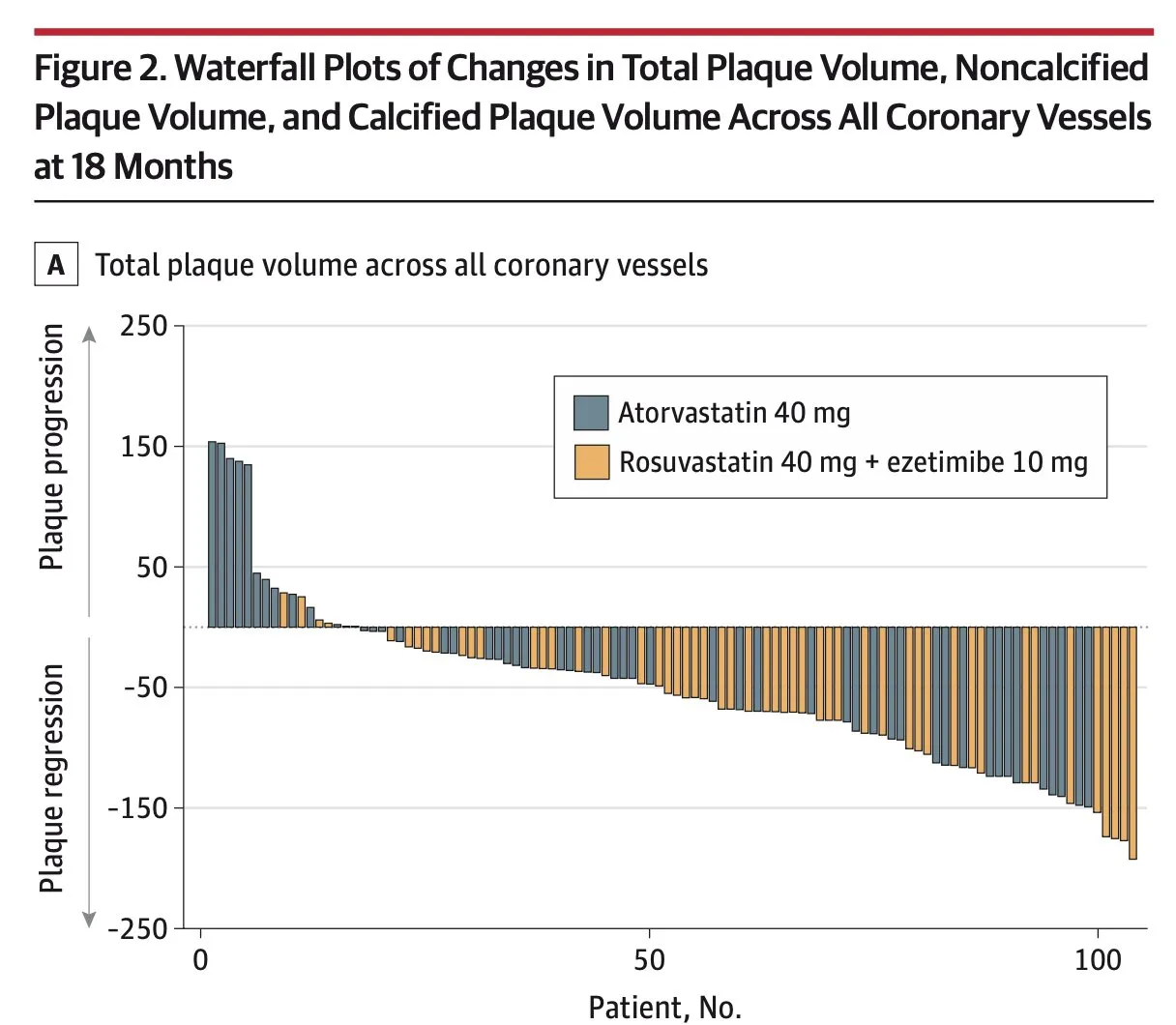
Coronary plaque waterfall chart. Each bar is one patient, ordered by change in plaque volume. Source: Mortensen et al., JAMA Cardiology, 2026.
Why can calcium increase while plaque improves?
Plaque is living tissue containing fat, inflammatory cells, scar-like tissue, and calcium. With cholesterol treatment, its fatty component can shrink while calcium deposits grow and become denser. A study using repeat CT scans found this pattern in statin users.
Physically, what’s going on? Calcium accumulates as mineral crystals in the tissue. Experiments using human plaque samples and laboratory models show that tiny particles released by cells can seed these crystals, which aggregate into larger deposits. This article on how plaque calcifies has more detail.l
A calcium scan measures only calcified plaque. CCTA measures both calcified and noncalcified plaque, so it can reveal shrinkage that a calcium score alone would miss.
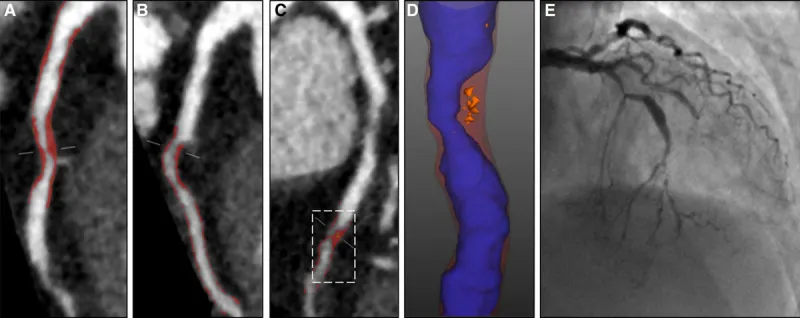
CT shows plaque in the artery wall; these images illustrate anatomy rather than a treatment response. Source: Williams et al., Circulation, 2020.
What does this mean for your heart disease treatment?
A previous study showed very low cholesterol targets (going from 70 to 55 mg/dL) reduced coronary events by 33%. This study reveals a potential mechanism, the shrinking of soft plaque.
Modern medicines can reduce LDL cholesterol or ApoB by 85%.
My guess is that as the evidence builds, future guidelines are going to recommend much lower targets. We don’t seem to have found a lower bound where the benefits of controlling cholesterol saturate.
Get your free 30-day heart health guide
Evidence-based steps to optimize your heart health.