The premise of Grail’s cancer test is simple: screen for more than 50 cancers with a single blood test in order to catch cancer early, when it can be cured.
The main concerns from doctors are false positives, and secondarily cost (Grail’s list price is $949).
So I ran the numbers on cancer cases caught, missed, and false positives. What surprised me was how good Galleri looked in comparison to conventional cancer screening. Across adults aged 50–74, my simulation estimates that conventional screening generates 33 false-positives per cancer detected. Adding Galleri detects 236% more cancers with just 8% more false-positives:

I’ll explain a bit of background on cancer screening, how this simulation worked, and then the results and what I think they mean.
Conventional cancer screening targets 4 cancers
Routine screening covers breast (mammograms), colorectal (colonoscopy or stool tests), cervical (Pap/HPV tests), and lung cancer (CT for eligible current and former smokers). Each has its own eligibility rules, set by the US Preventive Services Task Force.

Cancer caught, missed, and false postives among current USPSTF screening methods.
How did I calculate this? Let’s use an example. Suppose 1,000 women aged 65–69 each get a mammogram. We need three inputs: prevalence, sensitivity, and specificity.
Prevalence is the share who have cancer at screening. Our age-specific incidence input is about 4.2 new breast cancers per 1,000 women per year. Assuming a one-year detectable window gives an illustrative screening prevalence of 0.42%: 4.2 with cancer and 995.8 without.
Sensitivity is the share of cancers detected; specificity is the share of cancer-free people who test negative. Historical studies of mammography show a sensitivity of 86.9% and specificity of 88.9%.
Putting it all together:
| Outcome | Calculation | Expected results per 1,000 |
|---|---|---|
| True positives: cancer detected | 4.2 × 86.9% | 3.65 |
| False negatives: cancer missed | 4.2 × 13.1% | 0.55 |
| False positives: positive without cancer | 995.8 × 11.1% | 110.53 |
| True negatives: negative without cancer | 995.8 × 88.9% | 885.27 |
These are expected counts, so fractions are normal. A couple of caveats: these annual estimates include cancers missed between screenings. False positives do count some useful cervical precancer findings and non-precancerous polyp removals. Colorectal precancers are excluded; prevention is counted separately.
To apply this to Grail, we need to know the prevalence by age group of each cancer and Grail’s sensitivity and specificity for that sub-type.
How Grail’s accuracy varies by cancer sub-type
Grail has run a series of peer-reviewed validation studies on their test. The first, CCGA (Circulating Cell-Free Genome Atlas), was an observational study that compared people with an dwithout known cancer. Subsequent studies, PATHFINDER and PATHFINDER 2 are interventional trials that compared usual care (control arm) with Grail screening (experiment arm).
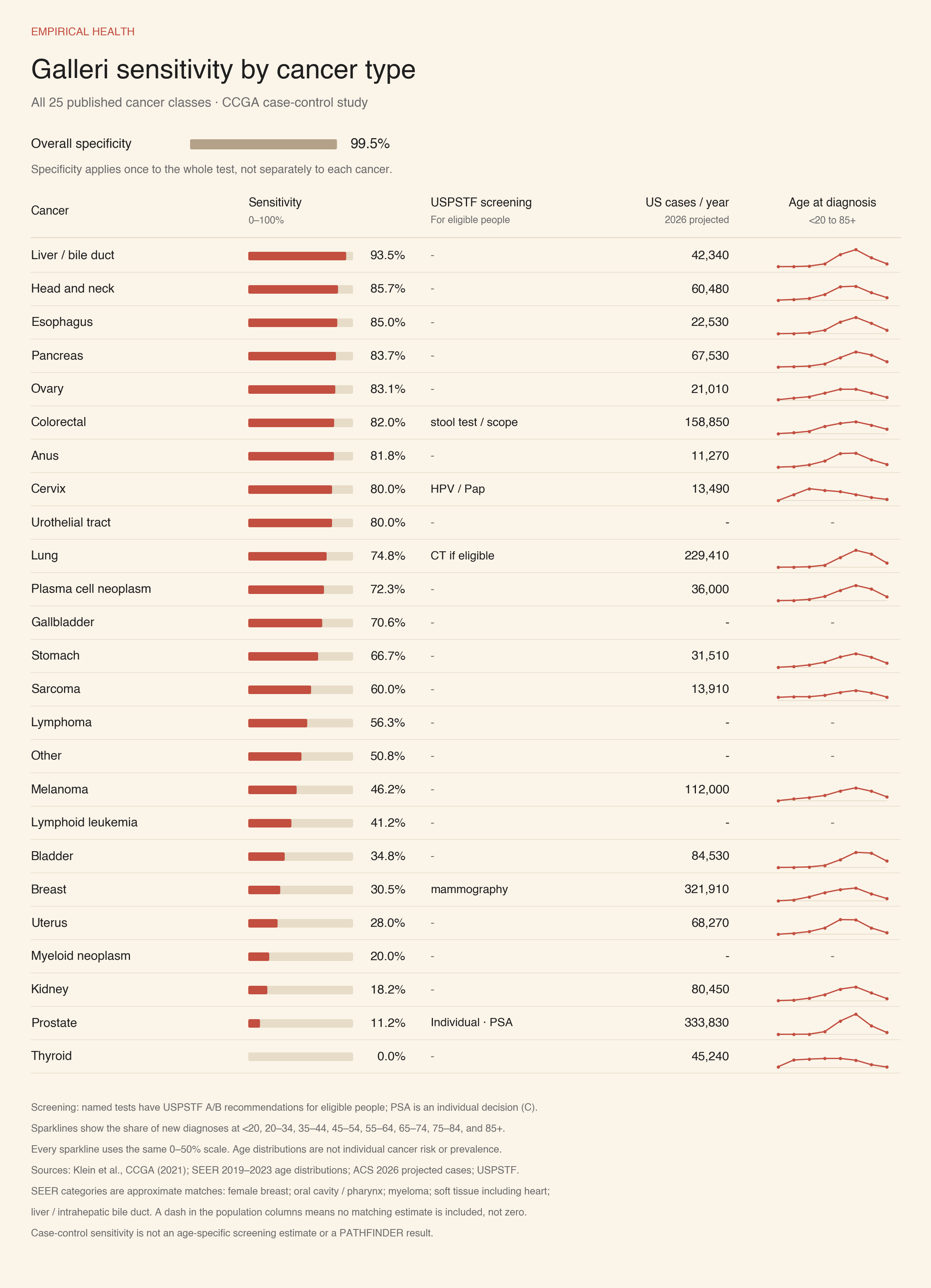
Grail’s overall specificity is 99.5% (Grail is tuned to minimize false positives). Sensitivity (the percent of cancer caught) varied by subtype. For example, Galleri detected 93.5% of liver/bile-duct cancers, 30.5% of breast cancers, 11.2% of prostate cancers, and no thyroid cancers:
Modeling the overall effect of adding Grail to conventional cancer screening
What happens when we add Galleri screening to the 4 conventional cancer screens above? (As an aside, it generally never makes sense to only do Galleri — it’s least accurate for the cancers that have conventional screens).
I combined US cancer incidence, screening eligibility, and test performance, then added annual Galleri:

Adding Galleri catches more cancers in every modeled age band, with about four extra false positives per 1,000 people/year.
How dangerous is a false positive?
The other dimension of false positives is how much danger is caused to the patient. If confirming a cancer simply requires another blood test, the danger is relatively low. Whereas invasive testing can do damage in itself.
In PATHFINDER 2’s targeted workup, 57 of 123 false-positive participants (46%) underwent an invasive procedure. Four had surgery, which found benign growths.
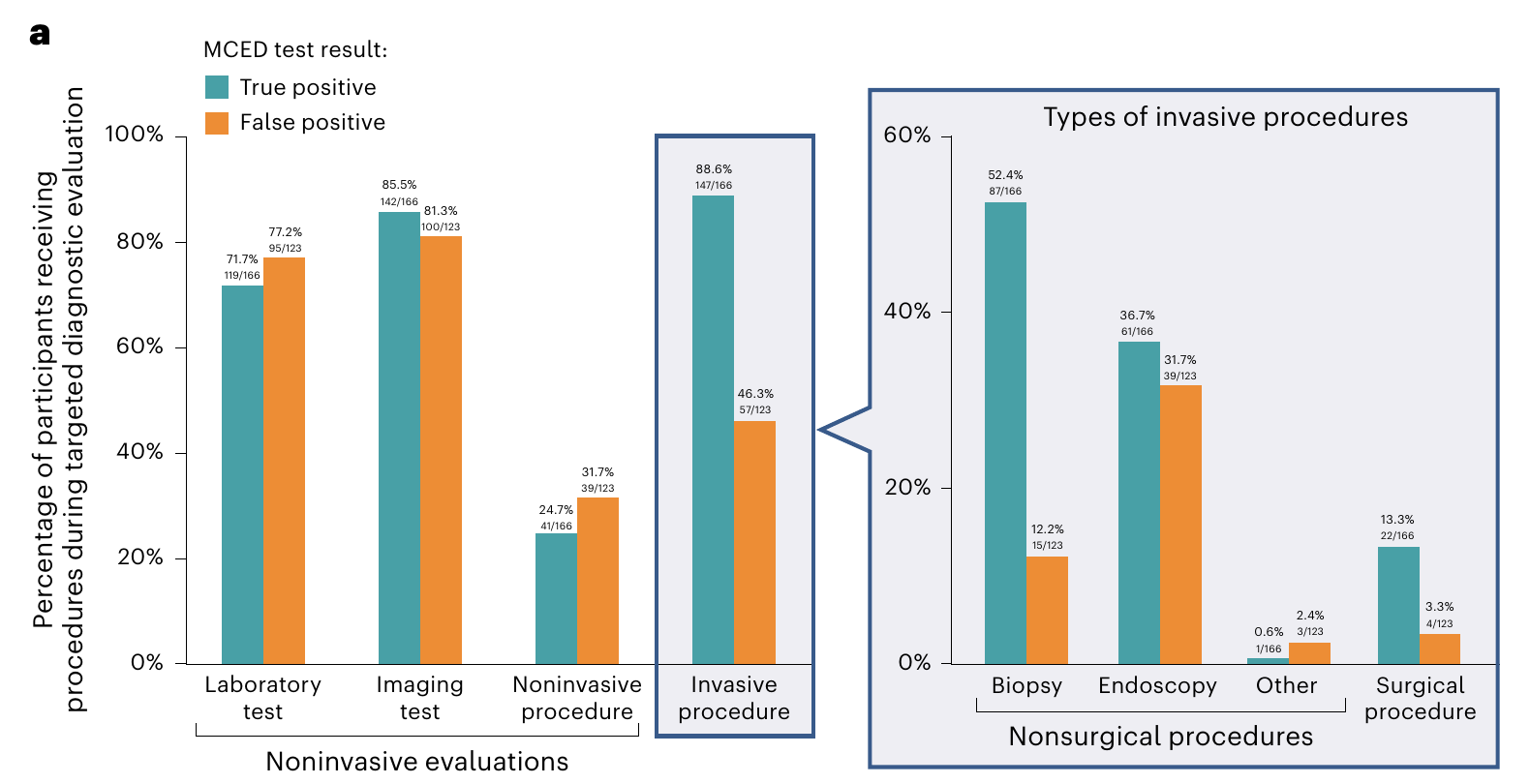
How often false alarms led to invasive testing. Source: Nabavizadeh et al., Nature Medicine, 2026
No serious study-related adverse events were reported by the analysis cutoff, though that doesn’t rule out rare complications. Across all positive-result workups, 91% of invasive procedures were nonsurgical. This data is all from a Nature article on study safety results.
What would change the conclusion?
The major unanswered question is whether earlier detection improves treatment or survival enough to justify the cost and follow-up. One clinical trial of Galleri the NHS failed to meet its primary endpoint (reduces the incidence of stage III or IV cancers), but did show good specificity, sensitivity, and incidence of Stage IV cancer. A similar trial of colonoscopy (which is widely believed to be a good thing) had a similar null primary outcome. This is often the case with screening trials; we’re usually dealing with incomplete evidence.
My read is that, based on the evidence we have today, the Galleri test more than doubles the rate of cancer detection at a surprisingly low number of false positives. It’s not covered by insurance, but is available for $849 online. I personally think if you can afford it, it’s a good tool to add to your arsenal, and I think it’ll likely become part of the standard of care as cost comes down and accuracy improves.
Get your free 30-day heart health guide
Evidence-based steps to optimize your heart health.