Peter Attia helped make zone 2 training a staple of longevity advice. Now he’s reconsidering how much of your limited workout time it deserves. In his October 12, 2026 podcast, he revisited the familiar 80/20 split between easy and hard cardio, particularly for people who don’t have hours to train. Attia’s October AMA
The practical question is whether carefully staying in an easy heart-rate zone gives you the most benefit from the time you have. To answer it, we need to separate what elite athletes do, what exercise experiments show, and what we actually know about living longer.
What did Peter Attia change about zone 2?
In August 2024, Attia’s website described zone 2 as “critical for improving and maintaining mitochondrial health and aerobic capacity.” Mitochondria are the structures inside your cells that use oxygen to produce usable energy. Attia’s 2024 guide
His August 2026 article puts more emphasis on your constraints. With abundant training time, easy exercise lets you accumulate work without overwhelming recovery. With only two hours a week, an established exerciser might skip dedicated zone 2 sessions and use two sessions containing higher-intensity intervals. Those sessions still include warm-ups and easy recovery periods. He explicitly excludes beginners from this prescription and rejects the idea that zone 2 has unique mitochondrial benefits. Attia’s updated explanation
Rhonda Patrick has also challenged zone 2’s special status. In a December 2025 discussion, she emphasized that harder exercise can provide a stronger stimulus for mitochondrial adaptation. Her comments support the broader reassessment, though they don’t establish that she reversed an earlier position. Patrick’s discussion
What is zone 2 training?
Zone 2 generally means sustained aerobic exercise just below the first lactate or ventilatory threshold, where blood lactate or breathing begins to increase more noticeably as effort rises. A 2025 expert panel favored this physiological definition. Zone numbering varies across training systems, so a watch’s zone 2 isn’t necessarily the same intensity. Expert viewpoint
In practice, think of cycling or jogging at a pace where you can speak in sentences, although talking takes some effort. Attia now emphasizes this talk test for most recreational exercisers rather than precise lactate testing. Finding zone 2
What evidence supported the original zone 2 advice?
The advice combined plausible biology with observations from endurance sports.
In an early interview with Attia, physiologist and cycling coach Iñigo San Millán described seeing improvements in fat oxidation and lactate clearance at this intensity across decades of work with athletes. Those observations offered a reason to investigate zone 2, but they weren’t a randomized comparison of exercise programs for longevity. Original interview
Training logs also showed that successful endurance athletes spent much of their training at low intensity. A 2006 study of junior cross-country skiers compared heart-rate records with ratings of perceived exertion across 318 sessions. Both methods classified about three-quarters of sessions as low intensity and roughly one-sixth as high intensity. Training-distribution study
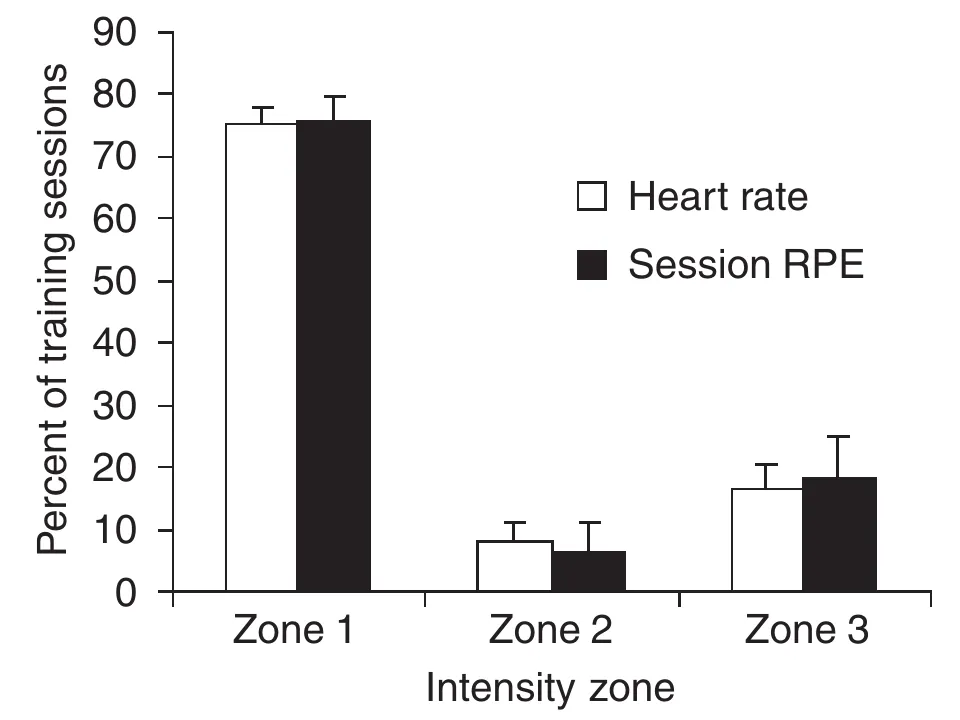
Most sessions were easy, with a smaller share of hard training. Source: Seiler and Kjerland, Scandinavian Journal of Medicine & Science in Sports, 2006.
The chart uses a three-zone system: its “zone 1” is below the first ventilatory threshold, encompassing the easy intensity discussed here as zone 2. Its “zone 2” is the harder range between two thresholds. RPE means rating of perceived exertion; the paired bars compare two ways of classifying the same training, not two exercise programs.
This pattern helped support the approach commonly summarized as 80/20. But counting minutes gives a different result: 91% of recorded training time was below the first threshold. Recovery periods within a hard session contribute easy minutes.
Applying the athletes’ pattern to someone with two hours a week requires an additional assumption: that the distribution supporting elite performance at high training volumes also maximizes health benefits at low volumes. The study observed training habits; it didn’t assign different programs or measure longevity.
What changed in the evidence?
A 2025 review, Much Ado About Zone 2, examined the claim that this intensity is optimal for mitochondrial capacity and fat oxidation. Its authors found insufficient evidence for that special status and argued for greater emphasis on harder exercise when training volume is low. It was a narrative review of existing research, not a new clinical trial. The authors also acknowledged that few studies explicitly tested zone 2, which limits precise comparisons. 2025 review
Some of the evidence challenging zone 2’s special status predates its recent popularity. In a 2017 experiment, ten active young men trained one leg with intervals and the other with continuous cycling. Each leg completed six sessions over two weeks, matched for total work and session duration.
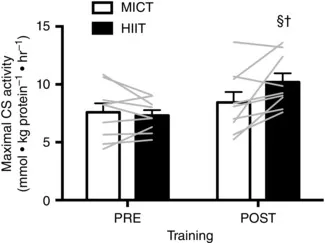
Interval training increased a marker of mitochondrial content more than continuous cycling matched for work and duration. Source: MacInnis et al., The Journal of Physiology, 2017.
The white bars represent moderate-intensity continuous training (MICT), and the black bars represent high-intensity interval training (HIIT). The measurement is citrate synthase activity, a marker used to estimate mitochondrial content in muscle. Gray lines show individual responses; error bars show the standard error of the mean. Nine participants had data for this analysis. The symbols mark significant changes within the interval condition and the post-training difference between conditions.
This was a short muscle experiment, not a direct test of today’s zone 2 prescription or of which program extends life. It challenges the idea that easy continuous exercise has a unique advantage for mitochondrial adaptation.
A 2007 randomized trial tested a different outcome: aerobic fitness. Forty moderately trained men completed one of four running programs for eight weeks. The interval groups improved VO₂ max more than continuous-training groups with comparable total work; the four-minute interval group improved by 7.2%. That result doesn’t guarantee the same improvement in older adults, women, or beginners.
VO₂ max measures how much oxygen your body can use during maximal exercise. A training program can improve it without proving that the program prevents more deaths than another program. The research above supports including harder exercise and questions claims of a uniquely beneficial zone. It doesn’t establish a single optimal split for longevity, or identify which study caused Attia to change his advice.
What exercise should you do instead?
Build a routine around your starting fitness, available time, and ability to recover. Easy cardio remains useful; the change is giving harder efforts a deliberate place when you can tolerate them.
Public-health guidance already allows this flexibility: adults should accumulate at least 150 minutes of moderate activity or 75 minutes of vigorous activity per week, or an equivalent combination, plus muscle-strengthening activity on at least two days. Some activity is better than none. These targets don’t require a particular zone distribution. CDC activity guidelines
If you’re starting from little exercise, build consistency with walking, cycling, or another manageable activity, then increase duration and effort gradually. If you’re already exercising regularly, a practical starting adjustment is to replace one easy cardio session with an interval session and assess how well you recover. People training for long endurance events will still need substantial easy volume.
For someone ready for sustained hard efforts, a 4 × 4 workout offers a concrete example:
- Warm up easily for about 10 minutes.
- Exercise hard for four minutes at an effort you can sustain through the interval.
- Recover easily for three minutes.
- Complete four hard intervals, with recovery between them, then cool down for about five minutes.
The four-minute efforts and three-minute recoveries follow the fitness trial; the warm-up and cooldown durations here are practical additions. Only 16 of the 40 minutes are hard work.
The hard intervals should feel demanding, with talking difficult, while leaving enough control to complete the session. They’re sustained efforts rather than all-out sprints. Shorter intervals may be a more manageable starting point; build up before attempting the full workout. If a heart condition or exercise symptoms limit your activity, work with your clinician on the progression.
Judge your routine by whether you can sustain it, recover, and gradually do more. Keep the easy sessions you enjoy, include harder work as your fitness allows, and preserve time for strength training. There’s no need to turn every workout into a test of whether you stayed inside a narrow heart-rate range.
Get your free 30-day heart health guide
Evidence-based steps to optimize your heart health.