When you think about cholesterol drugs, your mind likely goes to statins. Many people are surprised to hear there’s a second drug that’s just as effective as a statin, and can be layered on top of it.
PCSK9 inhibitors cut LDL cholesterol by about 60% beyond a statin. If you combine a statin, ezetimibe, and a PCSK9 inhibitor, you can drop LDL by around 85%. That level that was basically unreachable a decade ago, and is a bit of miracle of modern science.
This post covers how PCSK0 inhibitors lower LDL and ApoB, the trials that established it, a feature of PCSK9 inhibitors that most lipid drugs don’t share (they also lower Lp(a)), and a quick summary of what they cost with and without insurance.
How much do PCSK9 inhibitors lower LDL cholesterol?
PCSK9 is a protein that drags LDL receptors off the surface of your liver and sends them to be destroyed. LDL receptors are the “drains” that pull cholesterol out of your blood, so fewer drains means higher LDL. When you block PCSK9, your LDL receptors survive and recycle, which ultimately means more LDL is cleared from circulation. (For the mechanism side by side with statins, see PCSK9 inhibitors vs statins.)
Two major PCSK9 inhibitors, Repatha and Prevluent, cut LDL by about 60%:
| Drug | Trial | LDL reduction |
|---|---|---|
| Evolocumab (Repatha) | FOURIER | 59% (median LDL 92 → 30 mg/dL) |
| Alirocumab (Praluent) | ODYSSEY LONG TERM | ~61% vs placebo |
| Inclisiran (Leqvio) | ORION-10/11 | ~50% |
Evolocumab (Repatha) also cut major cardiovascular events by 15% over a couple of years, confirming that the lower LDL translated into fewer heart attacks and strokes.
Is there an oral PCSK9 inhibitor?
Every PCSK9 inhibitor on the market today is an injection, but that’s about to change. Enlicitide (Merck) is an oral PCSK9 inhibitor (i.e., a daily pill) that showed a 56% reduction in LDL. This means enlicitide is about as effective as Repatha and Preluent. The FDA approved it on July 16, 2026 under the brand name Lipfendra, the first oral PCSK9 inhibitor, though it isn’t on pharmacy shelves yet. A pill removes a big barrier to PCSK9 inhibitors (the needle), so an oral option could move PCSK9-level lowering much earlier in treatment.
Statin plus ezetimibe plus PCSK9 inhibitor: how low can LDL go?
Statins, ezetimibe, and PCSK0 inhibitors work through different mechanisms, so their effects stack multiplicatively rather than adding up. (In brief, a statin tells the liver to make less cholesterol. Ezetimibe blocks cholesterol absorption in the gut. A PCSK9 inhibitor keeps LDL receptors alive.)
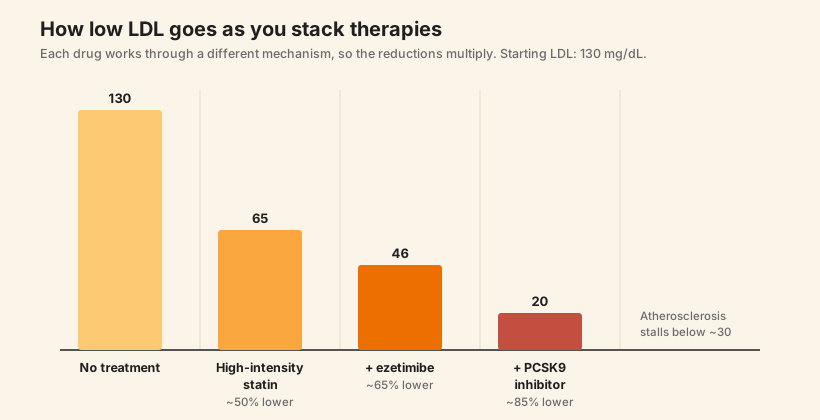 Each drug class works on a different mechanism, so the reductions multiply. A starting LDL of 130 mg/dL falls toward the 20s with all three.
| Regimen | LDL reduction | | --- | --- | --- | | High-intensity statin alone | ~50% | | Statin + ezetimibe | ~65% | | Statin + ezetimibe + PCSK9 inhibitor | ~85% |
No single trial randomized people to all three drugs at once and tracked outcomes, but the pieces are well established. IMPROVE-IT showed ezetimibe added to a statin lowered LDL further and reduced events after a heart attack. FOURIER then added a PCSK9 inhibitor on top of statin therapy (most patients were already on a high-intensity statin, some on ezetimibe too) and pushed median LDL to 30 mg/dL. The combination reliably reduces LDL in the 20s mg/dL. Triple therapy cuts ApoB around 75 to 80%.
Do PCSK9 inhibitors lower Lp(a)?
Unlike sattins, PCSK9 inhibitors also lower Lp(a). This’s part of what sets them apart. Lipoprotein(a) is an inherited risk factor. PCSK9 inhibitors lower Lp(a) by about 25 to 27%.
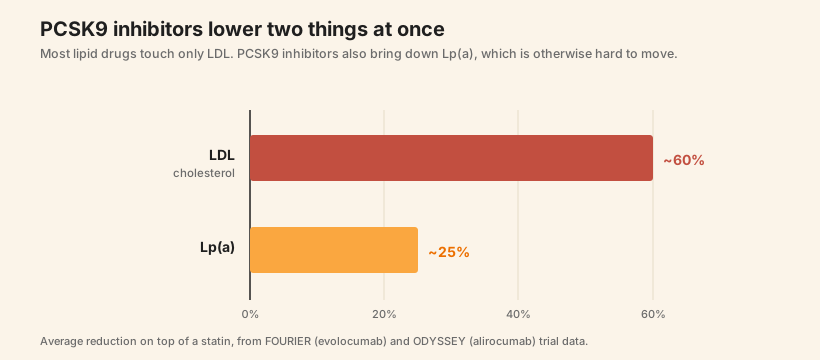 PCSK9 inhibitors lower LDL by about 60% and Lp(a) by about 25%, a combination few other approved drugs offer.
Now, a 25% drop is modest next to the 94% reduction of the various Lp(a)-specific drugs in trials. But none of the Lp(a)-specific drugs are approved quite yet.
How much do PCSK9 inhibitors cost?
The list price of PCSK9 inhibitors is about $6,500 a year for Repatha and Praluent. With commercial insurance, copay cards can bring the cost of PCSK9 inhibitors to as little as $5 a month. For Medicare, PCSK9 inhibitors are limited to $2,100 per year due to the new Part D cap in 2026. Amgen also now sells Repatha direct for cash at about $239 a month. The big catch is that insurers wrap these drugs in prior authorization, and you generally have to try a statin first. We cover the full rules in insurance coverage of PCSK9 inhibitors.
What to ask your doctor
If your LDL or ApoB stays above target on your current regimen, here are the questions I’d ask my doctor: 1. Am I on a maximally tolerated high-intensity statin?, 2. Would adding ezetimibe get me to goal, or do my numbers warrant a PCSK9 inhibitor?, 3. Is my Lp(a) high enough that a PCSK9 inhibitor’s effect on it matters for me?, 4. Does my insurance require an ezetimibe trial before approving a PCSK9 inhibitor?
Whether you need one layer, or all three, ultimately comes down to your numbers and your risk. So ask your doctor!
See also: a guide to every drug that lowers ApoB, PCSK9 inhibitors vs statins, and insurance coverage of PCSK9 inhibitors.
Get your free 30-day heart health guide
Evidence-based steps to optimize your heart health.