If your ApoB is high but your HDL is also high, does the “good cholesterol” offset the risk? The evidence has been difficult to reconcile: higher HDL is associated with lower cardiovascular risk, yet drugs that raise HDL, such as niacin added to statin treatment, have failed to improve cardiovascular outcomes.
A July 2026 study of nearly 294,000 people examines how HDL and ApoB relate to risk together. As HDL increased, the association between higher ApoB and cardiovascular events weakened; at very high HDL, the curve was nearly flat. The study adds evidence that HDL may help interpret the risk associated with a given ApoB level, without establishing that raising HDL would produce the same protection.
We’ll look at the study’s central figure, the biological explanations the authors propose, and why those explanations don’t necessarily imply that an HDL-raising drug will help.
Does high HDL offset high ApoB?
High HDL was associated with substantially less ApoB-related risk in this study. Whether HDL caused that difference remains uncertain.
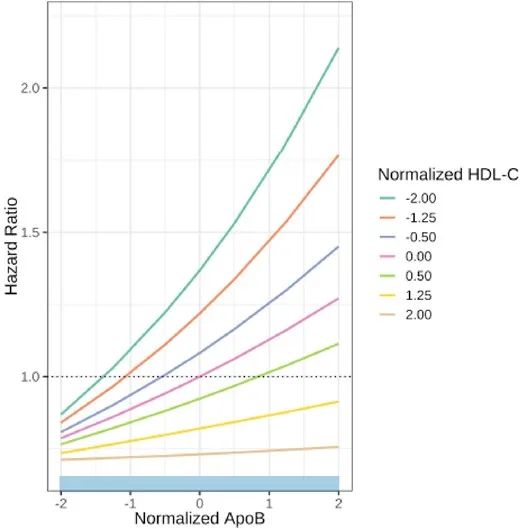
Higher HDL was associated with a weaker rise in modeled cardiovascular risk as ApoB increased. Source: Sniderman et al., European Journal of Preventive Cardiology, 2026.
The curves show relative hazard, not absolute risk or treatment effects. Read the figure from left to right as ApoB increases. Each colored line represents a different HDL level. At low HDL, the curve rises steeply. At HDL two standard deviations above the average, the curve is almost flat.
Both biomarkers are “normalized”: zero means the study average, and +2 means two standard deviations above it. A value of 2 on this chart is not a lab result of 2 mg/dL. The figure doesn’t give a clinical HDL cutoff above which ApoB can be ignored.
ApoB measures the concentration of a protein carried by particles that can deposit cholesterol in artery walls. Because each of these particles carries one ApoB molecule, the test reflects their number. HDL cholesterol, or HDL-C, measures the cholesterol carried inside HDL particles. It doesn’t directly measure how well those particles remove cholesterol from tissues.
Researchers studied 293,872 UK Biobank participants who had no prior cardiovascular disease and weren’t taking lipid-lowering medication at enrollment. Over a median follow-up of about 13.5 years, 23,942 experienced a first atherosclerotic cardiovascular disease (ASCVD) event. ASCVD includes disease caused by plaque in arteries, such as heart attacks and ischemic strokes. Study methods and Table 1.
Higher HDL predicted lower risk even after accounting for ApoB, triglycerides, and other risk factors. The researchers also found an interaction: the association between higher ApoB and cardiovascular events weakened as HDL increased.
How might HDL reduce the risk associated with ApoB?
The authors propose several ways HDL particles might limit the damage caused by ApoB particles. Their study measured blood markers and subsequent events, not these processes inside arteries.
Removing cholesterol from the artery wall
Once ApoB particles enter and become trapped in an artery wall, they deposit cholesterol. HDL might help carry some of that cholesterol away through reverse cholesterol transport. Less cholesterol in a plaque could make it less prone to rupture, although the authors say this explanation hasn’t been directly demonstrated for the process they describe. Study discussion.
Preventing particles from entering or becoming trapped
HDL might also act earlier. Its ApoA1 protein may interfere with ApoB particles binding to the artery wall. The authors also write that “HDL may reduce endothelial transcytosis of apoB”: transport through the cells lining blood vessels. That would reduce how many particles enter the wall in the first place. Study discussion.
Changing inflammation and clotting
Other possibilities include reducing inflammation, oxidative damage, or clot formation. None requires HDL cholesterol itself to be the protective agent. As Sniderman and colleagues put it, “HDL-C is a surrogate measure.” A cholesterol reading could track a useful property of HDL particles without measuring that property directly. Study discussion.
Does raising HDL prevent heart attacks?
Raising HDL cholesterol hasn’t reliably prevented cardiovascular events in clinical trials. In AIM-HIGH, adding niacin to statin treatment raised HDL but didn’t improve cardiovascular outcomes in people with established cardiovascular disease. That trial studied a different population from this UK Biobank analysis, but it directly tested a treatment rather than comparing people with different lab results.
Genetic research has also found that genetic changes that raise HDL don’t uniformly lower heart attack risk. A higher HDL number alone doesn’t establish a benefit.
Those failed treatment tests leave a narrower question open: can an intervention improve a protective function of HDL particles, rather than simply increase the cholesterol they carry? This observational study doesn’t answer that question, but its findings give researchers a reason to investigate it.
How much did HDL change estimated risk?
The researchers also estimated 10-year ASCVD risk from their statistical model. Among people modeled with ApoB two standard deviations above average, estimated risk ranged from 11.87% with low HDL to 4.39% with high HDL. Table 5.
| HDL level in the study | Estimated risk at low ApoB (−2 SD) | Estimated risk at high ApoB (+2 SD) |
|---|---|---|
| Low (−2 SD) | 5.10% | 11.87% |
| Average (0 SD) | 4.61% | 7.28% |
| High (+2 SD) | 4.17% | 4.39% |
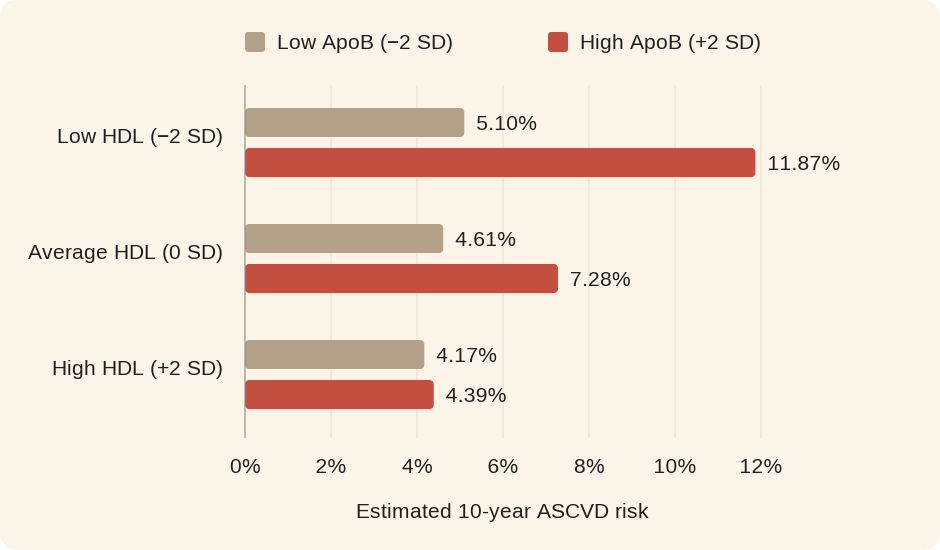
The model estimated a much smaller risk difference between low and high ApoB when HDL was high. Source: Sniderman et al., European Journal of Preventive Cardiology, 2026.
This chart plots selected estimates from the study, averaged over the cohort’s other characteristics; they are not observed subgroup event rates or individual predictions. Low and high mean two standard deviations below and above the study average. The source table does not provide uncertainty intervals.
At low HDL, estimated risk differed by almost 7 percentage points between the low- and high-ApoB values. At high HDL, it differed by just 0.22 percentage points. Even the lowest estimate here was about 4%, not zero.
The study can’t tell us that raising a person’s HDL would move their risk from one row to another. HDL is associated with metabolic and inflammatory factors that statistical adjustments may not fully capture. The researchers also excluded people with triglycerides of 250 mg/dL or higher, extreme lipid values, or incomplete data, limiting how broadly these results apply.
Should you lower ApoB if your HDL is high?
High HDL alone isn’t a reason to dismiss high ApoB or stop treatment. The study’s authors explicitly warn against that interpretation. Their findings don’t overturn the evidence that ApoB-containing particles cause atherosclerosis or that lowering them benefits people at high cardiovascular risk. Study discussion.
For someone with both high HDL and high ApoB, HDL adds context to a risk assessment that also includes age, blood pressure, smoking, diabetes, family history, and existing artery disease. This study doesn’t establish a new ApoB target or show that HDL-raising treatment can substitute for ApoB lowering.
If your ApoB is elevated, discuss your overall risk and the likely benefit of lowering it with your clinician. Our guides to lowering ApoB and ApoB-lowering medications explain the available approaches.
Get your free 30-day heart health guide
Evidence-based steps to optimize your heart health.