South Asians have four times greater risk of heart disease than the general population. One cause is Lipoprotein(a), the largest hereditary risk factor. Lp(a) is 90% genetic and, in UK Biobank data, South Asians had a median Lp(a) of 31 nmol/L, compared to 19 in White, 16 in Chinese, and 75 in Black participants.
But what about variation between South Asian groups?
A new UCSD study found about a 35% difference in Lp(a) between South Asian groups in MASALA, a US-based cohort. (As a side note, this UCSD research group has been on a tear recently, publishing a whole bunch of studies on Lp(a) testing, interaction with diabetes and inflammation, and more.)
Interestingly, they also found no clear difference in Lp(a)-associated risk between the groups, suggesting that Lp(a) may be an underlying cause.
Lp(a) varied by 35% between the highest and lowest South Asian groups
In MASALA, participants born in Bangladesh had the highest median Lp(a) (23 mg/dL), about 35% higher than the 17 mg/dL among those born in Sri Lanka.
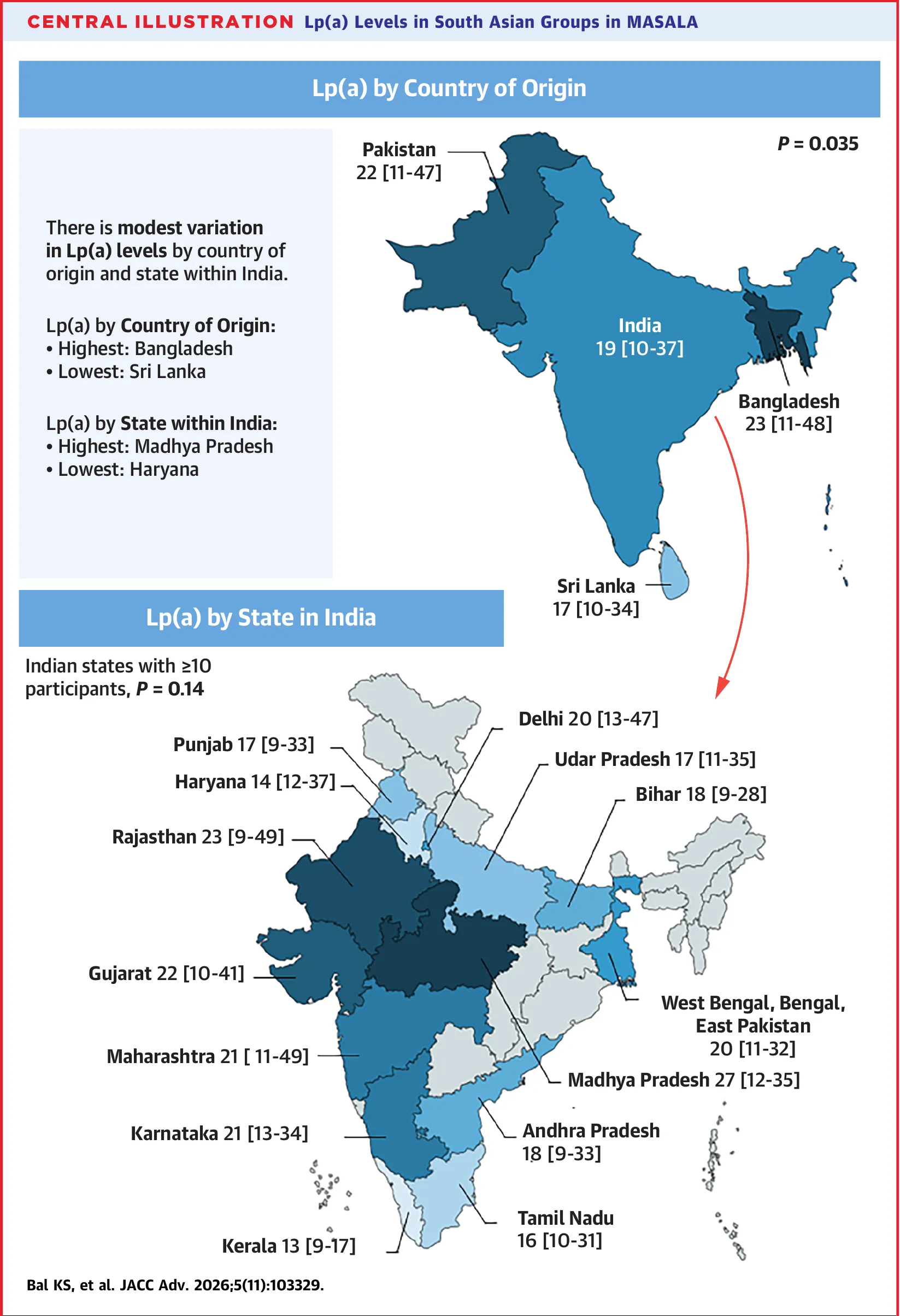
Median Lp(a) varied by birthplace. Source: Bal et al., JACC Advances, 2026
Among Indian states with >=10 participants, medians ranged from 13 mg/dL (Kerala) to 27 (Madhya Pradesh). Note that these are relatively small samples, and this entire cohort is US residents grouped by birthplace.
How many South Asian participants had elevated Lp(a)?
A quarter of MASALA participants born in Bangladesh had Lp(a) >50 mg/dL, compared to 1 in 6 born in India:
| Country of birth | Participants | Median Lp(a), mg/dL | Middle 50% of results, mg/dL | Lp(a) ≥50 mg/dL |
|---|---|---|---|---|
| Bangladesh | 572 | 23 | 11–48 | 25% |
| Pakistan | 524 | 22 | 11–47 | 23% |
| India | 959 | 19 | 10–37 | 17% |
| Sri Lanka | 18 | 17 | 10–34 | 0% |
Source: Bal et al., JACC Advances, 2026.
Results overlapped substantially.
In a separate UK cohort, some rankings reversed
This US cohort is still a relatively small sample. What happens if you do the same analysis in a separate cohort? The researchers also studied UK Biobank data (N=6,845), and some of the rankings reversed. Sri Lankan participants had the highest median Lp(a), at 39 nmol/L, followed by India at 32, Pakistan at 29, and Bangladesh at 28. The Sri Lankan sample was larger in this cohort, about 771 people.
(Note that MASALA measured mass in mg/dL and UK Biobank measured particle concentration in nmol/L. You can’t convert between the two since Lp(a) particles differ in mass, so we can compare rankings within cohorts but not numerical levels across them.)
The authors point to “the limitations of using country of origin to understand the variation in Lp(a) levels.” Different migration patterns, proportions of men and women, and the small US Sri Lankan sample may explain the reversed rankings. Birthplace describes these cohorts, but isn’t a precise measure of ancestry. (Original discussion)
Do studies within South Asia confirm the geographic pattern?
Unfortunately, the data is slimmer here. A study in Tamil Nadu and New Delhi measured Lp(a) and relevant genetic variation in 254 coronary-disease patients and 480 controls. Higher Lp(a) was associated with coronary disease in both populations, but this doesn’t validate MASALA’s state rankings. Another study of 751 healthy adults in Mumbai provided reference levels, but not a comparison across regions.
The study found no clear difference in Lp(a)-related risk between groups
We know Lp(a) varied between groups, but what about the association of Lp(a) with cardiovascular risk? Within this study, there wasn’t a difference.
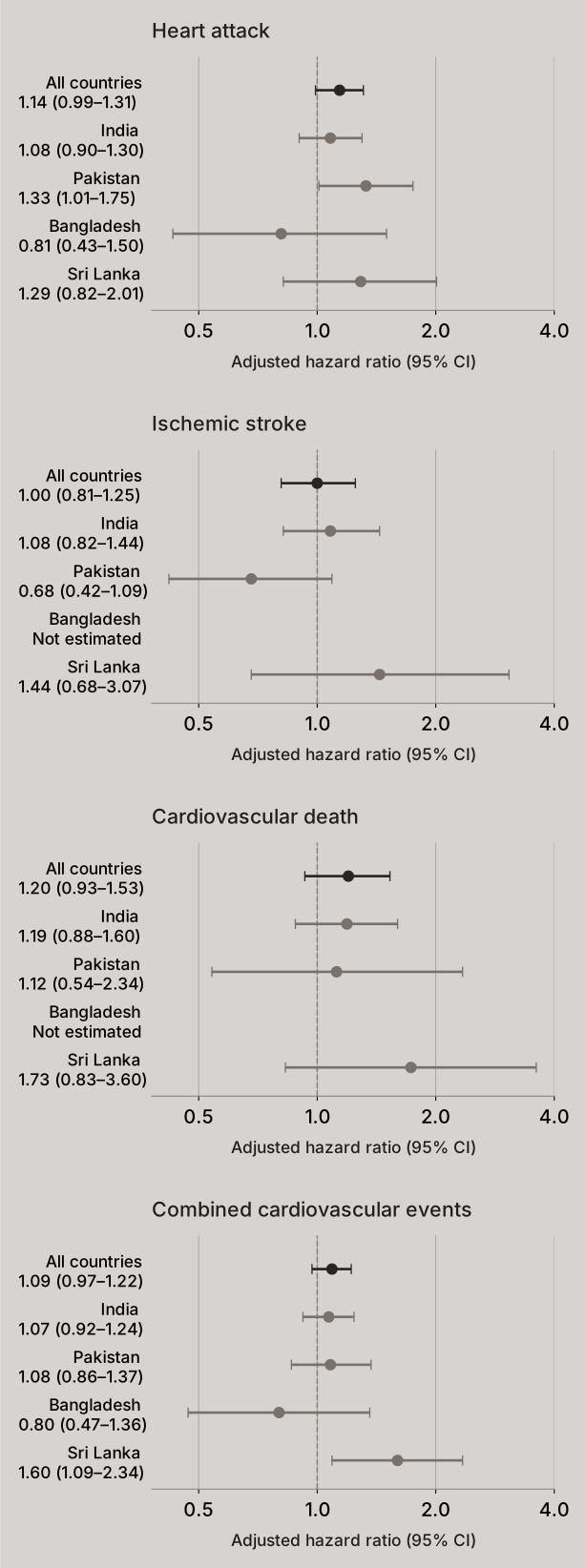 No clear differences between countries in Lp(a)-related cardiovascular risk. Dots show adjusted hazard ratios per standard deviation of log(Lp(a)). Source: Bal et al., JACC Advances, 2026.
The wide confidence intervals do leave room for differences a larger study might detect.
Should South Asians get an Lp(a) test?
The 2026 ACC/AHA guidelines recommend Lp(a) testing for everyone. If your result is high, close relatives may also benefit from testing. Our Lp(a) blood-test guide explains the results.
What can you do about Lp(a)?
For elevated Lp(a), the immediate treatment strategy is to lower the burden of other artery-damaging, ApoB-containing particles. The 2026 ACC/AHA guidelines recommend more intensive LDL cholesterol lowering, with ApoB measurements helping guide treatment in selected patients. Statins and ezetimibe can reduce that burden even though they don’t substantially lower Lp(a).
PCSK9 inhibitors can lower both. In FOURIER, the PCSK9 antibody evolocumab reduced Lp(a) by a median 27% at 48 weeks, alongside substantial LDL lowering. The guidelines recommend adding a PCSK9 antibody for people with established cardiovascular disease and elevated Lp(a) whose LDL and non-HDL cholesterol remain above goal on maximally tolerated statins. Its cardiovascular benefit is established, though how much comes specifically from lowering Lp(a) remains uncertain.
Drugs targeting Lp(a) directly can produce much larger reductions. In a phase 2 trial, lepodisiran reduced Lp(a) by about 94% relative to placebo at the highest tested dose, averaged over days 60–180. Whether that reduction prevents heart attacks and strokes remains under investigation.
Lowering the number on a lab report doesn’t guarantee fewer events. In September 2026, Novartis reported that another targeted drug, pelacarsen, lowered Lp(a) but failed to meet its phase 3 trial’s primary cardiovascular endpoint. Full results are needed to interpret that finding; it doesn’t settle whether other Lp(a)-targeted drugs will improve outcomes.
Get your free 30-day heart health guide
Evidence-based steps to optimize your heart health.