Last revised August 19, 2026
Lipfendra (enlicitide) is the first oral PCSK9 inhibitor, approved by the FDA in July 2026 and now becoming stocked in pharmacies. Previous PCSK9 inhibitors like Repatha are injections, but Lipfendra is a pill. Lipfendra lowers LDL by 56% to 60%, about the same as injectable PCSK9 inhibitors.
Lipfendra’s dose is one 20 mg tablet each morning. It must be taken on an empty stomach 30 minutes before eating (you can have water, black coffee, or plain tea). The most common Lipfendra side effects in the HeFH trial were dizziness and diarrhea. Both the diarrhea side effect, and the requirement to eat on an empty stomach, are likely because it uses sodium caprate to cross the intestinal wall. We cover more in the science behind how Lipfendra was developed as a macrocyclic peptide.
Lipfendra is now reaching pharmacies with a list price of $315 for 30 tablets before insurance or discounts.
| Lipfendra at a glance | Details |
|---|---|
| Generic name | Enlicitide |
| What it treats | High LDL cholesterol in adults, including HeFH |
| Drug class | PCSK9 inhibitor |
| Dose | One 20 mg tablet once daily |
| How to take it | In the morning on an empty stomach with water, black coffee, or plain tea; wait 30 minutes before other food or drinks |
| LDL reduction | 56% to 60% in phase 3 trials |
| Common side effects | Diarrhea and dizziness in the HeFH trial |
| List price | $315 for 30 tablets, or about $3,780 per year |
| Availability | Prescription only; now reaching U.S. retail pharmacies |
This guide covers Lipfendra’s uses, dosage, side effects, LDL reduction, cost, insurance coverage, and how it compares with statins and injectable PCSK9 inhibitors.
How much does Lipfendra lower LDL cholesterol?
Lipfendra lowers LDL cholesterol by 56% to 60% on top of existing treatment, about the same as injectable PCSK9 inhibitors. The phase 3 CORALreef Lipids trial tested Lipfendra in 2,912 adults, most of whom were already taking a statin.
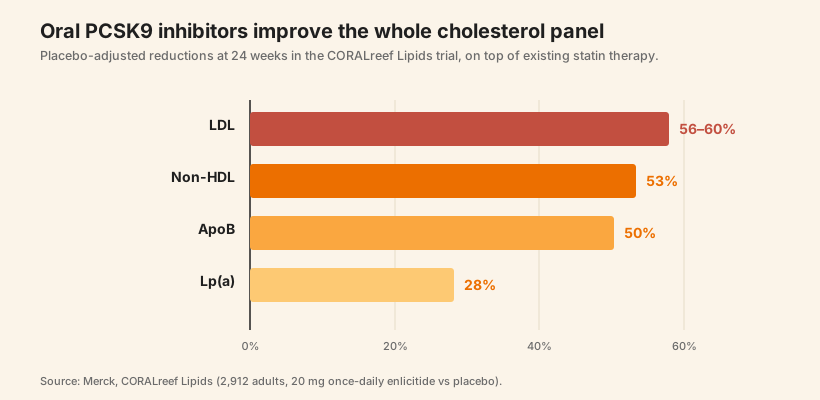 At 24 weeks in CORALreef Lipids, enlicitide lowered LDL, non-HDL cholesterol, ApoB, and Lp(a) together.
In the trial, 67.5% of people on Lipfendra achieved both a 50%-or-greater LDL reduction and an LDL below 55 mg/dL, versus 1.2% on placebo. Added to a statin, Lipfendra can push LDL into the 20s and 30s mg/dL, levels a statin alone rarely reaches.
Lipfendra also lowers the other major measures of atherogenic particles. It reduced non-HDL cholesterol by 53%, ApoB by 50%, and Lp(a) by 28%. The Lp(a) result stands out because drugs designed specifically to lower Lp(a) are still in clinical trials.
| Biomarker | Reduction | Why it matters |
|---|---|---|
| LDL cholesterol | 56–60% | The primary target for cardiovascular risk |
| Non-HDL cholesterol | 53% | Captures all cholesterol in artery-clogging particles |
| ApoB | 50% | Counts the actual number of atherogenic particles |
| Lp(a) | 28% | Inherited risk factor most drugs can’t touch |
The ApoB and non-HDL reductions track the LDL drop because all three measures reflect the same atherogenic particles in different ways.
How does Lipfendra work?
Lipfendra lowers LDL by blocking PCSK9, a protein that causes the liver’s LDL receptors to be destroyed. LDL receptors pull LDL out of the blood. Blocking PCSK9 leaves more receptors alive to clear LDL.
Lipfendra targets the same protein as Repatha and Praluent, but its structure lets it work as a pill. Repatha and Praluent are antibodies, which are too large to survive digestion and must be injected. Lipfendra is a macrocyclic peptide, a smaller ring-shaped molecule that can be absorbed from the gut. Derek Lowe explains the chemistry behind Lipfendra in more detail.
Why an oral PCSK9 inhibitor matters
Lipfendra removes the injection, refrigeration, and specialty-pharmacy handling required by earlier PCSK9 inhibitors. Roughly 6 million Americans qualify for a PCSK9 inhibitor because their LDL remains high despite a statin, yet only about 1% take one. Cost and prior authorization also limit access.
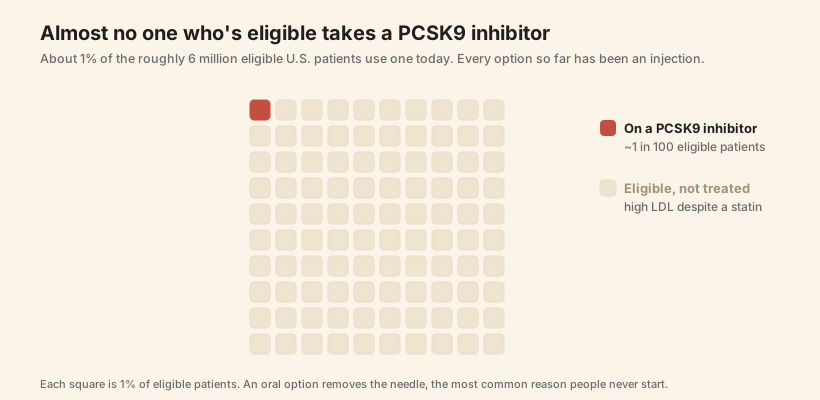 All PCSK9 inhibitors before Lipfendra were injections. Lipfendra replaces the needle and refrigeration with a daily pill.
A once-daily pill fits into the same routine as a statin. AstraZeneca also has an oral PCSK9 inhibitor, AZD0780, in trials, so Lipfendra may be the start of a new category rather than a single drug.
Lipfendra vs statins
Lipfendra is usually added to a statin rather than used as a replacement. Statins tell the liver to make less cholesterol, while Lipfendra preserves the LDL receptors that clear cholesterol from the blood. The effects stack because the drugs work by different routes. CORALreef therefore tested Lipfendra on top of statin therapy rather than against it. For the full comparison, see PCSK9 inhibitors vs statins.
A high-intensity statin, such as atorvastatin 40–80 mg or rosuvastatin 20–40 mg, lowers LDL by roughly 50% and can cost about $2 a month as a generic. Lipfendra lowered LDL by another 56% to 60% when existing treatment wasn’t enough.
Ezetimibe is the oral drug most people try after a statin. It lowers LDL by another 18% to 20%, while Lipfendra lowers it by roughly three times as much at more than 100 times the generic price.
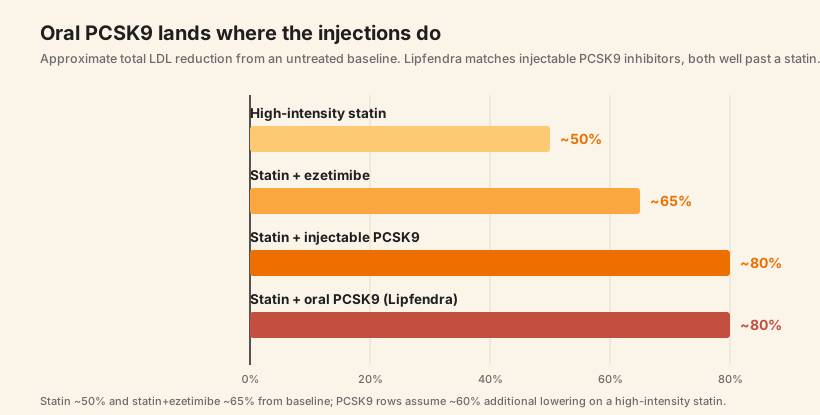 Added to a statin, an oral PCSK9 inhibitor reaches the same LDL reduction as the injections, and goes well past what a statin or statin-plus-ezetimibe delivers.
Lipfendra side effects
The most common Lipfendra side effects are diarrhea and dizziness. In the CORALreef HeFH trial, diarrhea occurred in 7% of people taking Lipfendra versus 2% on placebo, while dizziness occurred in 9% versus 4%. In the larger CORALreef Lipids trial, overall adverse events were similar with Lipfendra and placebo (77.7% versus 76.2%), with no meaningful difference in serious events.
Lipfendra may cause diarrhea because its sodium caprate absorption enhancer temporarily increases intestinal permeability, although the trials did not determine whether sodium caprate or enlicitide itself was responsible.
How much does Lipfendra cost?
Lipfendra costs $315 for a 30-day supply at list price, or about $3,780 a year before insurance and discounts. Injectable PCSK9 inhibitors list for roughly $6,900 a year.
| Drug | Form | List price |
|---|---|---|
| Lipfendra (enlicitide) | Daily pill | |
| Repatha, Praluent | Injection (every 2–4 weeks) | |
| Generic high-intensity statin | Daily pill | ~$24–144/yr |
Your actual Lipfendra cost depends on your insurance, deductible, and formulary restrictions. Early commercial formulary placements include tier 3 coverage with step therapy after a statin and, in some plans, no prior authorization. Eligible privately insured patients may pay as little as $15 per prescription through Merck’s savings offer, which doesn’t apply to Medicare or other government insurance. We track cash prices in our guide to Lipfendra’s cost and broader coverage rules in insurance coverage of PCSK9 inhibitors.
Is Lipfendra available at pharmacies?
Lipfendra is available by prescription at U.S. retail and mail-order pharmacies, although local stock and insurance coverage vary. The FDA approved Lipfendra on July 16, 2026, and major retail chains began quoting cash prices by early August. Unlike injectable PCSK9 inhibitors, the tablet doesn’t require a specialty pharmacy. Our Lipfendra cost and availability guide tracks current prices and formulary information.
Lipfendra dosage and prescribing information
The Lipfendra dosage is one 20 mg tablet once daily. Take Lipfendra in the morning on an empty stomach with water, black coffee, or plain tea. Swallow the tablet whole, and wait at least 30 minutes before eating or drinking anything else. Lipfendra doesn’t require dose titration or refrigeration. Merck’s full prescribing information explains what to do after a missed dose.
What to ask your doctor
If your LDL or ApoB is still above target on your current regimen, these are the questions worth raising: Am I on a maximally tolerated high-intensity statin? Would adding ezetimibe get me to goal, or do my numbers warrant a PCSK9 inhibitor? Now that there’s an oral option, does that change the calculus if a shot was the sticking point? And does my plan cover Lipfendra, or does it want an injectable first?
See also: PCSK9 inhibitors lower LDL by about 60%, PCSK9 inhibitors vs statins, and insurance coverage of PCSK9 inhibitors.
Get your free 30-day heart health guide
Evidence-based steps to optimize your heart health.