In September, Novartis announced that its new cardiovascular drug, pelacarsen, failed its clinical trial. Now, new details have come out in the NEJM and at the American Heart Association’s annual conference which explain what happened.
Pelacarsen did exactly what it was designed to do: cut Lp(a) by 78%. Yet cardiovascular events (heart attacks, strokes, etc) barely budged. Why is that? We could come up with three basic hypotheses:
- Lp(a) is a marker of cardiovascular disease, not a cause.
- The study participants had low Lp(a)-related risk (based on the enrollment criteria)
- Treatment started too late in life, after plaque had already accumulated.
Which hypothesis is right matters quite a bit because there are three more Lp(a)-lowering drugs in clinical trials. Let’s review what the full Lp(a) HORIZON trial results tell us, and what we might therefore learn about the other drugs.
Lp(a) fell by 78% in HORIZON
HORIZON recruited 8,322 adults with established cardiovascular disease and Lp(a) of >=70 mg/dL, and randomized patients to monthly pelacarsen. Most of these patients were already taking a high-intensity statin. Their median LDL cholesterol was quite low, about 65 mg/dL:
| At enrollment | Pelacarsen (n = 4,157) | Placebo (n = 4,165) |
|---|---|---|
| Median Lp(a) | 108.4 mg/dL | 108.2 mg/dL |
| Median LDL cholesterol | 65.0 mg/dL | 64.2 mg/dL |
| High-intensity statin use | 77.1% | 78.2% |
| Systolic blood pressure | 125.5 mmHg | 125.1 mmHg |
Pelacarsen blocks production of apolipoprotein(a), a part of Lp(a). The trial measured cardiovascular events: cardiovascular death, nonfatal heart attack or ischemic stroke, and urgent coronary procedures requiring hospitalization.
At 12 months, Lp(a) had fallen 78.4% with pelacarsen versus 3.2% with placebo. LDL cholesterol changed less: it averaged 62.3 mg/dL with pelacarsen versus 71.2 mg/dL with placebo.
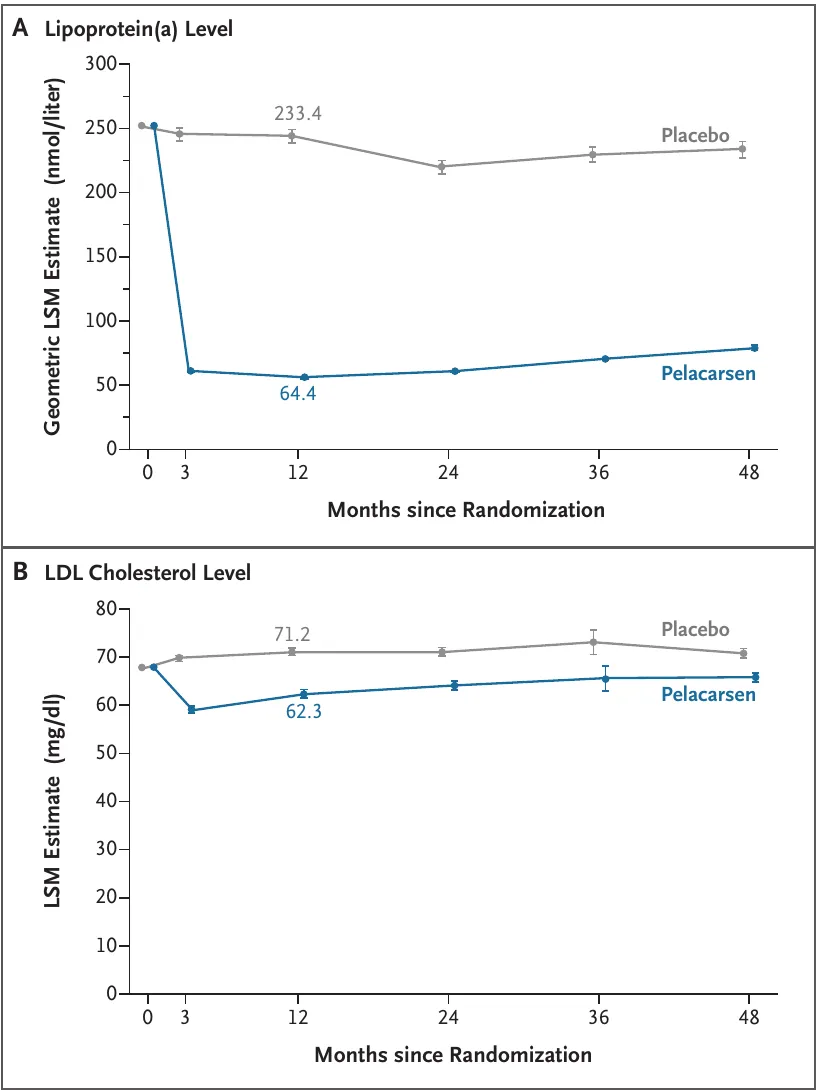 Pelacarsen sharply lowered Lp(a) in the treatment group. Source: NEJM
Yet cardiovascular events were nearly identical
Cardiovascular events were basically identical. 12.3% of people taking pelacarsen had a major cardiovascular event, vs 12.1% taking placebo (hazard ratio 1.02):
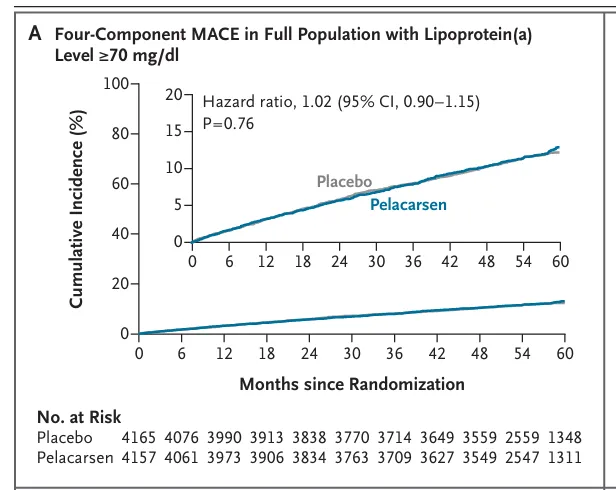
The event curves remained nearly identical through five years. Source: NEJM
Did any baseline subgroup benefit?
After the trial, researchers split participants by their starting Lp(a), LDL cholesterol, hs-CRP, and time since their qualifying cardiovascular event:
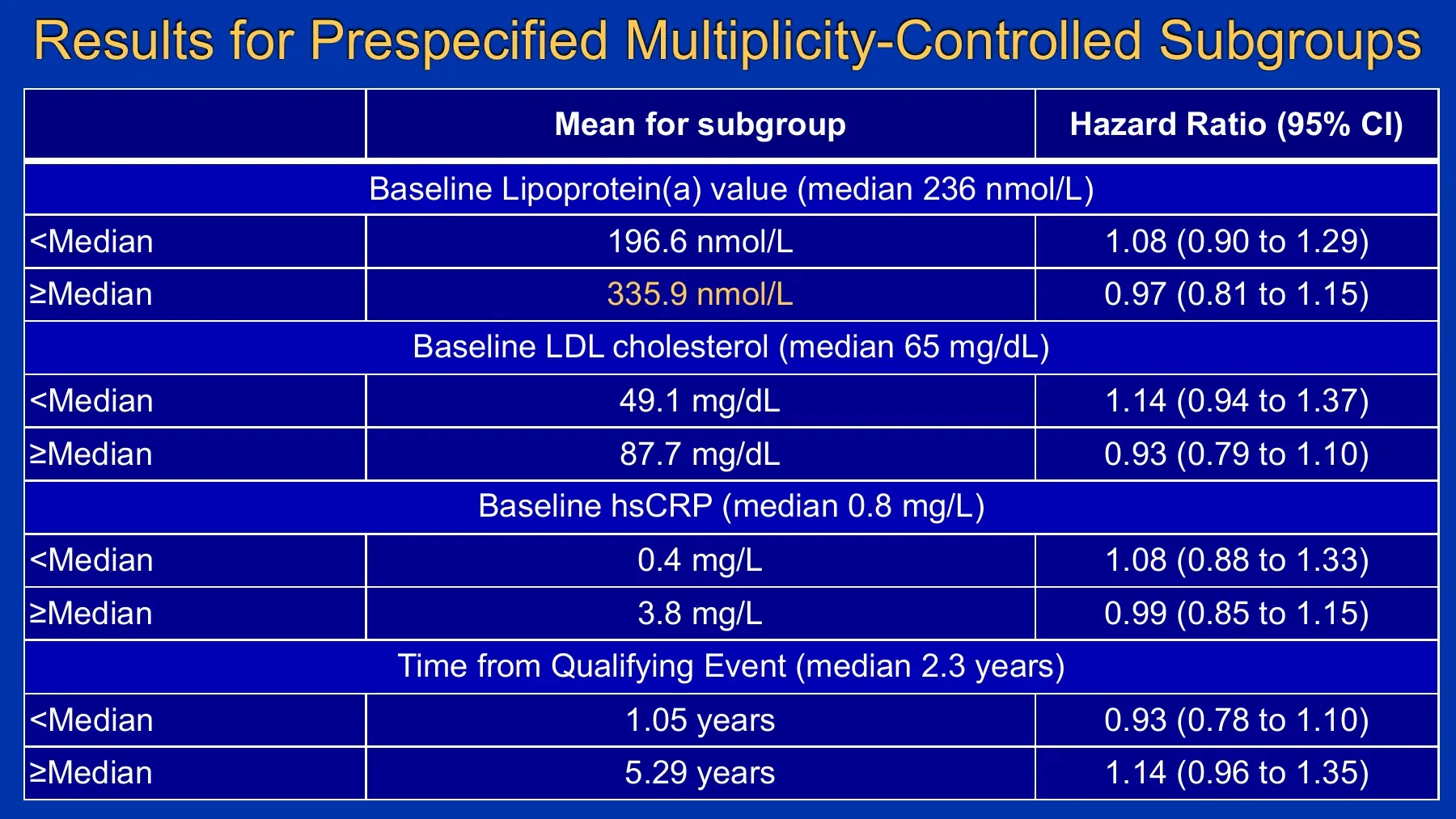 Subgroup analysis. Source: Steven Nissen, AHA Scientific Sessions, 2026.
Steven Nissen of Cleveland Clinic summarized the extended analyses: “No matter how we looked at the data, the result was the same — no effect.” In the higher-LDL half (baseline LDL ≥65 mg/dL; mean 87.7 mg/dL), the hazard ratio was 0.93 (95% CI 0.79–1.10), a 7% lower point estimate that is compatible with no benefit.
Why did lowering Lp(a) have no impact on outcomes?
So does Lp(a) matter? Let’s return to the hypotheses above:
- LDL was too low to show a benefit. One observational study found 8% higher cardiovascular event risk in people who had elevated Lp(a) and LDL cholesterol <70 mg/dL. That association does not establish how much benefit an Lp(a)-lowering drug could provide.
- Too little time. Much of the evidence for Lp(a) is genetic / Mendelian randomization. People born with low Lp(a) have decades of lower exposure, while HORIZON started treatment after cardiovascular disease had developed. Earlier or longer treatment might work differently. I think this is a fairly weak hypothesis since we see effects of other drugs and biomarkers.
- Lp(a) is a marker, but not a cause. The strongest evidence against “Lp(a) is only a marker” comes from human genetics. People inherit variants in the LPA gene that change their Lp(a) levels throughout life. In one study, two independent variants that raised Lp(a) were also linked to substantially higher odds of coronary disease (odds ratios 1.70 and 1.92).
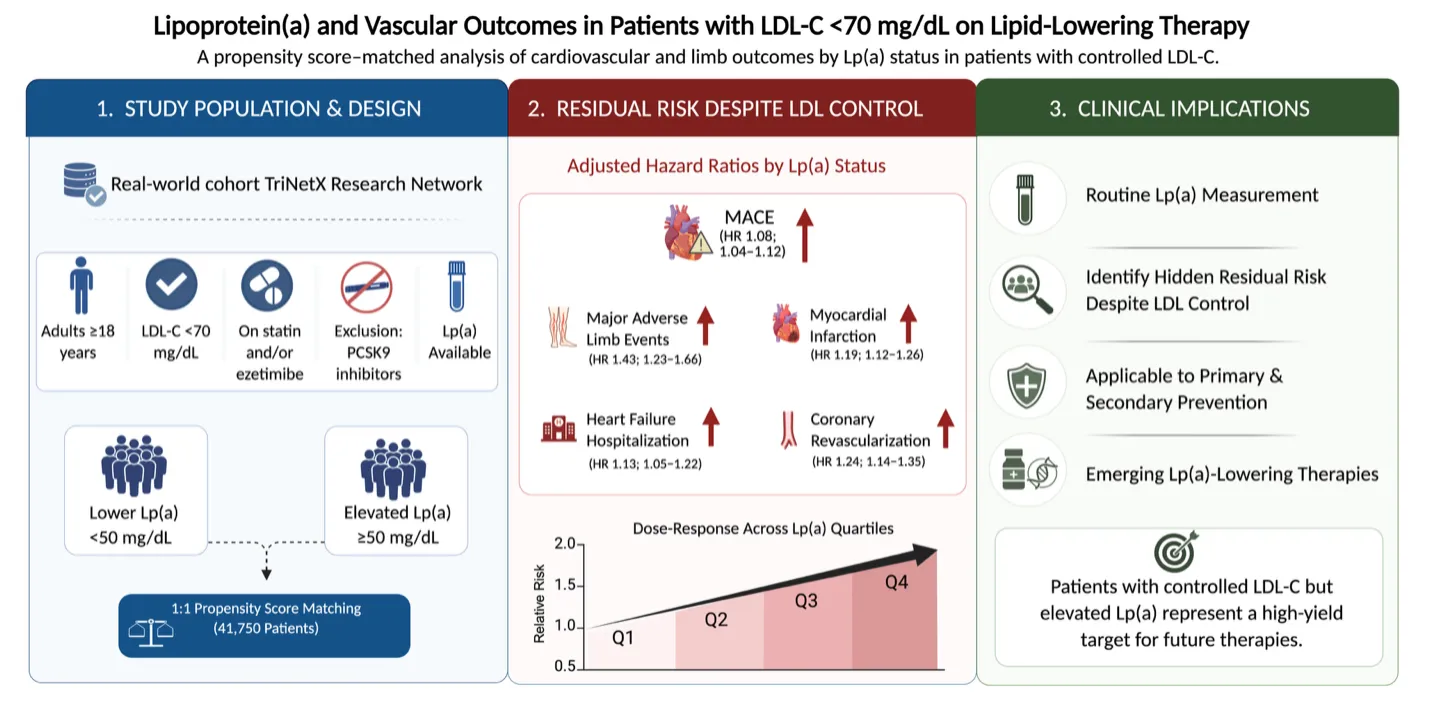
In groups with low LDL cholesterol, Lp(a) was linked to 8% higher risk of a cardiovascular event. Source: AHA Scientific Sessions, 2026.
When will the next Lp(a) trials finish?
To get a real answer, we’ll need to see how other Lp(a) drugs perform. Several trials are in progress, with expected completion dates in 2028 and 2029:
OCEAN(a)-Outcomes tests olpasiran in 7,297 people with Lp(a) of at least 200 nmol/L. It requires a prior heart attack, or a coronary artery procedure (PCI) plus another risk factor. HORIZON also enrolled people after an ischemic stroke or with symptomatic peripheral artery disease. OCEAN(a)‘s primary outcome covers coronary death, heart attack, or urgent coronary procedures; stroke is a secondary outcome. The registry estimates completion in March 2028. (HORIZON criteria)
ACCLAIM-Lp(a) tests lepodisiran in about 17,300 people with Lp(a) of at least 175 nmol/L. It includes people with established cardiovascular disease and adults 55 or older at high risk of a first event. This tests treatment before a first event, though not necessarily before plaque has developed. Lilly lists March 2029 as the expected end date.
Should you still test Lp(a)?
Lp(a) testing can identify inherited risk and prompt closer attention to LDL, ApoB, blood pressure, smoking, and family history. HORIZON tested a drug, not the value of knowing your Lp(a). (AHA trial summary)
If your Lp(a) is high, review proven ways to reduce your risk with your clinician. Our guide to high Lp(a) covers them.
Get your free 30-day heart health guide
Evidence-based steps to optimize your heart health.