While it’s tempting to frame statins and PCSK9 inhibitors as rivals—an old cheap pill versus a new expensive injection—that framing isn’t quite right. In nearly every guideline and trial, PCSK9 inhibitors are used on top of a statin to reduce LDL cholesterol even further. Statins are first because they are oral, cost a few dollars a month, and have the deepest outcomes evidence of any cardiovascular drug. PCSK9 inhibitors are mostly used when a statin is not enough or not tolerated.
However, there is one important difference that has nothing to do with cost or convenience. PCSK9 inhibitors lower Lipoprotein(a) significantly, whereas statins don’t move Lp(a). Statins lower inflammation (hs-CRP), whereas PCSK9 inhibitors don’t.
This post compares PCSK9 inhibitors and statins in terms of their mechanisms; how much they lower LDL, Lp(a), and hs-CRP; cost, insurance coverage, and side effects. We also cover the newest oral PCSK9 inhibitor, Lipfendra, which was FDA approved in July 2026.
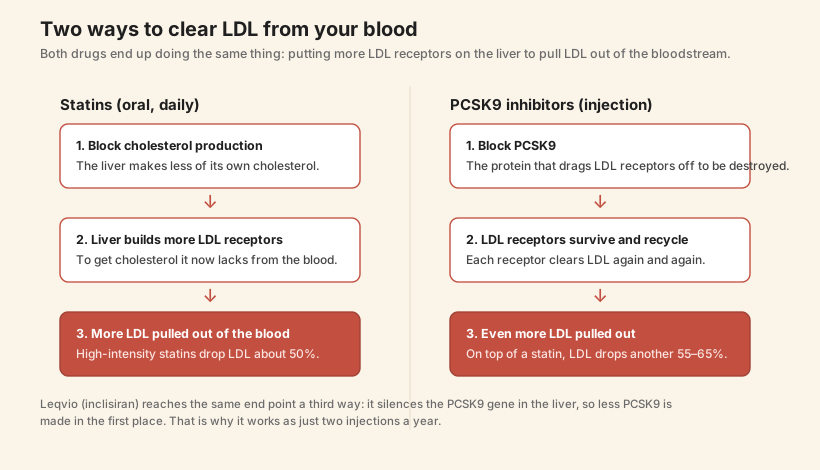 Both PCSK9 inhibitors and statins increase the number of LDL receptors on the liver, but through different mechanisms.
How do statins and PCSK9 inhibitors work?
Both statins and PCSK9 inhibitors work by putting more LDL receptors on the surface of your liver. LDL receptors are the “drains” that pull LDL particles out of your blood. More drains, lower LDL.
But statins and PCSK9 inhibitors differ in the mechanism they use to regulate LDL receptors:
-
Statins block an enzyme (HMG-CoA reductase) that the liver uses to make its own cholesterol. With less cholesterol being produced internally, liver cells build more LDL receptors to pull cholesterol in from the bloodstream instead.
-
PCSK9 inhibitors block PCSK9, a protein that grabs LDL receptors and sends them to be destroyed. Repatha (evolocumab) and Praluent (alirocumab) are antibodies that block PCSK9, so the receptors survive and recycle back to the surface again and again. They are self-injected every two weeks or once a month. Leqvio (inclisiran) reaches the same end point a third way, by silencing the PCSK9 gene in the liver, which is why it works as just two injections a year. Lipfendra is a macrocyclic peptide that blocks PCSK9, and comes in the form of a daily pill.
How much do statins and PCSK9 inhibitors lower LDL?
A high-intensity statin (like atorvastatin 40 to 80 mg or rosuvastatin 20 to 40 mg) lowers LDL by about 50%. A moderate-intensity statin lowers LDL 30 to 50%. Adding a PCSK9 inhibitor on top of a statin drops LDL by another 45% to 64%. That combination can push LDL into the 20s and 30s mg/dL, levels a statin or diet alone rarely reaches.
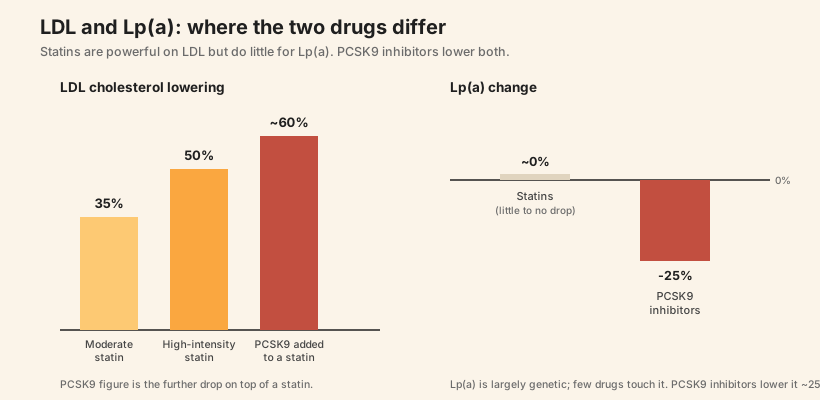 PCSK9 inhibitors add to the LDL lowering a statin provides. Unlike statins, PCSK9 inhibitors also lower Lp(a).
Do statins or PCSK9 inhibitors lower Lp(a)?
The effect on Lp(a) is the clearest dividing line between statins and PCSK9 inhibitors. Statins do not lower Lp(a); some studies suggest they may nudge it slightly upward. PCSK9 inhibitors lower Lp(a) by about 25 to 27%. In the FOURIER trial, the Lp(a) reduction appeared to lower cardiovascular risk independently of the LDL reduction. That makes PCSK9 inhibitors meaningful for people whose risk is driven by high Lp(a), not just high LDL. The 25% drop is smaller than the 80%-plus reductions seen with the new Lp(a)-specific drugs still in trials, but those are not yet approved.
Statins are cheap, PCSK9 inhibitors are expensive
Cost is where statins and PCSK9 inhibitors differ. Generic atorvastatin runs $24 to $144 a year. PCSK9 inhibitors have a list price around $6,900 a year. Amgen’s direct-to-patient program now offers Repatha for cash at about $239 a month (roughly 60% off list). Still, that’s costlier than a generic statin.
The difference shows up in what patients actually pay. A 2024 ICER survey found a median monthly copay of $10 for statins versus $150 for Repatha on commercial plans. The cost gap is the main reason insurers require prior auth for PCSK9 inhibitors.
Statins vs PCSK9 inhibitors
| Statins | PCSK9 inhibitors | |
|---|---|---|
| LDL lowering | ~30–50% (moderate), ~50% (high-intensity) | Additional ~45–64% on top of a statin |
| Lp(a) lowering | None (may rise slightly) | ~25% |
| Form | Daily pill | Injection (every 2–4 weeks, or twice a year for Leqvio) |
| Cost per year | ~$24–144 (generic) | |
| Insurance | Covered, usually no prior auth | Covered with prior authorization |
| Main side effect | Muscle aches | Injection-site reactions |
Are PCSK9 inhibitors covered by insurance?
Statins are cheap and almost never require prior authorization. PCSK9 inhibitors are covered by nearly every insurer, but only after prior authorization, and usually only once you have tried a statin and your LDL is still above goal. We covered the full PCSK9 coverage rules by insurer separately, including the LDL thresholds, the ezetimibe question, and why these drugs get denied. The short version: the statin trial is part of how you qualify for the PCSK9 inhibitor, so the two are linked rather than mutually exclusive.
What are the side effects of statins vs PCSK9 inhibitors?
Both statins and PCSK9 inhibitors are well tolerated by most people. PCSK9 inhibitors are notably clean.
Statins are best known for the side effect of muscle aches. True muscle injury is rare, and blinded trials like SAMSON found that most muscle symptoms also appeared on placebo, which points to a strong “nocebo” effect. Statins carry a small increase in new-onset type 2 diabetes, mostly in people already near the threshold, and rarely cause liver enzyme bumps or serious muscle breakdown (rhabdomyolysis). Decades of use make statins the most studied cardiovascular drug class.
PCSK9 inhibitors most often cause mild injection-site reactions, like redness or soreness, and occasional flu-like symptoms. They do not cause muscle aches, and they show no diabetes signal. Concerns about memory and cognition were specifically tested in the EBBINGHAUS study and not borne out. For people who genuinely cannot tolerate statins, that clean profile is a large part of the appeal.
When are PCSK9 inhibitors used with or instead of statins?
In practice, the positioning is straightforward. Statins are the foundation. Guidelines add ezetimibe, then a PCSK9 inhibitor, when LDL stays above goal on a maximally tolerated statin, or when someone cannot take statins at all. People with familial hypercholesterolemia or established cardiovascular disease and high Lp(a) are where PCSK9 inhibitors add the most, because they address both the LDL and the Lp(a) component of risk.
So the honest comparison is not statins versus PCSK9 inhibitors. It is statins, and then PCSK9 inhibitors when statins alone do not get you where you need to be. Knowing your LDL, ApoB, and Lp(a) numbers is what tells you (and your doctor) whether that second step is worth taking.
Key references and sources
| Source | Link |
|---|---|
| National Lipid Association PCSK9 patient sheet | lipid.org |
| PCSK9 inhibitors and Lp(a) meta-analysis (JACC Advances) | jacc.org |
| Lp(a), PCSK9 inhibition, and CV risk (FOURIER, Circulation) | ahajournals.org |
| Repatha cost overview | drugs.com |
See also: PCSK9 inhibitors explained, statins compared, PCSK9 inhibitor insurance coverage, and medications that lower Lp(a).
Get your free 30-day heart health guide
Evidence-based steps to optimize your heart health.