Several GLP-1-based treatments lower inflammation markers as well as weight and blood sugar. Semaglutide, tirzepatide, liraglutide, and retatrutide all have randomized trial evidence of lower C-reactive protein (CRP). Tirzepatide also activates the GIP receptor, and investigational retatrutide activates GIP and glucagon receptors in addition to GLP-1. Some studies show reductions in inflammatory signals such as interleukin-6 (IL-6). The evidence does not establish which drug is best for treating inflammation itself.
hs-CRP is a high-sensitivity test for CRP, a protein your liver makes in response to inflammation. It measures the low concentrations used to assess cardiovascular risk.
Which GLP-1s lower CRP, and by how much?
| Medication | What studies found | Study context |
|---|---|---|
| Semaglutide (Wegovy, Ozempic) | 39–48% lower CRP versus placebo at 68 weeks | Weekly 2.4 mg in adults with overweight or obesity, with or without diabetes; STEP 1–3 analysis |
| Tirzepatide (Zepbound, Mounjaro), a dual GIP/GLP-1 agonist | 51–65% lower hs-CRP from baseline, versus 22% with placebo, at 72 weeks | Weekly 5–15 mg in a roughly 400-person subset of adults with overweight or obesity without diabetes; SURMOUNT-1 analysis |
| Liraglutide (Saxenda, Victoza) | 38% lower hs-CRP from baseline, versus 10% with placebo, at 56 weeks | Daily 3 mg in adults with overweight or obesity without diabetes; FDA review of SCALE |
| Retatrutide, an investigational triple GLP-1/GIP/glucagon agonist | 62.6% lower hs-CRP from baseline at 12 mg, versus 24.9% with placebo, at 80 weeks | Weekly 12 mg in adults with obesity or overweight without diabetes; TRIUMPH-1 trial, trial results table |
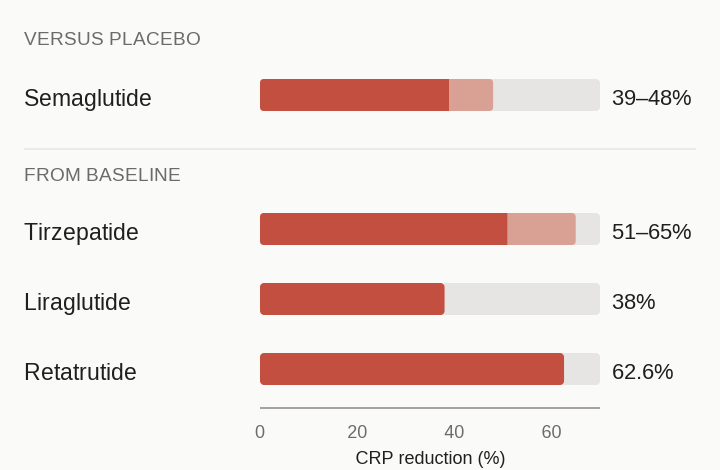 The bars show separate trials with different comparison bases, so their lengths do not rank drug potency. STEP 1–3, SURMOUNT-1, SCALE, TRIUMPH-1.
These aren’t head-to-head comparisons. The studies used different populations, doses, durations, and analyses. The semaglutide row reports an effect relative to placebo; the other rows report changes from baseline in each arm. For example, the 62.6% hs-CRP decrease with retatrutide includes change also seen in its placebo group. Subtracting the two percentages gives 37.7 percentage points, but that arithmetic is not necessarily the trial’s modeled placebo-adjusted treatment effect. The percentages describe the studied doses, not every formulation sold under each brand. Most inflammation results were secondary or exploratory analyses.
What about inflammation markers besides hs-CRP?
In the same SURMOUNT-1 analysis, tirzepatide lowered IL-6, an inflammatory signaling protein, versus placebo. White blood cell counts also fell significantly versus placebo at the 10 mg and 15 mg doses.
There are signals for other drugs, too. A small study of dulaglutide and liraglutide reported lower IL-6 after treatment. That study lacked a placebo group, so it provides weaker evidence of a drug effect than a randomized placebo-controlled trial.
Is it just the weight loss?
Weight loss explains at least part of the improvement. In STEP, CRP reductions tracked with weight loss; in SURMOUNT-1, mediation analyses suggested weight loss accounted for much of the longer-term reduction in hs-CRP and IL-6. Those analyses can’t definitively separate weight loss from direct drug effects.
A lower hs-CRP shows less systemic inflammation, but it doesn’t prove that lowering CRP caused a health benefit or that a medication treats every inflammatory condition. Drug choice should follow evidence for your condition and overall health. If you’re tracking hs-CRP, interpret repeat measurements with your clinician: an infection can temporarily raise it, obscuring the longer-term trend.
How do statins compare?
Statins lower hs-CRP too: in the randomized JUPITER trial, rosuvastatin 20 mg lowered median hs-CRP by 37% and LDL cholesterol by 50%, alongside fewer cardiovascular events. Because both markers fell, the trial cannot isolate which change drove the benefit, and its different population makes the 37% result unsuitable for ranking rosuvastatin against these GLP-1-based treatments.
Get your free 30-day heart health guide
Evidence-based steps to optimize your heart health.