Test your Iron Sat. and 100+ other biomarkers for $190

Iron Saturation (Transferrin Saturation)

Normal range: 20 – 50 % (higher is better)

Iron saturation (also called transferrin saturation) tells you what percentage of your iron-carrying protein is actually loaded with iron. It is calculated as serum iron divided by TIBC. Low saturation means your iron transport is running mostly empty (iron deficiency). High saturation (above 50%) means it is running at full capacity, which may suggest iron overload or hereditary hemochromatosis.

Test your Iron Sat.

How much does an Iron Sat. test cost?

Iron Sat. is calculated rather than ordered on its own, so it comes with an iron panel (about $50). A fuller workup adds Ferritin ($45), Vitamin D ($75), hs-CRP ($69), and ApoB ($50). You can test Iron Sat. and 100 other biomarkers for $190 as part of an Empirical membership.

Empirical is FSA/HSA eligible, so you can pay with pre-tax dollars. Fast for 8-12 hours beforehand for the most accurate lipid and metabolic results, and expect results in days rather than weeks.

Get tested for $190

Iron saturation (transferrin saturation) tells you what percentage of your iron-carrying protein is actually loaded with iron. Low saturation means iron deficiency. High saturation (above 45-50%) raises suspicion for hereditary hemochromatosis, a genetic disorder affecting about 1 in 200 people of Northern European descent.

How does Iron Saturation change with age?

Iron Saturation stays relatively flat across adult ages (correlation with age, r = -0.03). Most of the spread in the chart below comes from differences between people rather than from age.
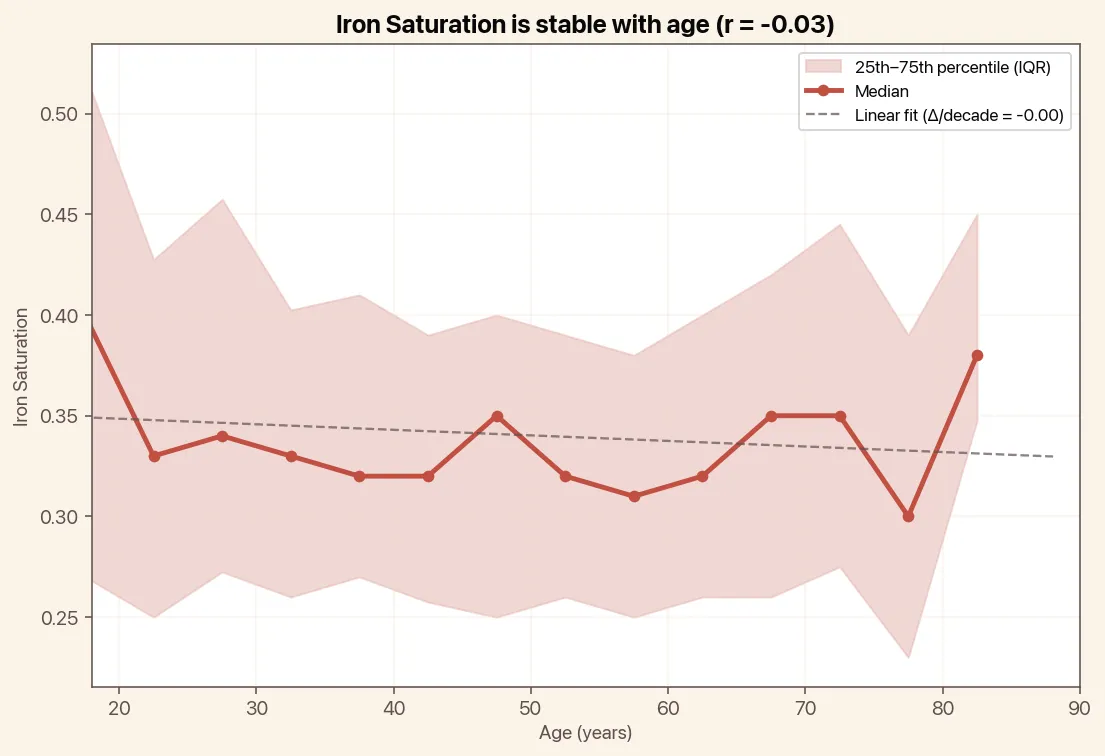

Iron Saturation is stable with age, chart with median and linear trend

What can cause low Iron Sat.?

A normal Iron Sat. is 20 – 50 %. Higher is better.

Low iron saturation is the hallmark of iron deficiency. There is too little iron relative to the available transferrin carriers. Blood loss, poor dietary intake, and impaired absorption are the most common causes.

High iron saturation (above 45-50%) raises suspicion for hereditary hemochromatosis, a genetic disorder affecting about 1 in 200 people of Northern European descent. Excessive supplementation and repeated transfusions can also cause high saturation.

The same lifestyle changes that improve serum iron and TIBC apply here. If saturation is low, increasing dietary iron and treating any underlying blood loss are the priorities. If saturation is persistently high, genetic testing for hemochromatosis may be warranted. Therapeutic phlebotomy (regular blood donation) is the standard treatment for iron overload.

Biomarkers related to Iron Sat.

Iron Sat. is most highly correlated with Hematocrit and Mean Platelet Volume. Here are the top biomarkers correlated with Iron Sat., based on 500,000 tests done by Empirical Health.

The percentage shows how strongly two biomarkers move together. A higher number means the relationship is stronger. Green = rises and falls together. Orange = one rises as the other falls.

Frequently asked questions about Iron Sat.

Where to get an Iron Sat. test near you

Iron Sat. is drawn at 2,200+ Quest and BioReference patient service centers across the US, so there's usually one within a short drive. Browse the full directory to find the one closest to you.

Browse all testing locations

Know your Iron Sat.. Know your health.

Test your Iron Saturation (Transferrin Saturation) and 100+ other biomarkers in a single blood draw.

Image of a man on cellphone
Start testing