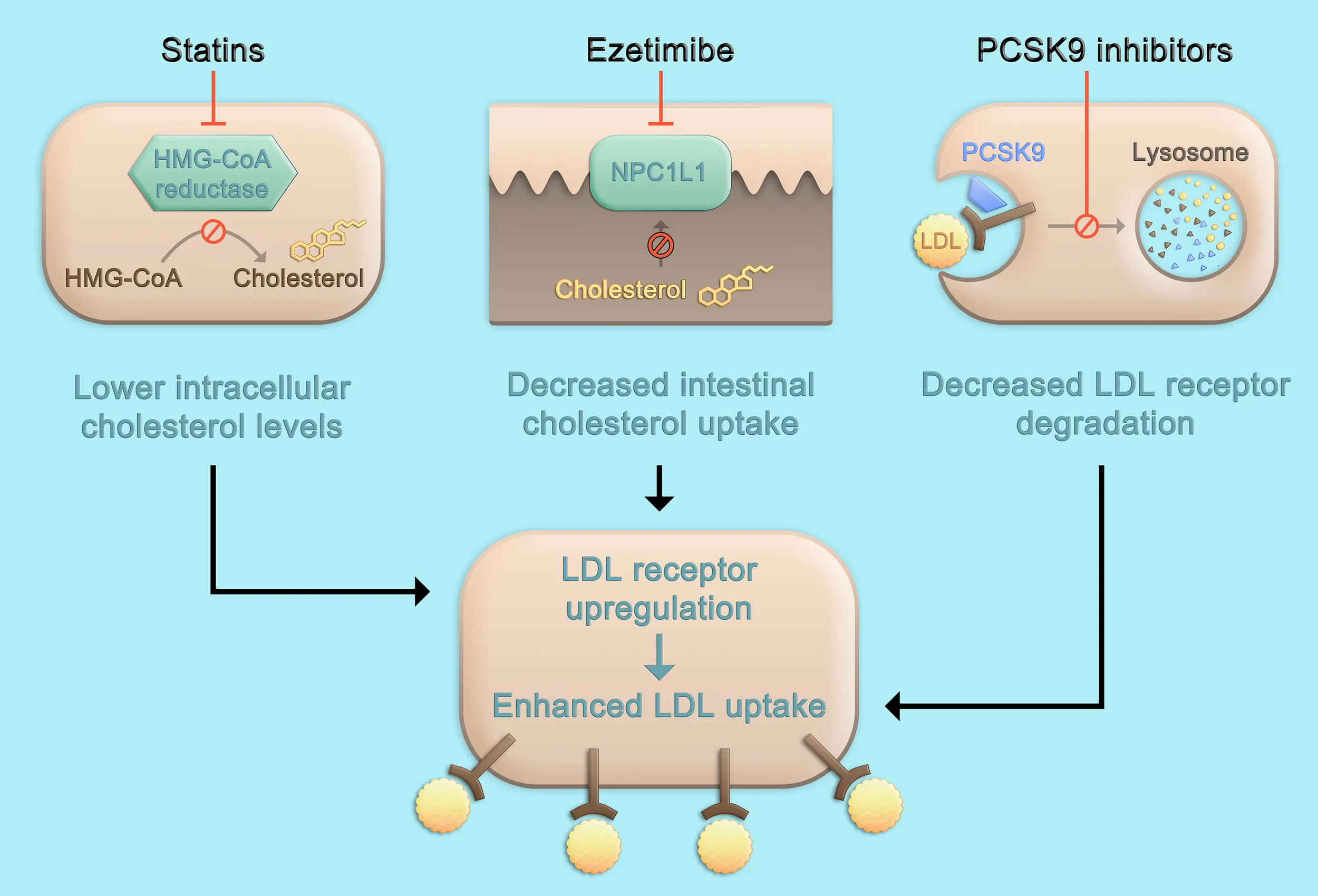
Ezetimibe is easy to overlook. It’s less potent and less familiar than statins or PCSK9 inhibitors. But Ezetimibe is generic once-daily pill which lowers LDL cholesterol another 15-25%, with few side effects or drug interactions.
Zetia is the original brand name; ezetimibe is the generic. Both Zetia and ezetimibe have the same active ingredient. Doctors most often add ezetimibe when a statin hasn’t lowered LDL enough, or when you can’t tolerate a full statin dose.
This guide covers how ezetimibe works, how much it lowers LDL and ApoB, whether it prevents heart attacks, side effects and cost, and how it compares with other cholesterol drugs.
What is Zetia (ezetimibe)?
Ezetimibe is a cholesterol-absorption inhibitor. Ezetimibe blocks a transporter called NPC1L1 in the small intestine, reducing the amount of cholesterol that moves from the gut into the bloodstream. The liver responds by increasing LDL receptors and clearing more LDL particles from circulation.
Statins reduce cholesterol production in the liver; ezetimibe reduces absorption in the intestine. Because statins and ezetimibe work through different pathways, their effects stack.
The standard ezetimibe dose is 10 mg once daily, with or without food. There are combination tablets that pair ezetimibe with statins, including simvastatin (formerly branded Vytorin) and rosuvastatin.
How much does ezetimibe lower LDL and ApoB?
By itself, ezetimibe lowers LDL about 18% on average. Added to a statin, it commonly lowers LDL another 15-25% from the level reached on the statin. This is consistent with the FDA prescribing information.
If a statin has lowered LDL from 160 to 80 mg/dL, adding ezetimibe might reduce it another 20%, to about 64 mg/dL. Here are some scenarios:
| Treatment | Typical LDL reduction from untreated baseline | Example starting at 160 mg/dL |
|---|---|---|
| Ezetimibe alone | ~18% | ~131 mg/dL |
| Moderate-intensity statin | ~30-49% | ~82-112 mg/dL |
| High-intensity statin | ≥50% | ≤80 mg/dL |
| High-intensity statin + ezetimibe | ~60-65% | ~56-64 mg/dL |
| Statin + PCSK9 inhibitor | ~75-80% | ~32-40 mg/dL |
Ezetimibe also lowers ApoB, generally by a similar or slightly smaller percentage than LDL. ApoB counts atherogenic particles rather than the cholesterol inside them. Rechecking both markers after a treatment change shows how each responded. Ezetimibe has little effect on Lp(a).
Does ezetimibe prevent heart attacks and strokes?
The main outcomes trial, IMPROVE-IT, enrolled 18,144 people soon after hospitalization for a heart attack or unstable angina. Everyone received simvastatin; half also received ezetimibe. The primary cardiovascular endpoint occurred in 32.7% of the ezetimibe group and 34.7% of the statin-only group. That’s a 2 percentage-point absolute reduction, or roughly one prevented event for every 50 people treated. Evidence for ezetimibe alone is thinner. EWTOPIA 75 found fewer cardiovascular events among Japanese adults aged 75 or older who had elevated LDL but no history of coronary disease. The trial was open-label, ended early, and studied a narrow population, so it doesn’t establish ezetimibe as a universal substitute for statins.
When should ezetimibe be added to a statin?
Ezetimibe is most often added when LDL remains above the treatment goal despite a tolerated statin dose.
The 2026 ACC/AHA dyslipidemia guideline keeps statins as the foundation of treatment and recommends nonstatin drugs when more LDL lowering is needed. Ezetimibe is particularly practical when:
- A statin lowered LDL substantially, but not enough to reach the person’s goal.
- A person can tolerate a moderate statin dose but not a high-intensity dose.
- A small additional reduction may be enough, avoiding a more expensive injectable.
- An insurer requires a statin and sometimes an ezetimibe trial before approving a PCSK9 inhibitor.
- Someone can’t take a statin, although ezetimibe alone is less potent and has less evidence that it prevents cardiovascular events.
The RACING trial tested combination therapy in people with established cardiovascular disease. Over three years, rosuvastatin 10 mg plus ezetimibe produced cardiovascular outcomes that were noninferior to rosuvastatin 20 mg, got more patients below 70 mg/dL, and caused fewer intolerance-related dose reductions or discontinuations. The study took place in South Korea, so the exact tolerability difference may not transfer to every population. Still, it supports combination therapy as an alternative to raising the statin dose.
Ezetimibe vs statins
For most people who can take one, a statin remains the first medication. Statins lower LDL more, have a much larger evidence base, and prevent heart attacks and strokes in both primary and secondary prevention.
Ezetimibe is usually a complement, not a replacement. It doesn’t inhibit cholesterol synthesis in muscle, has few important drug interactions, and doesn’t appear to cause the small increase in diabetes risk associated with statins.
| Ezetimibe | Statin | |
|---|---|---|
| Main action | Blocks intestinal cholesterol absorption | Reduces liver cholesterol production |
| Typical LDL reduction | ~18% alone | ~30-55%, depending on drug and dose |
| Outcomes evidence | Strongest when added after acute coronary syndrome | Extensive across primary and secondary prevention |
| Common role | Add-on or alternative when statin is limited | First-line medication |
| Dosing | 10 mg once daily | Varies by statin and intensity |
| Generic cost | Usually inexpensive | Usually inexpensive |
Ezetimibe vs bempedoic acid and PCSK9 inhibitors
The right add-on depends on the LDL reduction needed, side effects, cost, and whether someone prefers a pill or injection.
| Medication | Additional LDL reduction | Route | Main tradeoff |
|---|---|---|---|
| Ezetimibe | ~15-25% | Daily pill | Modest effect, inexpensive and well tolerated |
| Bempedoic acid | ~20-25% | Daily pill | Useful with statin intolerance; can raise uric acid and gout risk |
| Bempedoic acid + ezetimibe | ~35-40% | Daily pill | More oral potency, but higher cost and bempedoic-acid risks |
| PCSK9 inhibitor | ~50-60% | Injection or daily oral drug, depending on product | Much larger effect; cost and coverage can be harder |
Ezetimibe is often enough when a 15-20% additional reduction will reach the goal. A PCSK9 inhibitor makes more sense when LDL needs to fall by half or more, particularly in familial hypercholesterolemia or established cardiovascular disease. Our guide to ApoB-lowering medications compares the major drug classes.
What are the side effects of ezetimibe?
Most people tolerate ezetimibe well. Trials reported diarrhea, joint pain, upper-respiratory symptoms, and fatigue, but rates were generally close to placebo. In IMPROVE-IT, adding ezetimibe to simvastatin didn’t meaningfully increase prespecified muscle, gallbladder, liver, or cancer events.
Important cautions from the FDA label include:
- Muscle symptoms: myalgia and rare cases of myopathy or rhabdomyolysis have been reported, particularly when ezetimibe is combined with a statin. New unexplained muscle pain or weakness should be discussed with a clinician.
- Liver enzymes: the combination with a statin can raise liver enzymes. People with active liver disease or persistent unexplained transaminase elevations need individual review.
- Pregnancy and breastfeeding: review lipid-lowering treatment with a clinician rather than continuing or stopping it without guidance.
- Cyclosporine: either drug can increase the other’s exposure, so monitoring is recommended.
- Fibrates: fenofibrate is sometimes used with ezetimibe, but gallstone risk should be considered. Combining ezetimibe with gemfibrozil is not recommended in the label.
Ezetimibe doesn’t usually require a slow introduction. If side effects are suspected, a clinician can assess whether they resolve off the drug, return after restarting it, or have another explanation.
How much does generic Zetia cost?
Generic ezetimibe has been available in the US since 2016 and is usually inexpensive. Cash-discount prices can be under $10 for 30 tablets, although prices vary by pharmacy, location, and insurance. Brand-name Zetia can cost far more for the same active ingredient.
For Medicare, generic ezetimibe is widely covered and commonly sits on a low formulary tier. Our Medicare cardiovascular medication guide covers the broader comparison.
How quickly does ezetimibe work?
Ezetimibe starts reducing cholesterol absorption quickly, and most of its LDL effect appears within about two weeks. Clinicians often repeat a lipid panel 4-12 weeks after starting or changing cholesterol medication to measure the full response and check adherence.
Response varies. Follow-up LDL, non-HDL cholesterol, and ApoB measurements show whether the drug worked as expected and reached the treatment goal.
Is ezetimibe worth taking?
Ezetimibe isn’t the strongest cholesterol drug. It’s a generic pill that works through a different pathway from statins, usually lowers LDL another 15-25%, and has evidence that the additional reduction prevents cardiovascular events.
For someone near an LDL goal, that may be enough. Someone far from goal may need ezetimibe as part of a combination with a statin, bempedoic acid, or a PCSK9 inhibitor. The choice depends on the LDL or ApoB reduction needed, cardiovascular risk, tolerance, cost, and coverage.
Get your free 30-day heart health guide
Evidence-based steps to optimize your heart health.