Combining cholesterol medications can lower LDL by 80% or more. Going from 160 to 100 mg/dL requires about a 38% reduction; reaching 70 requires 56%.
Use the cheat sheet to compare doses and combinations. For effects on ApoB, see our ApoB medication guide.
How much do you need to lower LDL cholesterol?
The 2026 AHA/ACC guidelines set LDL targets below 100, 70, or 55 mg/dL, depending on cardiovascular risk and medical history. For the target you and your clinician choose:
Required reduction = (current LDL − target LDL) ÷ current LDL × 100.
| Starting LDL (mg/dL) | Target LDL (mg/dL) | Example medications | Reduction |
|---|---|---|---|
| 125 | 100 | Add ezetimibe 10 mg to existing therapy | 20% |
| 160 | 100 | Atorvastatin 20 mg or simvastatin 40 mg | About 38% |
| 140 | 70 | Rosuvastatin 20 mg or atorvastatin 80 mg | 50% |
| 180 | 70 | Rosuvastatin 20 mg + ezetimibe 10 mg | About 61% |
| 275 | 55 | Rosuvastatin 20 mg + ezetimibe 10 mg + evolocumab | 80% |
The percentages show the change from starting to target LDL; the medications can provide roughly that reduction or more. Only the first row starts from treated LDL. Responses vary; combination estimates use the calculation below.
Which medications lower LDL cholesterol the most?
The cheat sheet compares medication doses, dietary changes, and two calculated combinations:
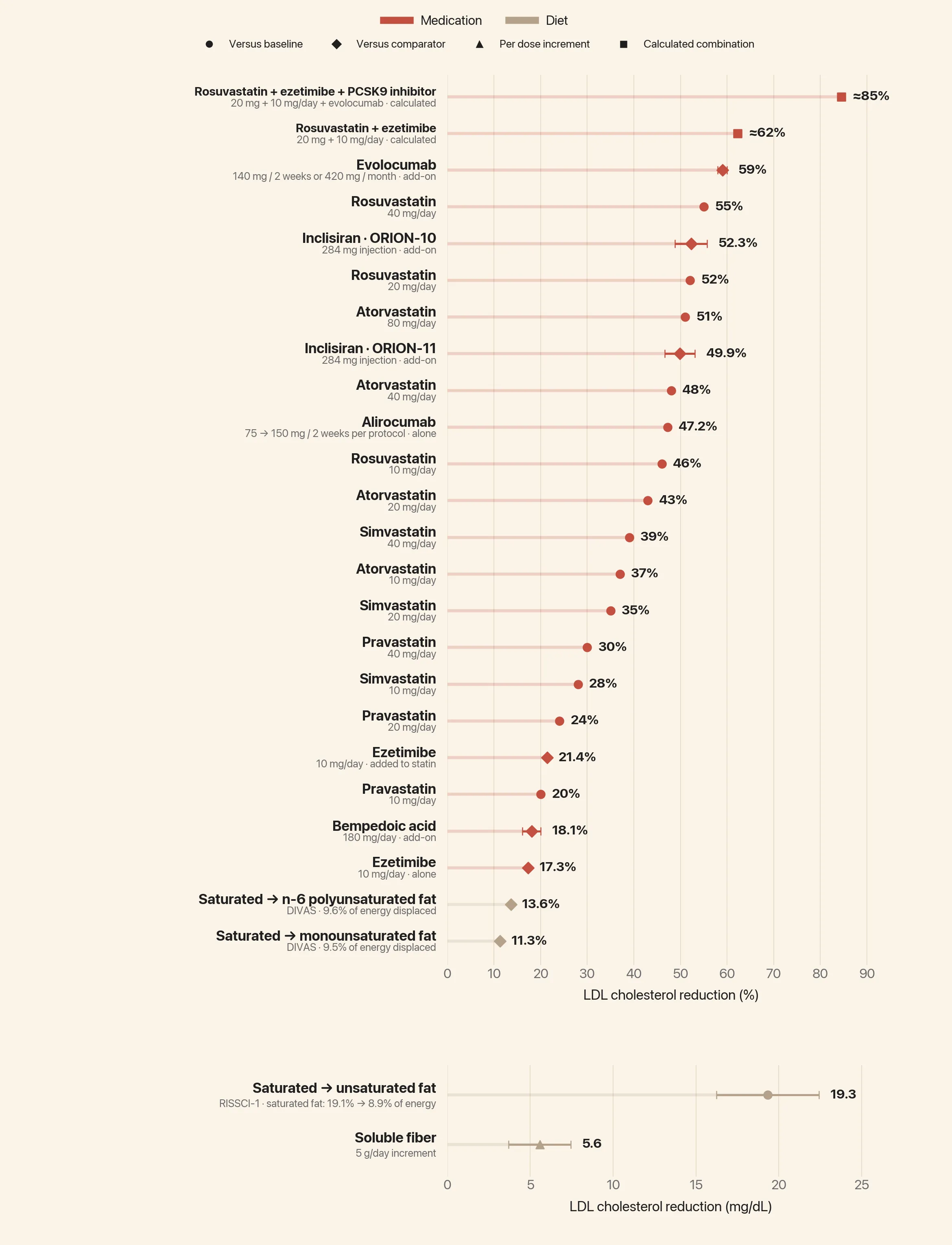 Circles: changes from baseline. Diamonds: differences versus the study comparator. Squares: calculated combinations. Whiskers: 95% confidence intervals, not individual response ranges. Populations, background therapy, and follow-up differ. Data and sources.
How much does each statin lower LDL?
Statins help the liver make less cholesterol and clear more LDL from blood. All seven have generic versions; prices depend on the pharmacy, dose, and insurance.
- Rosuvastatin (Crestor) lowers LDL about 46% at 10 mg/day, 52% at 20 mg, and 55% at 40 mg. Muscle-injury risk rises at 40 mg; severe kidney impairment limits dosing to 10 mg/day in patients not on hemodialysis. Prescribing information.
- Atorvastatin (Lipitor) lowers LDL about 37% at 10 mg/day, 43% at 20 mg, 48% at 40 mg, and 51% at 80 mg, similar to rosuvastatin 20 mg’s 52%. It needs no kidney-based dose adjustment, though certain antibiotics and antivirals can raise drug levels and muscle-injury risk. Prescribing information.
- Simvastatin (Zocor) lowers LDL about 28% at 10 mg/day, 35% at 20 mg, and 39% at 40 mg. Walmart lists those strengths at $9 for 30 tablets, with state and program restrictions. Avoid starting or increasing to 80 mg because of muscle-injury risk; interactions can also limit dosing. Prescribing information.
- Pravastatin (Pravachol) lowers LDL about 20% at 10 mg/day, 24% at 20 mg, and 30% at 40 mg. It has fewer drug interactions, though muscle symptoms remain possible. See the ACC’s statin comparison tool.
- Lovastatin lowered LDL about 24% at 20 mg once daily, 30% at 40 mg once daily, and 40% at 40 mg twice daily in EXCEL. Grapefruit and certain antibiotics or antifungals can increase lovastatin levels and muscle-injury risk. Trial results and prescribing information.
- Pitavastatin (Livalo, Zypitamag) lowers LDL about 31% at 1 mg/day, 39% at 2 mg, and 44% at 4 mg. Muscle symptoms remain possible; moderate or severe kidney impairment limits dosing to 2 mg/day. Prescribing information.
- Fluvastatin (Lescol) lowers LDL about 22% at 20 mg/day, 25% at 40 mg/day, and 36% at 40 mg twice daily. Fluconazole raises its levels and requires a dose limit for the capsules. Trial results and prescribing information.
The first four report six-week averages from STELLAR. The others use separate studies: EXCEL weeks 12–48, pitavastatin at 12 weeks in older adults, and fluvastatin medians at 24 weeks. Individual responses vary. Our statin guide covers other differences.
How much do non-statin medications lower LDL?
- Ezetimibe (Zetia) blocks intestinal cholesterol absorption. At 10 mg/day, it lowered LDL an additional 21% on a statin, or 17% versus placebo when used alone. Adding it to a statin also reduced cardiovascular events after acute coronary syndrome in IMPROVE-IT.
- Increase the statin dose or add ezetimibe? Doubling atorvastatin from 10 to 20 mg increased LDL lowering from 37% to 43% in STELLAR. In RACING, rosuvastatin 10 mg + ezetimibe 10 mg performed similarly to rosuvastatin 20 mg for cardiovascular events, with more patients reaching LDL below 70 and fewer reducing or stopping treatment because of side effects.
- Bempedoic acid (Nexletol) lowered LDL an additional 18% versus placebo on existing therapy at 180 mg/day, and reduced cardiovascular events in statin-intolerant patients. Combined with ezetimibe as Nexlizet, it lowered LDL 38% versus placebo. Gout and tendon injury are important risks. Prescribing information.
- PCSK9 inhibitors can lower LDL roughly another 50–60% on existing therapy. See the comparison below for medications, dosing, and cash prices.
PCSK9 antibodies can cost $225–$239/month cash and lower LDL about 60%
Evolocumab (Repatha) and alirocumab (Praluent) block PCSK9, preserving liver LDL receptors that clear cholesterol from blood. US cash programs advertise Praluent at $225 for two pens and Repatha at $239/month. September 2026 cash prices; eligibility requirements apply and insurance costs differ.
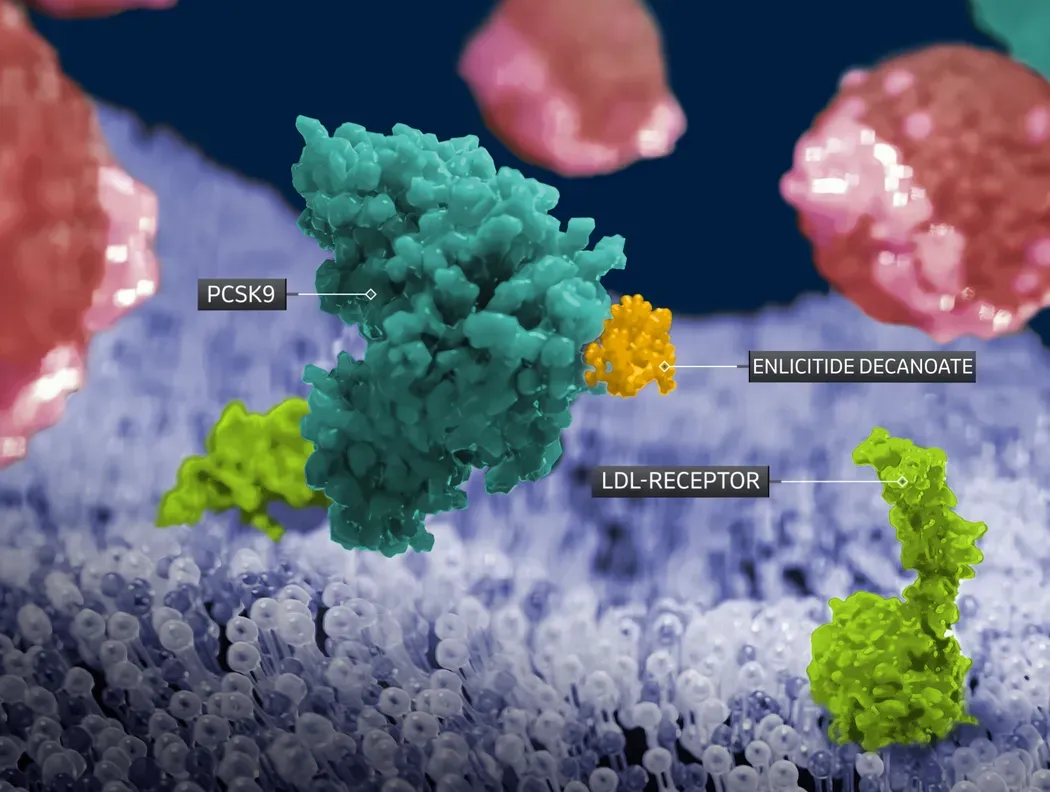 The oral PCSK9 inhibitor enlicitide (yellow) binds PCSK9 (teal), helping preserve LDL receptors (green) that clear cholesterol from blood. Read more about how this peptide works. Image: Merck & Co., Inc., via The Scientist.
| Medication | LDL reduction | Treatment context |
|---|---|---|
| Repatha | 59% versus placebo at 48 weeks | On statins; 140 mg every two weeks or 420 mg monthly. FOURIER |
| Praluent | 47.2% from baseline | Alone; 75 mg every two weeks, increased to 150 mg per protocol. ODYSSEY MONO |
| Praluent | 62-percentage-point advantage over placebo at 24 weeks | On statins; 150 mg every two weeks. ODYSSEY LONG TERM |
| Inclisiran (Leqvio) | 49.9–52.3% versus placebo at day 510 | On existing therapy; reduces PCSK9 production. Given initially, at three months, then every six months. ORION; label |
| Lerodalcibep (Lerochol) | About 50–59% versus placebo | On existing therapy; 300 mg monthly injection. FDA |
| Enlicitide (Lipfendra) | 56% versus placebo in CORALreef Lipids; 59% in heterozygous familial hypercholesterolemia, at 24 weeks | On existing therapy; 20 mg daily pill. Label |
Trial populations and regimens differ; similar LDL reductions don’t establish equal cardiovascular benefits. Lerochol and Lipfendra aren’t in the chart yet. Our Lipfendra guide explains its fasting requirements.
Other LDL-lowering medications
Bile-acid sequestrants (colesevelam, cholestyramine, and colestipol) lower LDL roughly 10–27%. Colesevelam lowered it 15% at about 3.8 g/day. Constipation, medication interactions, and increased triglycerides can limit their use.
Two specialist drugs treat homozygous familial hypercholesterolemia (HoFH), a rare inherited condition:
| Medication | LDL result in HoFH | Main considerations |
|---|---|---|
| Evinacumab (Evkeeza) | 49% versus placebo at 24 weeks on background therapy | Monthly infusion; works despite severely impaired LDL-receptor function. FDA label |
| Lomitapide (Juxtapid) | 40% mean reduction from baseline at 26 weeks, adult intent-to-treat analysis | Requires liver monitoring, dietary restrictions, and interaction review. Label |
Niacin lowers LDL, but adding it to intensive statin therapy didn’t reduce cardiovascular events in AIM-HIGH. Fibrates mainly treat high triglycerides: fenofibrate lowered LDL 20.6% in elevated-LDL trials, while gemfibrozil can raise LDL when triglycerides are very high.
How much can rosuvastatin + ezetimibe + a PCSK9 inhibitor lower LDL?
Each added medication lowers the LDL remaining. For rosuvastatin 20 mg, ezetimibe 10 mg, and evolocumab, use decimals (52% = 0.52):
Combined reduction = 1 − (1 − statin effect) × (1 − ezetimibe effect) × (1 − PCSK9 effect).
Starting at 160 mg/dL, this estimates LDL of 77 with rosuvastatin, 60 after adding ezetimibe, and 25 after adding evolocumab: reductions of 52%, 62%, and 85%.
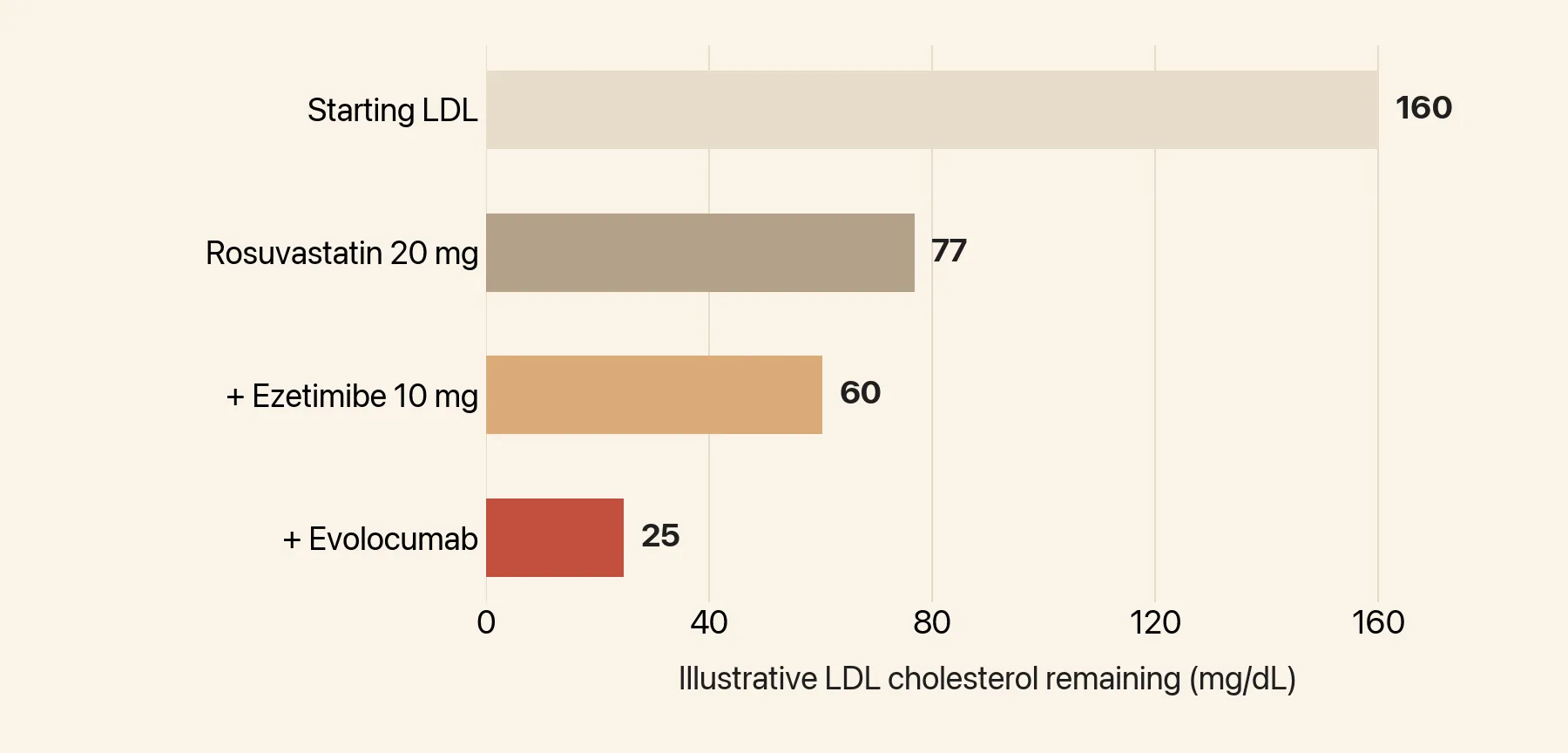 Calculated using 52%, 21.4%, and 59% effects from separate trials, assuming each transfers to the combined regimen. These are illustrative estimates, not observed combination-trial results, individual forecasts, or recommended targets.
Statins vs PCSK9 inhibitors
High-intensity statins lower LDL roughly in half. In FOURIER, evolocumab lowered LDL another 59% versus placebo on statins. The choice depends on dosing, coverage, side effects, and cardiovascular benefits. See our comparison and insurance guide.
What if you can’t tolerate a statin?
Your clinician can review symptoms and interactions, then try a different statin or lower dose. Alternatives include ezetimibe, bempedoic acid, PCSK9 treatments, and bile-acid sequestrants.
When should you recheck LDL after changing medication?
The 2026 guideline recommends a lipid profile 4–12 weeks after starting or intensifying treatment. Use the result to calculate how much further LDL needs to fall.
Empirical Health’s comprehensive health panel measures LDL, ApoB, and other markers to assess your response. For diet changes, see our cholesterol-lowering food guide.
Get your free 30-day heart health guide
Evidence-based steps to optimize your heart health.