Test your LDL/Chol and 100+ other biomarkers for $190

LDL/Cholesterol Ratio

Normal range: 0 – 0.65 (lower is better)

The LDL/Cholesterol ratio shows what proportion of your total cholesterol is made up of LDL. Higher values suggest a less favorable cholesterol profile, meaning more of your cholesterol is the harmful type. This ratio helps put your LDL level in context relative to your overall cholesterol.

Test your LDL/Chol

How much does an LDL/Chol test cost?

LDL/Chol is calculated rather than ordered on its own, so it comes with a standard lipid panel (about $45). A fuller workup adds Vitamin D ($75), hs-CRP ($69), ApoB ($50), and ApoA1 ($50). You can test LDL/Chol and 100 other biomarkers for $190 as part of an Empirical membership.

Empirical is FSA/HSA eligible, so you can pay with pre-tax dollars. Fast for 8-12 hours beforehand for the most accurate lipid and metabolic results, and expect results in days rather than weeks.

Get tested for $190

The LDL/Cholesterol ratio shows what proportion of your total cholesterol is made up of LDL. Higher values suggest a less favorable cholesterol profile, meaning more of your cholesterol is the harmful type. This ratio helps put your LDL level in context relative to your overall cholesterol.

How does LDL/Cholesterol Ratio change with age?

LDL/Cholesterol Ratio tends to fall with age (correlation with age, r = -0.10). The chart below shows the median by 5-year age bin and a linear trend line.
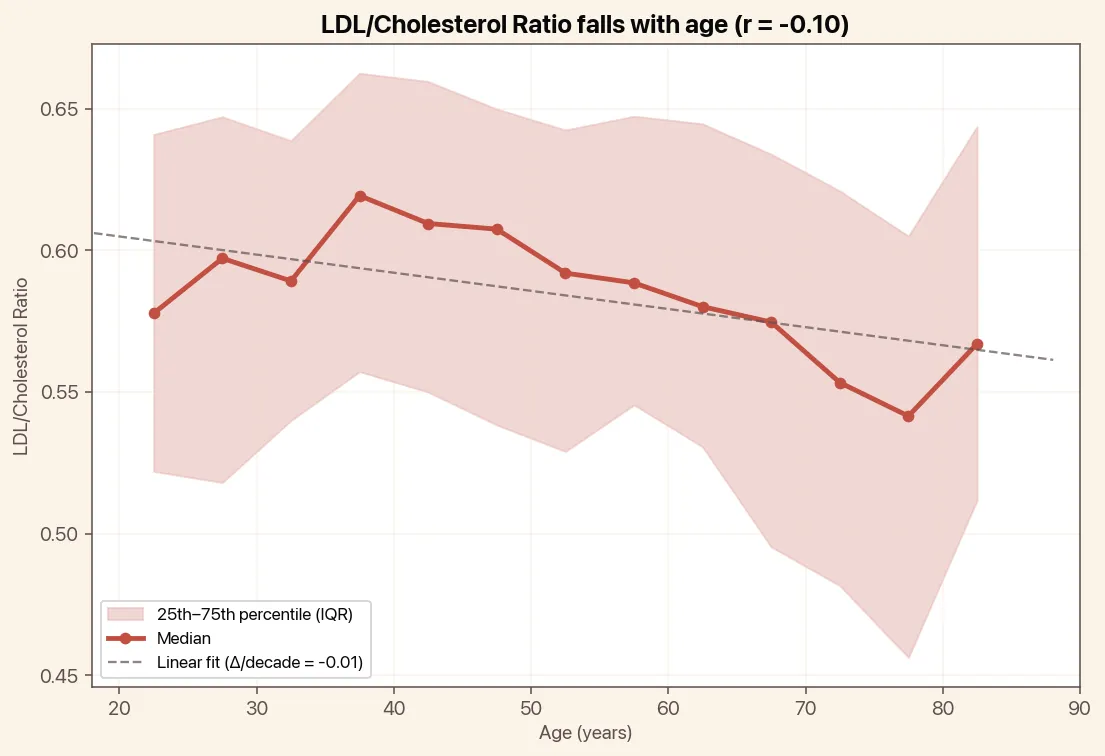

LDL/Cholesterol Ratio falls with age, chart with median and linear trend

What can cause high LDL/Chol?

A normal LDL/Chol is 0 – 0.65. Lower is better.

A high LDL/cholesterol ratio means LDL dominates your cholesterol pool. This happens when LDL is elevated (poor diet, genetics) and HDL is low (inactivity, smoking). Raising HDL through exercise shifts the ratio favorably even without changing LDL.

The same lifestyle changes and medications that lower LDL or raise HDL improve this ratio. Regular exercise is particularly effective because it works on both sides.

Biomarkers related to LDL/Chol

LDL/Chol is most highly correlated with LDL Cholesterol and Non-HDL Cholesterol. Here are the top biomarkers correlated with LDL/Chol, based on 500,000 tests done by Empirical Health.

The percentage shows how strongly two biomarkers move together. A higher number means the relationship is stronger. Green = rises and falls together. Orange = one rises as the other falls.

Frequently asked questions about LDL/Chol

Where to get an LDL/Chol test near you

LDL/Chol is drawn at 2,200+ Quest and BioReference patient service centers across the US, so there's usually one within a short drive. Browse the full directory to find the one closest to you.

Browse all testing locations

Know your LDL/Chol. Know your health.

Test your LDL/Cholesterol Ratio and 100+ other biomarkers in a single blood draw.

Image of a man on cellphone
Start testing